It is a Tuesday morning after a weekend ice storm. Your front desk phone is ringing while a customer stands at the counter asking about a rental car, a tow truck is backing into the lot, and your estimator is under a hood in bay three with a clipboard. The phone rings four times and rolls to voicemail. On the other end is a driver whose bumper is hanging off, who just got off the phone with their insurance adjuster, and who has three shop numbers written on a sticky note. They do not leave a message. They dial the next number.
That caller was ready to bring you a car. They had a claim number, a deductible, and a car that was not going to drive itself anywhere. By the time you clear the counter and check voicemail an hour later, that estimate is sitting in someone else's bay.
Collision work runs on the phone in a way that a lot of shop owners underrate. A missed inbound call after a wreck is not a missed sale you can win back later. It is an estimate that goes to the next shop on the list, and it usually stays there.
This guide covers why post-accident callers behave the way they do, how your front desk gets pulled away exactly when the phone matters most, and what a dependable inbound-call process looks like when crash season hits.
Why post-accident callers do not wait
A driver calling a body shop is not in a browsing mood. They have a wrecked car, an open insurance claim, and a deadline in their head, whether real or imagined. Many of them have already been told by an adjuster to "get an estimate," and they are working down a list.
That urgency cuts against you when the phone goes unanswered. A homeowner shopping for a kitchen remodel might call back tomorrow. A collision caller with a car on a flatbed will not. They move to the next shop because moving is the whole point of the call. Voicemail reads as "closed" or "too busy to help," and neither of those is a message a stressed driver wants to hear.
Insurance-claim callers add another wrinkle. They often need specific answers before they commit: do you work with their carrier, can you handle the claim paperwork, will they owe anything beyond the deductible. A voicemail box cannot answer any of that. A live, informed response can be the difference between a car booked and a car gone.
How the front desk gets pulled to the bay
Most collision shops do not have a dedicated receptionist who does nothing but answer calls. The person on the phone is also writing estimates, walking customers to rentals, matching paint, and chasing parts. During peak crash-season weeks, all of that happens at once.
So the phone competes with everything else, and it usually loses. A tech needs a decision on a repair. A customer at the counter needs their keys. The tow driver needs someone to sign. Meanwhile the phone rings, and the one person who could pick it up is thirty feet away with grease on their hands.
This is not a discipline problem. It is a coverage problem. You cannot ask someone to be present at the counter, present in the bay, and present on the phone in the same minute. When call volume spikes after a storm or a bad commute morning, the gap between "phone ringing" and "someone free to answer" grows, and that gap is where estimates leak out.
What a reliable inbound-call process looks like
A dependable process is not about answering every call yourself. It is about making sure every call gets a real response, fast, no matter what is happening in the shop. A few pieces matter.
Set a standard for pickup. Decide how many rings a call gets before it goes somewhere other than voicemail. If the front desk cannot get to it, the call needs a fallback that still talks to the caller.
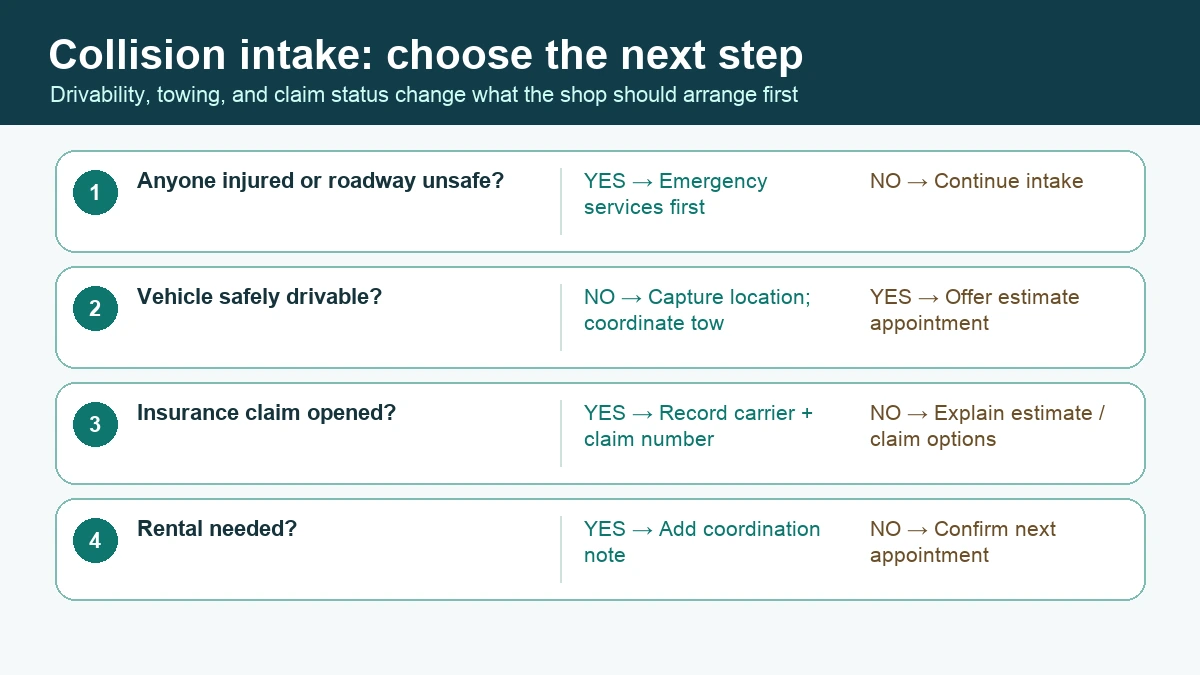
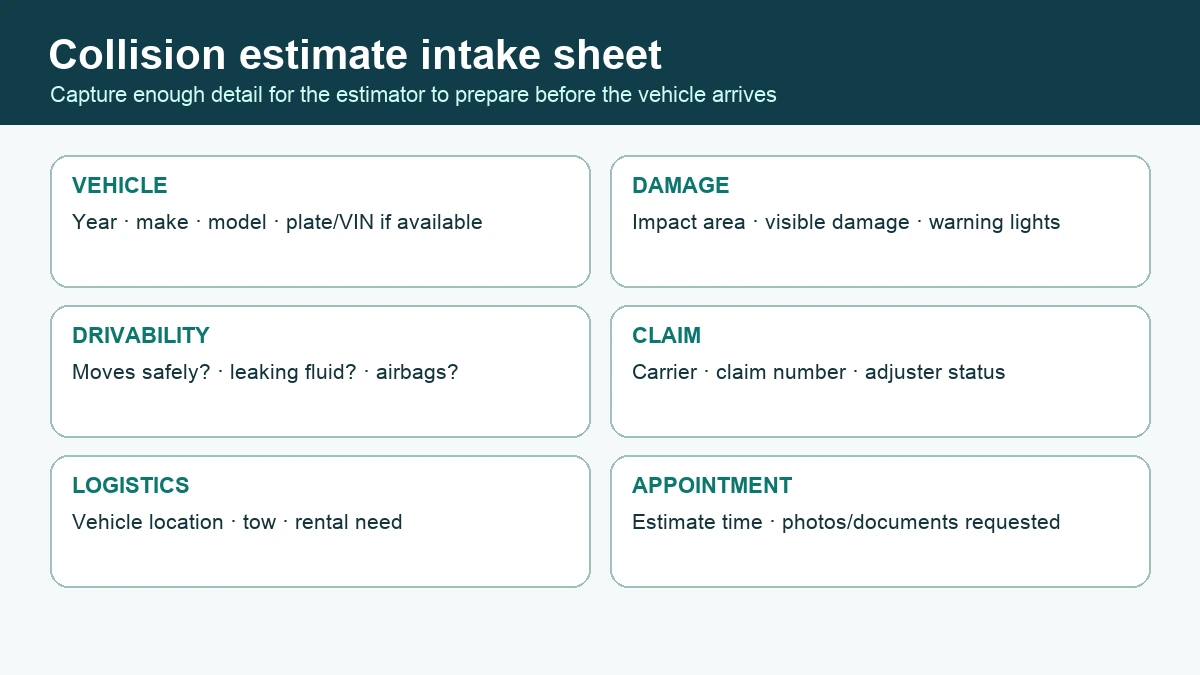
Capture the essentials on every call. For a collision caller, that means the car, the damage, whether it is drivable, the insurance carrier and claim number if they have one, and a callback number. A call that captures those details is a call your estimator can act on later even if nobody could talk long in the moment.
Have a plan for after hours and overflow. Accidents do not keep business hours. A wreck at 6 p.m. on a Friday is a Monday estimate if the caller finds someone who picks up.
There are several ways to close these gaps, and the right mix depends on your volume and budget:
- An extra front-desk hire gives you a dedicated person for the phone, though it adds payroll and only covers the hours they work.
- A live answering service puts a human on overflow and after-hours calls, taking messages or booking estimates on your behalf.
- A dedicated overflow line routes unanswered calls to a second phone, whether that is a manager's cell or a shared queue.
- An AI voice receptionist like Answara answers every call on the first ring, asks the collision-specific questions, captures claim details, and books the estimate into your calendar, including nights and weekends.
None of these is the single right answer. A high-volume shop in a storm-prone region might run an answering service and an overflow line together. A smaller shop might just need coverage for the hours the front desk is slammed. The point is to pick a method and make it consistent, so that a caller with a wrecked car always reaches something that responds.
An AI receptionist is worth a look specifically because collision calls follow a predictable script. The questions rarely change: what happened, is it drivable, who is the insurer, when can you come in. A tool that handles that script the same way every time closes the coverage gap without pulling anyone off the floor. It is one option among several, and it fits some shops better than others.
FAQ
How many rings should a body shop phone get before a fallback picks up? There is no universal number, but many shops aim for three to four rings before a call routes to overflow, an answering service, or an automated receptionist. The goal is to reach the caller before they give up and dial the next shop.
What information should we capture on a collision call? The car and the nature of the damage, whether it is drivable, the insurance carrier and claim number if they have one, and a reliable callback number. Those details let your estimator follow up even if the initial call was short.
Can an answering service handle insurance-claim questions? A general answering service can take messages and basic details, but it may not answer carrier-specific questions. If claim handling is a common part of your calls, look for a service or tool trained on your intake questions.
Do we still need a receptionist if we use an AI phone system? Many shops use both. The front desk handles walk-ins and in-person work while the automated system covers overflow, after-hours, and peak-volume calls the front desk cannot reach in time.