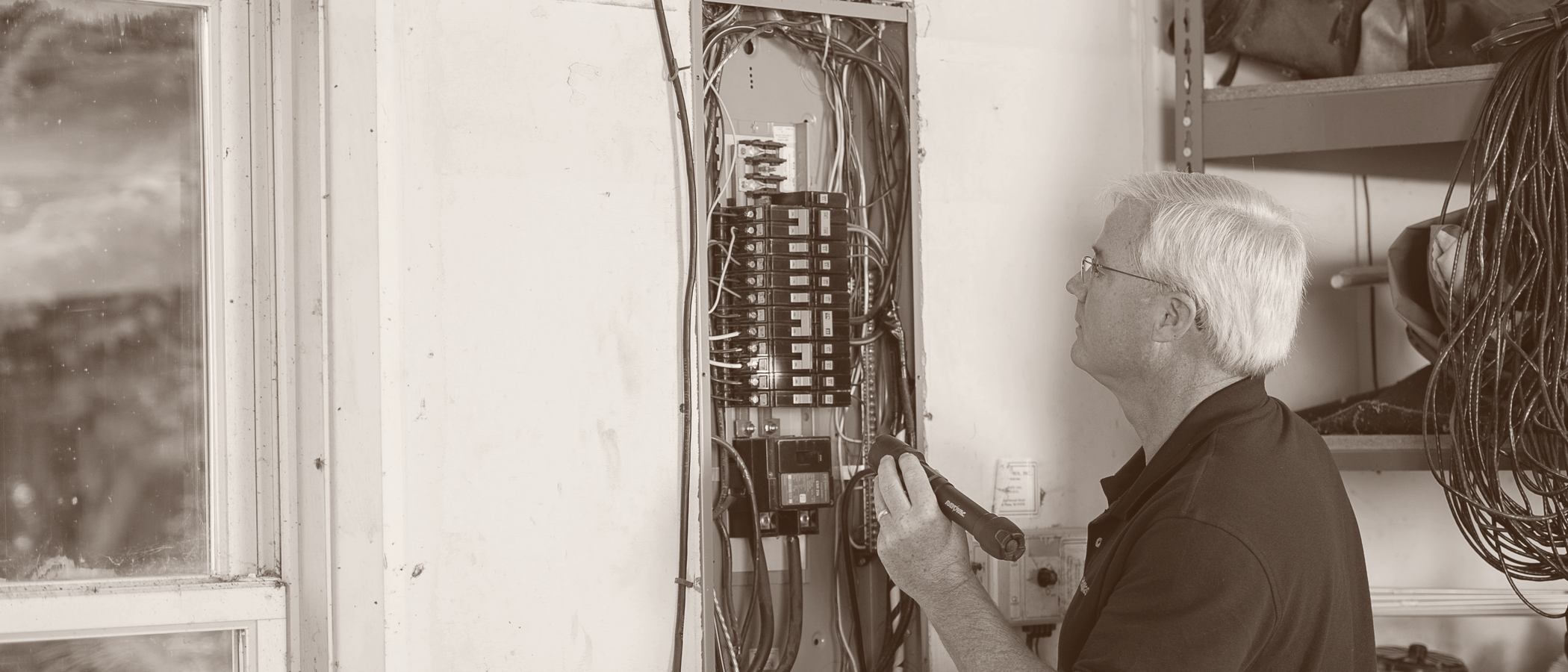
Rewiring a house touches every room and hides behind every wall. You cannot see most of the work once it is finished, which makes the person doing it, and the questions you ask before they start, matter more than usual.
If you are reading this, you are probably somewhere between "the lights flicker and I'm annoyed" and "I've decided to do this." This guide covers how to tell which end of that range you are on, what the project looks like from the inside, and what to ask when you get an electrician on the phone.
Signs your house may be due for a rewire
Old wiring does not always announce itself. Some warning signs are obvious. Others are the kind of thing you have quietly lived with for years without registering them as a problem.
Watch for these:
- Breakers that trip when you run a couple of appliances at once, or a fuse box instead of a breaker panel
- Outlets that feel warm, are discolored, or spark when you plug something in
- Lights that dim or flicker when the fridge or HVAC kicks on
- Two-prong outlets throughout the house, or a shortage of grounded outlets
- A burning or fishy smell near outlets or the panel
- Visible wiring in the attic or basement that is cloth-sheathed, or older systems like knob-and-tube or aluminum branch wiring
Age alone is a reasonable prompt to get an inspection. Homes wired several decades ago were built for a fraction of the load a modern household puts on them. Nobody in 1955 was running a heat pump, an EV charger, a home office, and a kitchen full of high-draw appliances at once.
None of these signs on its own means you need a full rewire. Some point to a single repair or a panel upgrade instead. That distinction is exactly what a licensed electrician is there to make, so have them look before you assume the worst or the best.
What "whole-home rewiring" actually involves
A full rewire replaces the wiring that runs through your walls, ceilings, and floors, and usually updates the panel, outlets, switches, and grounding to current standards. It is more invasive than most people expect.
To reach the wiring, electricians often need to open sections of drywall or plaster, especially in finished spaces without easy attic or crawlspace access. Good crews minimize the holes and fish wire through existing cavities where they can, but some cutting is normal. Patching and repainting are frequently a separate job, so ask early whether that is included or on you.
Scope varies a lot by house. A single-story home with an open basement below and an accessible attic above is far easier to run new wire through than a three-story house with plaster walls and no clear path between floors. Your electrician also works to your local code, and requirements differ by jurisdiction. Permits and at least one inspection are typically part of the process, and you want them to be. An inspected job is your proof the work was done to standard.
How long it takes and what living through it is like
For a typical single-family home, a whole-home rewire often runs several days to a couple of weeks of active work, depending on size, access, and how much wall opening is involved. Larger or more complicated houses take longer. Treat any number here as a rough frame and get a real estimate for your place.
The bigger question for most families is what daily life looks like while it happens. Expect power to be shut off in sections, sometimes for a full working day, as the crew moves room to room. Some households stay put and work around it. Others, during a fuller rewire in a smaller home, find it easier to stay elsewhere for a few nights. There is dust from any cutting, and crews move through most of the house, so plan for furniture to be shifted and rooms to be out of use.
A few things worth sorting before day one:
- How the crew wants rooms cleared, and whether they move furniture or you do
- How to handle the fridge, freezer, or any medical equipment during power-off windows
- Where pets will be while doors are open and crews are in and out
Ask your electrician to walk you through the day-by-day sequence. A crew that has done this many times can tell you which rooms get hit when, and that lets you plan your week instead of reacting to it.
The estimate call is where the project really starts
Before any wall gets opened, there is a phone call. It is easy to treat it as a formality, a quick step to get a number. It is more than that. The estimate call is your first real read on whether this is a business you want inside your home for two weeks.
You learn a lot from how the call goes. Does someone answer, or does it ring out? Do they ask sharp follow-up questions or just quote a figure? Do they explain what an on-site assessment covers before committing to a price? A contractor who is careful and responsive on the phone tends to be careful and responsive on the job. One who is hard to reach before you have paid them anything rarely gets easier to reach later.
Here are questions worth asking on that first call, or at the in-person assessment.
Licensing, insurance, and permits
- Are you licensed for this work in my area, and can you share your license number?
- Do you carry liability insurance and workers' compensation, and can I get proof?
- Will you pull the permits, and is the inspection included in the price?
Scope and the actual work
- Based on what I have described, does this sound like a full rewire or something narrower?
- Does the estimate include a panel upgrade and grounding, or are those separate?
- How much wall opening do you expect, and who handles patching and paint?
- Will you bring the house up to current code throughout, or only where you touch?
Timeline, crew, and cost
- How many days of active work, and how many people will be on site?
- How will power be staged during the job?
- Is this a fixed price or an estimate, and what typically changes the final number?
- What is the payment schedule, and how do you handle anything unexpected behind the walls?
After the job
- What warranty covers the work and the parts?
- Will I get the signed-off inspection and documentation for my records?
Get more than one estimate. Two or three gives you a sense of the fair range and surfaces anyone whose scope is very different from the rest. If one quote is far below the others, that usually means it covers less, not that you found a bargain.
FAQ
How do I know if I need a full rewire or just a repair?
You often cannot tell for certain without an inspection. Flickering lights or a warm outlet might be a single fault, and a panel that trips constantly might need an upgrade rather than new wiring throughout. A licensed electrician can assess the system and tell you where the line is. Knob-and-tube or aluminum branch wiring is a stronger reason to get a full evaluation.
Do I have to move out during a rewire?
Not always. Many people stay home and work around scheduled power shut-offs. Whether it is comfortable depends on the size of the job, how much of the house is opened at once, and how you handle days without power in certain rooms. Ask your electrician how they plan to stage the work so you can decide.
Will the walls be torn apart?
There will be some cutting, but a skilled crew keeps it targeted. They fish wire through existing cavities where possible and open drywall or plaster only where they have to. Confirm before work starts whether patching and repainting are included or handled separately.
Do I need permits to rewire my house?
In most places, yes, and you want them. A permitted job includes inspection, which is your independent confirmation the work meets local code. Requirements vary by jurisdiction, so ask your electrician what applies where you live and confirm with your local authority.
How many quotes should I get?
Two or three is a sensible range. It shows you the fair cost band and helps you spot an estimate that is quoting a different scope. Compare what each one actually includes, not only the bottom-line number.
Before you make the call
Rewiring is a project you commit to before you can see most of the result, so the trust you build on the front end carries the whole job. Write down your warning signs, note which rooms concern you most, and have your questions ready before you dial. You can find more homeowner guides on our electrical resources page.
One practical note on the calling itself. Good electricians are busy, and busy trades miss calls. Some shops now use tools like Answara, an AI voice receptionist, so a homeowner reaching out about a rewire gets answered and booked instead of landing in a voicemail box that fills up during a job. If your first call goes unanswered, try the next name on your list rather than waiting, and notice which businesses make it easy to reach a person.
The house you rewire well is one you stop thinking about. Get the questions right at the start, and two weeks of dust turn into decades of not worrying about what is behind the walls.