When your central air conditioner blows warm or room-temperature air, the cause is usually one of a short list of problems. Some you can fix in a few minutes. Others need a licensed HVAC technician and the right tools. This guide walks through the likely reasons in order, with a quick do-it-yourself check for each and a note on when to call for service.
Work through the checks from simplest to most technical. Anything involving refrigerant, wiring, or a unit that keeps tripping its breaker is your signal to bring in a professional.
Start With the Thermostat
The most common reason for warm air has nothing wrong with the equipment at all. If the thermostat fan is set to "On" instead of "Auto," the indoor blower runs continuously, even when the system is not actively cooling. Between cooling cycles it pushes unconditioned, room-temperature air through your vents, which feels warm.
Set the fan to "Auto" and the mode to "Cool." On "Auto," the blower runs only when the system is cooling, so the air should feel cold. Confirm the temperature is set several degrees below the current room temperature, and if the screen is blank, replace the batteries.
Check the Air Filter
A clogged air filter is one of the most common airflow problems in a home. When the filter is packed with dust, the system cannot pull enough air across the indoor coil. Cooling drops off, and in some cases the coil ices over, which we cover below.
Pull the filter and hold it up to a light. If you cannot see light through it, replace it with the same size, which is printed on the frame. This is a routine homeowner task. Changing the filter every one to three months prevents a lot of warm-air calls.
Look at the Breakers
A central AC system usually runs on two separate circuits: one for the indoor air handler and one for the outdoor condenser. If only the outdoor circuit trips, the indoor blower keeps running and blows warm air, because the part of the system that actually cools the air has lost power.
Find your electrical panel and look for a breaker sitting between "on" and "off." Flip it fully to "off," then back to "on," one time. If it holds, you are done. If it trips again right away, stop. A breaker that keeps tripping points to an electrical fault, and that is a job for a licensed technician, not a repeated reset.
Check for a Frozen Evaporator Coil
The evaporator coil is the indoor coil that absorbs heat from your air. If it freezes into a block of ice, air cannot pass through it, and what does reach your vents feels warm or barely moving. You may see frost or ice on the coil or on the copper refrigerant line near the indoor unit.
To thaw it, turn the system off at the thermostat but leave the fan set to "On" to move air across the coil. Full thawing can take several hours. A frozen coil is a symptom, not the root cause. It usually comes from restricted airflow, such as a dirty filter, or from low refrigerant. Replace the filter and let the coil thaw fully. If it freezes again after that, the underlying cause needs a technician.
Consider Low Refrigerant
Refrigerant is the fluid that carries heat out of your home. It is not consumed over time, so a low level almost always means there is a leak. Signs include weak cooling, a frozen coil that keeps coming back, or a hissing or bubbling sound near the lines.
This is not a do-it-yourself repair. Refrigerant is federally regulated, handling it requires EPA certification, and diagnosing a leak takes specialized gauges and tools. Adding refrigerant without fixing the leak only postpones the problem. If you suspect a low charge, call a licensed HVAC technician to find and repair the leak and recharge the system correctly.
Clean the Outdoor Condenser
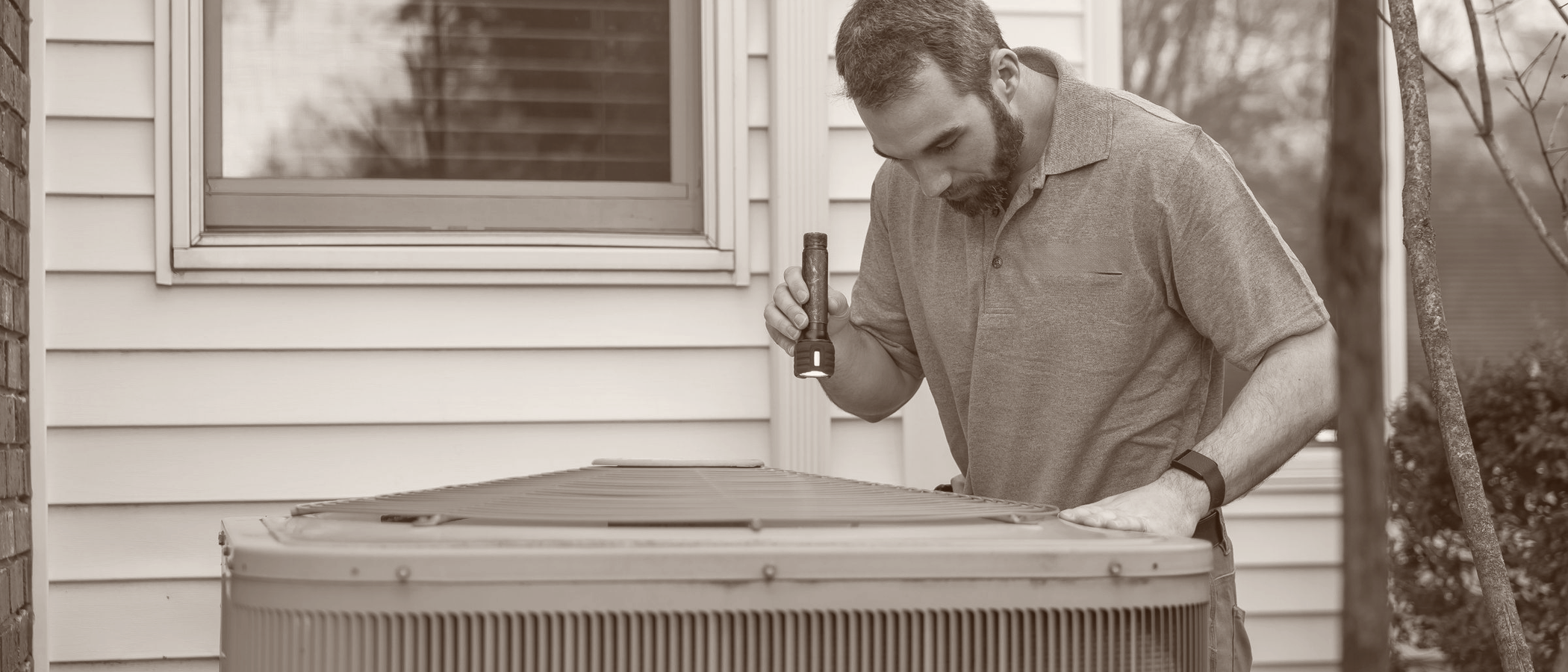
The outdoor unit, the condenser, releases the heat your system pulls from inside. Its coil is the grille of fins wrapping the unit. When those fins are packed with grass clippings, leaves, dust, or cottonwood, the system cannot shed heat well, and cooling suffers.
You can help here. First, shut off power to the outdoor unit at its disconnect box or breaker. Clear leaves and debris from around it, and gently rinse the fins with a garden hose on low pressure, keeping at least two feet of clearance around the unit. Avoid a pressure washer, which bends the delicate fins. If the fins are crushed or the unit needs to be opened, leave that to a technician.
The Outdoor Unit Is Not Running
Stand next to the outdoor unit with the system set to cool. You should hear a hum and see the top fan spinning. If the indoor blower runs but the outdoor unit sits silent, the condenser is not doing its job, and the air indoors turns warm.
After you have ruled out the thermostat and the breaker, a silent outdoor unit often points to a failed capacitor, a stuck contactor, or a motor problem. These are high-voltage electrical components and not homeowner repairs. This is the point to call a professional.
When to Call a Licensed HVAC Pro
Reach out to a technician if any of these apply:
- The breaker trips again after one reset.
- The evaporator coil keeps freezing after you replace the filter.
- You suspect low refrigerant or hear hissing near the lines.
- The outdoor unit will not run, hums without the fan turning, or clicks and stops.
- Cooling is weak even though the filter is clean and airflow is clear.
There is no downside to calling early. A trained technician has the tools to diagnose refrigerant, electrical, and airflow problems safely.
What to Tell the HVAC Shop When You Call
A few details up front help the shop send the right technician with the right parts:
- System age. Roughly how old the unit is, if you know.
- The exact symptom. Warm air, weak airflow, no airflow, or strange noises.
- Whether the outdoor unit runs. Say if the outdoor fan spins and whether you hear a hum.
- What you already checked. Thermostat setting, filter condition, and whether a breaker tripped.
- Any ice or water. Frost on the coil or lines, or water pooling near the indoor unit.
Frequently Asked Questions
Why is my AC blowing warm air but the thermostat is set to cool? The most likely causes are a tripped breaker on the outdoor circuit, a frozen evaporator coil, or an outdoor unit that is not running. Check the breaker and look for ice on the indoor coil first.
Can a dirty filter really stop my AC from cooling? Yes. A clogged filter chokes airflow across the indoor coil, which weakens cooling and can freeze the coil solid. It is one of the first things to check.
Should I add refrigerant myself? No. Low refrigerant means a leak, and handling refrigerant requires EPA certification. Topping it off without a repair does not fix the problem. Call a licensed technician.
Reaching a Real Person When Your AC Quits
When the house is warming up, the frustrating part is often just getting an HVAC shop on the phone. Answara.ai helps home-services businesses answer every inbound call around the clock, so a homeowner with a warm house reaches a real answer instead of a voicemail.