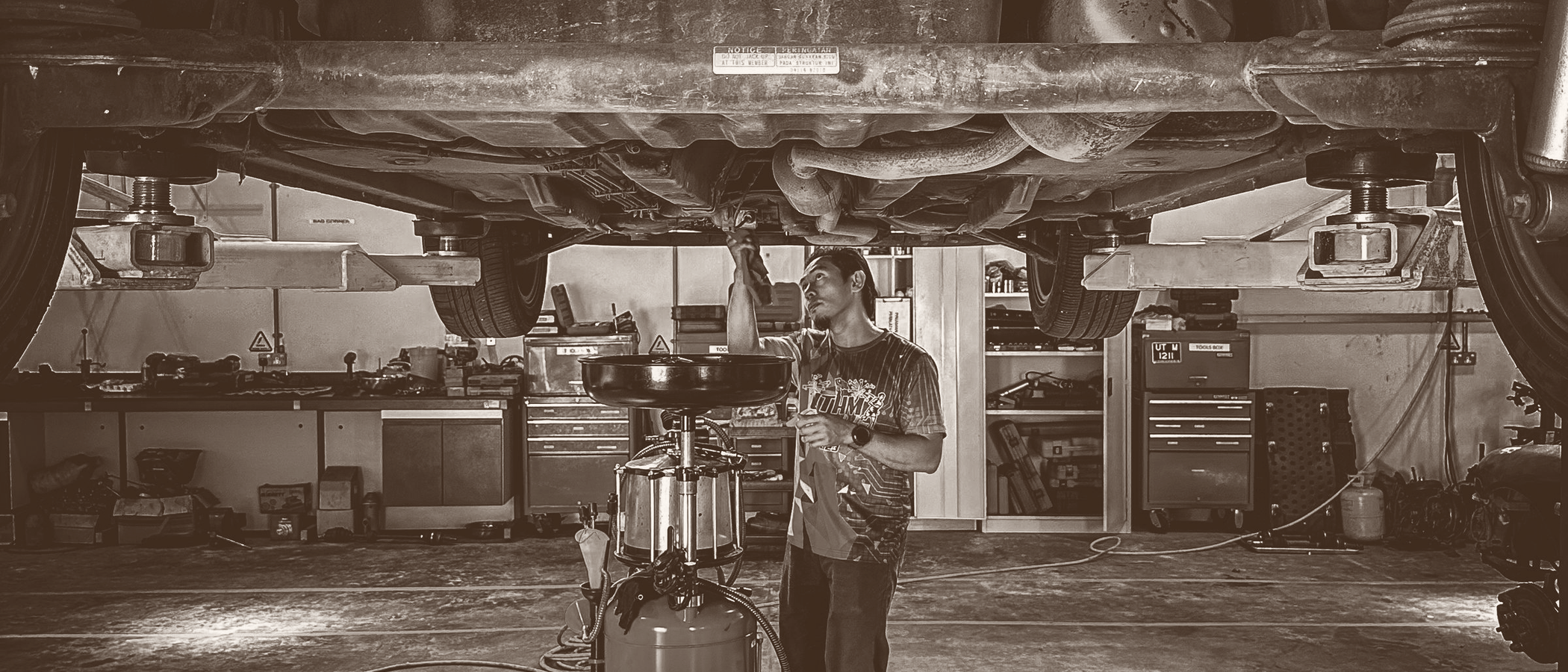
You are on your back under a Silverado with a transmission crossmember half unbolted, and the phone starts buzzing in your chest pocket. Both hands are committed. The bolt you are on is the one holding the whole assembly. You let it ring.
Ninety minutes later you check the log: three missed calls, one voicemail that says "hi, yeah, my car's making a noise, call me back," no address, no vehicle, no callback preference. You dial the number twice. Nobody picks up.
That is the mobile mechanic's dispatch problem in one afternoon. The job that pays you is the exact thing that stops you from booking the next one, and the calls you miss come back to you stripped of everything you needed to act on them.
Dispatch for a mobile tech is a different animal
A shop takes a call and the answer is "bring it in." Address known, parts room down the hall, the car sits in a bay until it is done. Almost every variable is fixed before the phone hangs up.
You have none of that. Every call you take has to resolve three things a shop never thinks about: where the vehicle physically is, whether you can carry what it needs, and when you can realistically be standing next to it. Get one of those wrong and you have driven forty minutes to look at a car you cannot fix today.
So the intake question is not "what is wrong with it." It is "can I complete this job, at that spot, with what is in the van."
Location capture is more than an address
An address gets you to a pin on a map. It does not tell you whether you can work when you arrive.
What dispatch actually needs:
- The street address, confirmed and repeated back. Not "the Walmart on 5th." There are two. Get the number, get the cross street, and read it back to the caller. A wrong address is the single most expensive intake error you can make, because it costs the drive both ways.
- Where on the property the vehicle sits. A driveway is fine. A tandem underground garage spot with low clearance and cars boxed in on three sides is not a mobile job. Neither is a street spot on a busy road with no shoulder. Ask, plainly: can you get a jack under it and stand beside it safely.
- Whether the car moves under its own power. This changes everything downstream. A car that runs can be repositioned to somewhere workable. A car that will not start is fixed in place, and if that place does not work, you are either declining the job or coordinating a tow before you roll.
- Surface and shelter. Gravel and grass are a jack-stand problem. A steep driveway is a jack-stand problem. Rain with no cover changes what you can safely open up.
- Access permissions. Apartment complexes, office parks, and HOA properties all have people who will ask what you are doing. Find out on the phone whether the caller has cleared it, and get a gate code if there is one.
None of that takes long. It is five questions. What it does is turn "come to 1420 Oak Street" into a job you already know you can finish.
Parts availability decides whether this is one trip or two
Here is the part that separates a mobile operation from a shop. Your parts room is a van, and it is finite.
Every intake call has to produce enough vehicle detail for you to check parts before you commit to a window. That means year, make, model, and engine, and for anything where trim matters, the VIN. Ask for the VIN by where to find it: the driver's side of the dash at the base of the windshield, or the door jamb sticker. Most callers can read it to you in thirty seconds if you tell them where to look.
With that in hand, sort the job into one of three buckets:
Stocked. The part is on the van. Book it, drive out, do the work. This is the ideal and it is mostly brakes, batteries, filters, belts, and common sensors.
Orderable same-day. The local supplier has it and can have it on a counter or a delivery route in a couple of hours. Book the appointment after the part is confirmed, not before. A part that is "probably available" has a way of being on backorder at the exact moment the customer is standing in their driveway waiting for you.
Diagnosis first. You genuinely do not know what it needs. A noise, an intermittent no-start, a check engine light the caller has not read. Do not guess at parts. Book it as a diagnostic visit and tell the customer exactly that on the phone: this trip is to find out, the repair is a second trip or the back half of the same one if the part is on board.
That third category is where mobile techs get themselves in trouble by over-promising. A customer who was told "I'll fix it Tuesday" and got a diagnosis Tuesday feels misled. A customer who was told "Tuesday I'll find out what it is, and I'll have common wear parts with me in case it's one of those" feels well handled by the same visit.
Setting an ETA you can actually hit
A shop gives a customer a day. You are giving them a time, and they are rearranging their afternoon around it.
Give a window, not a moment. "Between one and three" is honest and survives a job before it running twenty minutes long. "One o'clock" is a promise that traffic can break.
Build drive time into the window out loud, at least to yourself. Mobile work is jobs plus transit, and transit is the part that gets underestimated. Two hours of labor at a site thirty-five minutes away is a three-hour block minimum, and that assumes you find parking and the car is where they said it is.
Sequence the day so risk sits early. The unknown diagnostic and the vehicle you have never seen go in the morning, while there is still a day left to absorb them. The known brake job at the office park goes last, because if it slips it slips into tomorrow and nobody is upset about it.
And leave one slot open. Not for emergencies, though it will catch those. Leave it open because something today will run long, and a route with no slack turns one overrun into four late arrivals and four annoyed customers.
Then tell people when you are moving. A text when you leave the previous job costs you ten seconds and eliminates most of the "are you still coming" calls that interrupt you mid-repair.
Callback protocol for the calls you could not take
You will miss calls. Your hands will be inside an engine bay during business hours and there is no version of this trade where that stops being true. What you control is what happens next.
Set a callback standard and hold it. Same business day, or within a stated number of hours. Pick a number you can hit and put it in your outgoing message so the caller knows what to expect instead of guessing.
Make your voicemail do intake work. A generic "leave a message" gets you the useless voicemail from the top of this article. Ask for the four things by name: vehicle year make and model, the address where the car is, what it is doing, and the best number to reach them. People follow instructions when you give them.
Text back, immediately. This is the highest-leverage habit on the list, because you can send one from under a car in ten seconds and many drivers would rather text anyway. Acknowledge the call, state when you will phone back, and ask for the details you need. That turns a dead ring into a lead with half the intake already done, waiting for you when you surface.
Triage before you sort by arrival order. Someone stranded on a highway shoulder is not the same call as someone booking a Saturday oil change. One screening question sorts it: is the vehicle safe where it is, or are you stuck. Stranded callers get the fast callback. Routine bookings can wait for your next break.
Close the loop even on a no. If you cannot take the job, say so and say it quickly. A caller who hears "that one needs a lift, here's a shop I trust" at 10 a.m. remembers you well. A caller who hears nothing until 6 p.m. does not.
The structural problem, and what people do about it
Every workflow above depends on somebody answering a phone during the hours you are least able to. That is the bind, and it does not resolve with better discipline. You cannot be under a vehicle and on a call at the same time.
Missed calls are a well-known drain across home and mobile services, and callers routinely move down the search results rather than leave a voicemail. Mobile techs are structurally the worst positioned in the trade to answer, because the work itself is the obstacle.
Operations handle it three ways. Some route to a partner or a family member during heavy hours. Some use a traditional answering service, which picks up under your name and takes a message, though a generic operator rarely knows to ask for a VIN. Some use an AI receptionist that answers every call and runs the same intake script every time, so what lands on your phone already has an address, a vehicle, a symptom, and an urgency flag attached. Answara does this for auto and mobile service operations and holds the scheduling side, so a caller can be offered a real window instead of a callback.
Whichever layer you pick, the test is the same. Does the caller reach something that responds, and do you get back notes you can dispatch from without a second phone call.
The related discipline here is catching the call at all, which we covered in the mobile mechanic missed call playbook. Catching the call gets you the lead. The workflow on this page is what turns that lead into a van that arrives at the right address, at a time you promised, carrying the part it needs.