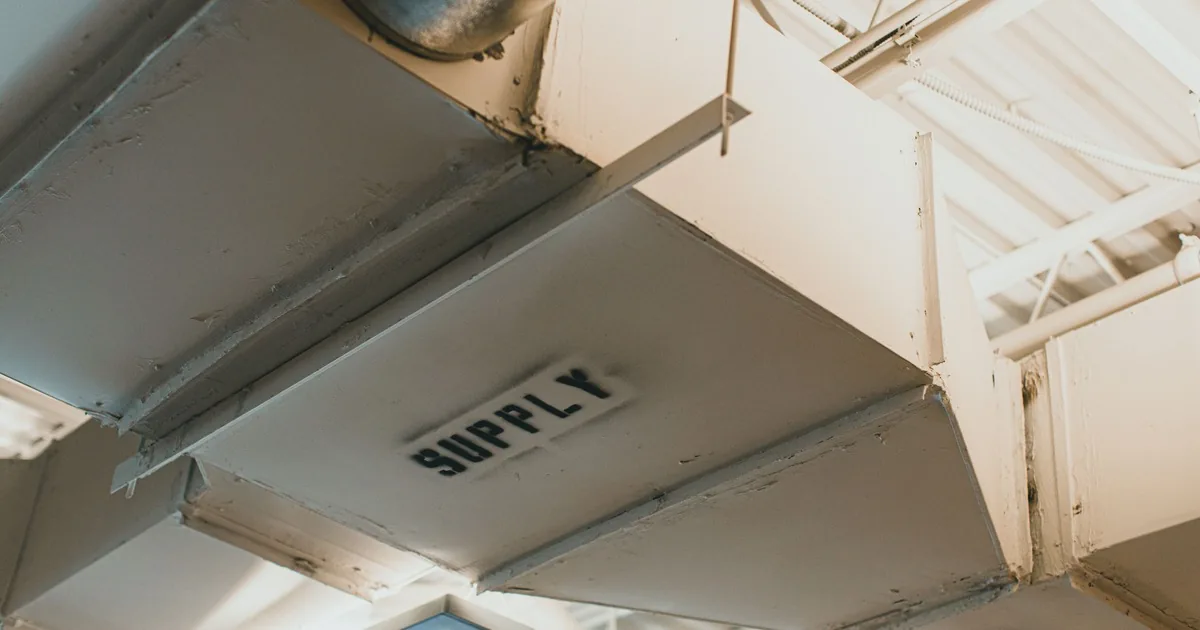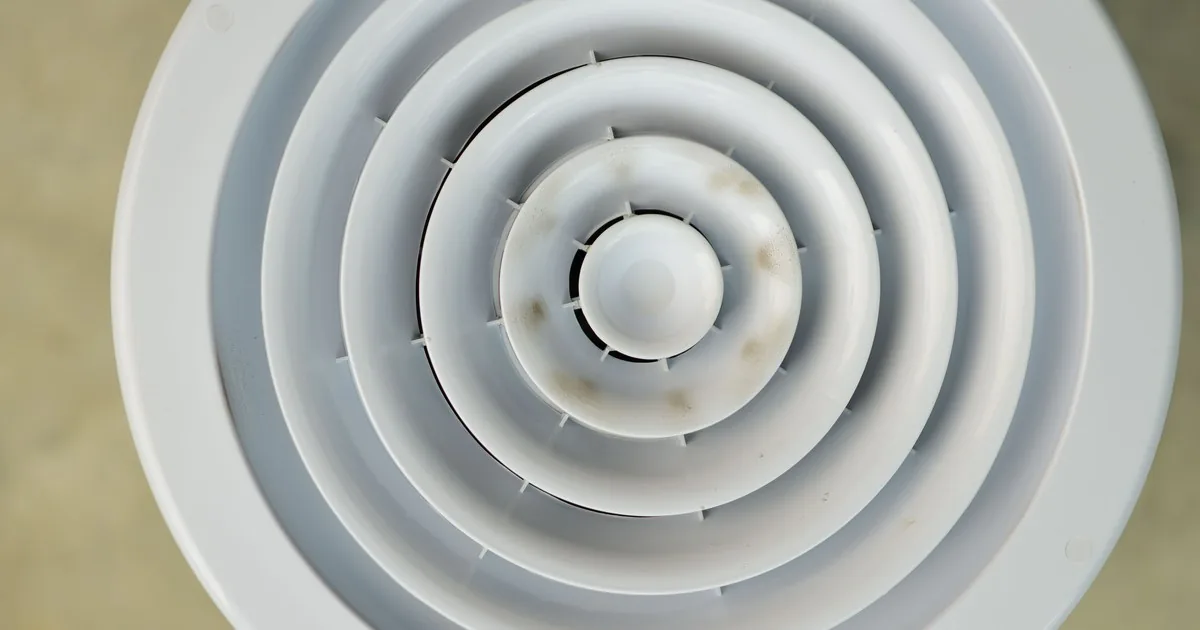
A homeowner calls after removing a ceiling grille and says, “There is black mold all through the duct.” The photo shows a dark patch near the opening, but it does not show the branch, the air handler, or the material behind the grille. The caller also mentions a drain-pan overflow last summer.
The office needs facts before it chooses a service lane. Record the exact opening or component, the affected HVAC system, what the caller can see or smell, the moisture timeline, the visible duct material, whether the system is running, prior testing or remediation, and safe access. Keep “mold” as the caller’s concern until a qualified person evaluates the material.
Start with the exact observation location
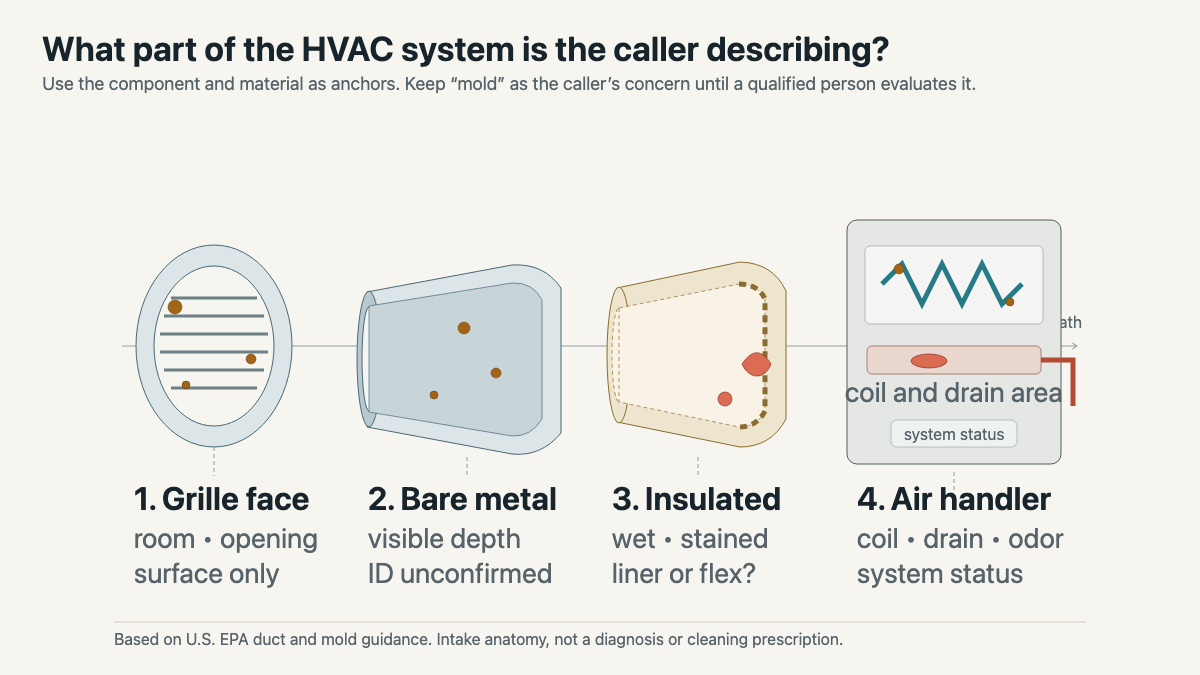
“Inside the vent” is too broad. Ask the caller to point to the closest accurate location in plain language: on the room-side grille, just behind the grille, farther inside a metal duct, on flexible or lined duct material, around the filter cabinet, on the coil or drain area, or on the wall or ceiling beside the opening.
Then identify the opening. Does air blow into the room when the system runs, or is air drawn toward it? A supply register, return grille, bathroom exhaust, and passive transfer grille can look similar to someone who has never named one. If the caller cannot tell, write “opening type unknown.” A wide photo of the room and opening is more useful than a close crop of one dark spot.
Record the caller’s words without promoting them into a finding. “Caller reports dark spotting around the upstairs return grille” is accurate. “Mold confirmed in return duct” is not. The U.S. Environmental Protection Agency’s air-duct guidance says a substance may look like mold without being mold, and final identification can require an expert or laboratory analysis. It also notes that many sections of a heating and cooling system cannot be reached for a casual visual inspection.
Location also separates this call from the broader mold-remediation inspection intake. Growth on drywall around several rooms, a wet crawlspace, or a wall opened after a plumbing leak may need a building-wide assessment. A report limited to one accessible HVAC component can follow a narrower inspection path, subject to company scope.
Build the moisture and system timeline
Mold questions become useful intake when they turn into a moisture story. Ask what happened before the caller noticed the mark or odor. Possibilities include a clogged condensate drain, standing water in a pan, a roof leak near an attic unit, wet crawlspace ductwork, a plumbing leak, high indoor humidity, or construction that exposed the system to damp materials.
Get dates where the caller knows them. When was the condition first noticed? Has it spread or returned after the grille was cleaned? Did the odor begin after cooling started, after a storm, or after a water event? Was the leak repaired? Is anything still wet?
Next, map the HVAC system. Ask which thermostat controls the affected rooms and where the furnace or air handler sits. A home with one unit in the attic and another in a garage closet has two separate investigation paths. The air-duct cleaning estimate intake guide provides the full system-and-access map when the request may become an inspection or cleaning estimate.
Duct material belongs in the note because EPA guidance treats hard surfaces and wet internal insulation differently. A caller may see bare sheet metal, flexible insulated duct, fiberglass duct board, internal liner, or a mixture. Do not ask the caller to reach deeper into an opening or remove a panel to identify it. “Material unknown” is a safe and useful field.
EPA says wet or moldy internal insulation cannot be effectively cleaned and may need replacement. The same guidance says growth can recur when the condition causing it remains. Those points belong with the qualified reviewer. Reception should capture wet material, recurring stains, an unresolved leak, and prior repairs without promising cleaning or replacement.
Set a firm boundary around system operation and symptoms
A caller may ask, “Should I shut the air conditioner off right now?” The office should follow its written safety and escalation policy. Do not improvise a universal answer based on a phone photo.
EPA’s home mold cleanup guidance says not to run an HVAC system known or suspected to be contaminated because it could spread mold through the building. That supports prompt review. It does not tell reception whether a particular system, occupant, climate, or property can safely wait without heating, cooling, or ventilation. Capture whether the equipment is running, whether an odor or material appears when the blower starts, and whether the caller has an alternate safe place to wait while a qualified person reviews the case.
Use the same boundary for health questions. If a caller reports coughing, wheezing, eye irritation, a rash, or an asthma flare, document the words they used. Refer health concerns to a healthcare professional and immediate medical emergencies to emergency services. Do not say the duct caused the symptom or that cleaning will resolve it.
The Centers for Disease Control and Prevention’s mold overview explains that damp and moldy environments can affect people differently. CDC also says routine home mold testing is not recommended. The office can record an existing lab or inspection report and ask why the caller wants testing, but it should not sell sampling as the automatic first step.
Choose the service lane from the facts
The best route may be an air-duct inspection, HVAC service, moisture-source repair, mold assessment, or coordinated visit. A cleaning slot should not be the default merely because the caller used the word “duct.”
Use the location and timeline to choose who reviews the call:
- Air-duct inspection: the concern appears inside an accessible duct or at several openings connected to one system, and the company evaluates that material and system type.
- HVAC service review: standing water, drain trouble, coil-area moisture, a wet filter cabinet, or a recent equipment problem is central to the report.
- Mold or restoration assessment: visible growth extends onto walls, ceilings, insulation, framing, or several areas outside the HVAC system, especially after a water event.
- Other qualified trade: an active roof or plumbing leak, pest problem, fire residue, or building-envelope issue needs source control beyond the company’s scope.
Some calls need two lanes. A restoration firm may assess affected building materials while an HVAC contractor evaluates equipment and duct sections. Tell the caller who will review the information and what the first appointment is meant to determine. Avoid promising that one visit will settle every part of the problem.
If the request is mostly about humidity, odors, filtration, or general comfort with no visible condition, use the broader HVAC indoor-air-quality consultation guide. Keeping those intents separate prevents a suspected-contamination call from becoming a product pitch.
Ask for a small, labeled photo set
Photos should preserve context. Request only images the caller can take from a safe standing position:
- a wide view of the room and affected opening
- a closer view of the grille or visible duct surface
- the furnace or air handler exterior, including the filter location if safely visible
- any existing water stain, drain-pan overflow, wet insulation, or nearby leak already in view
- the thermostat or equipment label that identifies the affected system
- any prior inspection, laboratory, drying, remediation, or HVAC service report
Label each image by room, opening, system, and date. “Second-floor hall return, system A, photographed Monday” gives the reviewer a usable reference. Six unlabeled close-ups do not.
The caller should not climb into an attic, open an electrical panel, remove an air-handler door, scrape material, smell it closely, or reach into ductwork for the sake of intake. Record that the area was inaccessible and let the field team plan the inspection.
Hand the reviewer a record that preserves uncertainty
A strong handoff can be read in one breath: caller reports dark spotting on the room side of the second-floor return grille and a musty odor when the upstairs system starts. The upstairs air handler is in the attic. A condensate drain overflowed last summer and was repaired, but the caller does not know whether nearby insulation got wet. No material is visible beyond the opening. The system is running. The caller has two labeled photos and no prior mold report.
That note identifies the observation, system, moisture event, current operating status, access, and missing facts. It also leaves room for a qualified person to disagree with the caller’s label after inspection.
An AI receptionist can collect the same fields after hours, provided the script uses the same limits. The most valuable sentence in the record may be a plain one: “Caller suspects mold; material and extent are unconfirmed.”