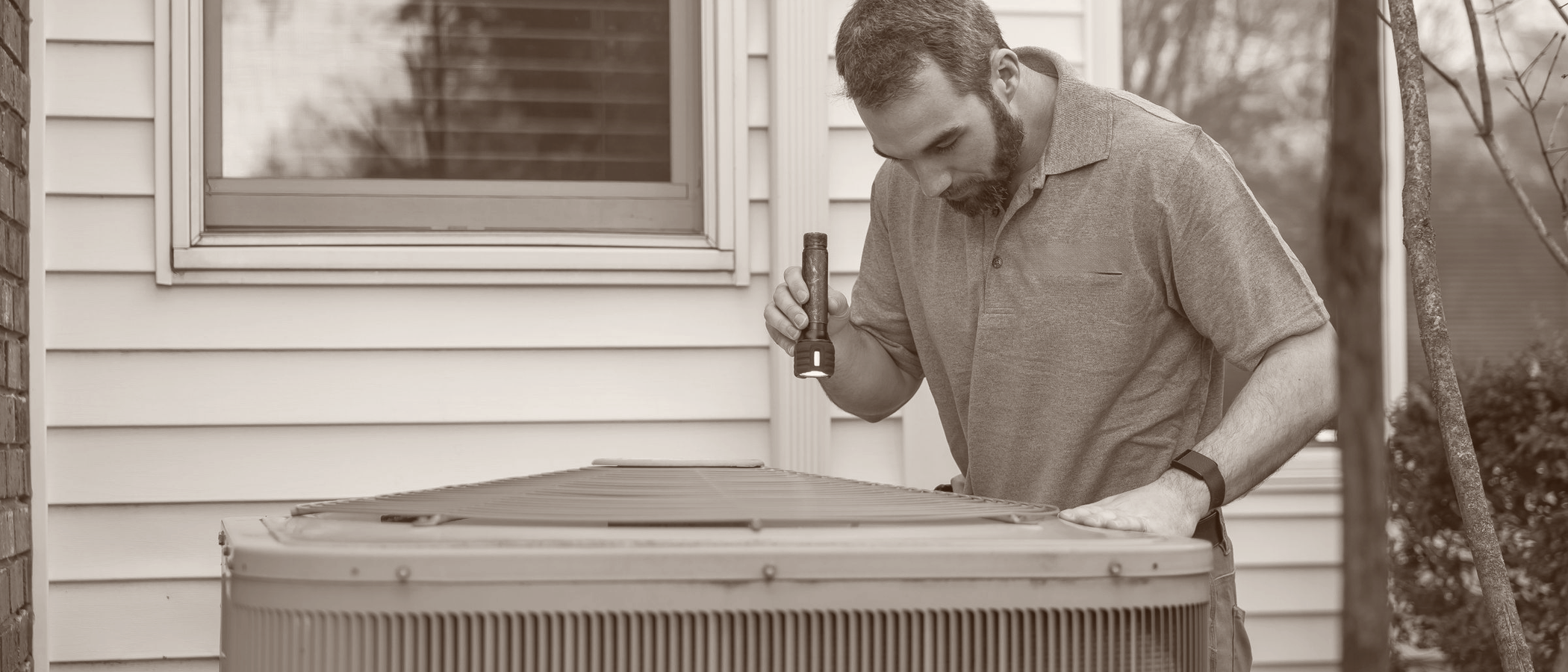
You walk out to the outdoor AC unit and the fan on top is sitting still. Maybe the unit is humming. Maybe it is completely silent. Either way the house is not getting cold, and if the compressor is running with no fan moving air across the coil, the system is overheating right now.
This guide covers what makes a condenser fan stop, which checks are safe for a homeowner, and where the line is. That line matters more here than in most AC problems. The condenser cabinet holds line-voltage wiring and a capacitor that stores a dangerous electrical charge even after the power is off. Opening the panel is not a homeowner job.
First: Shut the System Off
Before you diagnose anything, turn the thermostat to "Off."
If the compressor is running while the fan is stopped, the unit cannot shed heat. Refrigerant pressure and temperature climb, and the compressor is the most expensive component in the system. Leaving it running while you troubleshoot can turn a fan repair into a compressor replacement. Shut it down and let it cool.
Only after the system is off should you start looking at causes.
What the Sound Tells You
Stand near the unit and listen while it tries to start. What you hear narrows things down fast, and it is the single most useful thing you can tell the technician.
A hum with no fan movement. The unit has power and the contactor has pulled in, but the fan motor is not turning. This is the classic signature of a failed run capacitor, and it is by far the most common cause of a stopped condenser fan.
Complete silence. No hum, no click, nothing. The unit is probably not getting power at all, or the contactor is not closing.
A clicking or chattering sound. Often a contactor that is trying to pull in and failing, or a low-voltage control problem.
A grinding or screeching noise. A motor with failing bearings. It is on its way out.
Write down what you hear. It saves the tech diagnostic time.
Check Power First
This is the part you can do safely, because it happens outside the unit.
The breakers. Central AC usually runs on two circuits: one for the indoor air handler and one for the outdoor condenser. Open your electrical panel and look for a breaker sitting halfway between "on" and "off." Flip it fully off, then back on. One time. If it holds, restart the system and see if the fan spins.
If the breaker trips again immediately, stop. Do not keep resetting it. A breaker that trips repeatedly is doing its job, and it usually means a shorted motor, a failed capacitor, or a wiring fault inside the unit. Repeated resets push current into a fault. Call a technician.
The disconnect box. There is a small metal box mounted on the wall near the outdoor unit. It holds a pull-out block or a switch that cuts power to the condenser. Sometimes it gets pulled during landscaping or a previous service call and never gets put back. Make sure it is seated and in the "on" position.
The thermostat. Confirm it is set to "Cool," the target temperature is several degrees below the room temperature, and the display is not blank. Dead thermostat batteries can leave the outdoor unit with no call for cooling. It sounds too simple to be the answer, and sometimes it is the answer.
Check for Physical Obstruction
With the power off at the breaker and the disconnect pulled, look down through the fan grille from above. Do not reach in, and do not remove the grille or any side panel.
Sometimes a stick, a chunk of ice, or a mat of leaves has jammed the blade. If you can see debris on top of the grille or clearly wedged in the blade path, you may be able to clear it from outside with the power off. If clearing it requires taking the cabinet apart, that is where you stop.
Also check that the fins around the unit are not packed with grass clippings or cottonwood. A smothered coil will not directly stop the fan, but it makes everything else run hotter. Keep about two feet of clearance around the unit.
The Causes You Should Not Touch
Here is the honest part. If power is fine and nothing is jammed, the remaining causes all live inside the cabinet, and all of them are line-voltage components.
The capacitor. The run capacitor gives the fan motor the electrical kick it needs to start turning. When it weakens or fails, the motor gets power but cannot start, so it hums and sits there. Here is the safety issue: a capacitor stores a high-voltage charge and holds that charge after the power is cut. Turning off the breaker does not make it safe. A charged capacitor can deliver a serious, potentially fatal shock to someone who touches its terminals, and it can hold that charge for a long time. Technicians discharge capacitors deliberately with the right tool before touching anything. Do not open the panel to "just look."
You will find videos showing people spinning the fan blade with a stick to get a humming unit started. Do not do this. It puts your hand near an energized cabinet and a blade that may suddenly spin up, and it does not fix anything. The capacitor is still bad.
The contactor. The contactor is the relay that switches high voltage to the compressor and fan when the thermostat calls for cooling. Its contacts pit, corrode, and stick. Ants get inside them, which is a genuinely common failure. A stuck or burned contactor is a straightforward part swap for a tech and a live 240-volt component for everyone else.
The fan motor. Bearings seize. Windings burn out. A motor that is grinding, running hot, or tripping on thermal overload after a few minutes needs replacement, and it has to be matched on voltage, horsepower, rotation, and mounting.
None of these three are DIY repairs. They involve line voltage, stored charge, and parts that have to be matched to the equipment.
When to Call a Licensed HVAC Pro
Call if any of the following is true:
- The unit hums but the fan does not turn.
- The breaker trips again after one reset.
- The fan grinds, screeches, or starts and then stops after a few minutes.
- The unit is silent after you have confirmed the breaker, the disconnect, and the thermostat.
- You are considering opening the cabinet.
Bring the tech the details you gathered: what you heard, whether the breaker tripped, whether the compressor was running, and how long the unit has been acting up. It shortens the diagnosis.
For more homeowner guides on cooling and heating problems, see our HVAC resources hub.
Frequently Asked Questions
My condenser fan hums but does not spin. What is it? Most often a failed run capacitor. The motor is receiving power but cannot start. It needs a licensed technician, because the capacitor holds a dangerous charge even with the breaker off.
Can I run the AC with the condenser fan not working? No. Without the fan, the condenser cannot release heat, and the compressor overheats. Turn the system off at the thermostat until it is repaired.
Is it safe to spin the fan blade with a stick to start it? No. It exposes you to a live cabinet and a blade that can start suddenly, and the failed part remains failed. Shut the system off and call a technician.
Why does my breaker trip as soon as I reset it? A repeated trip usually means a short or a failing motor drawing too much current. Stop resetting it and get the unit inspected.
Getting a Tech on the Phone
A dead condenser fan tends to announce itself on the hottest afternoon of the year, often after the shop has closed. Answara.ai answers inbound calls for home-services businesses around the clock, so a homeowner with a stopped fan reaches a real answer instead of a voicemail box.