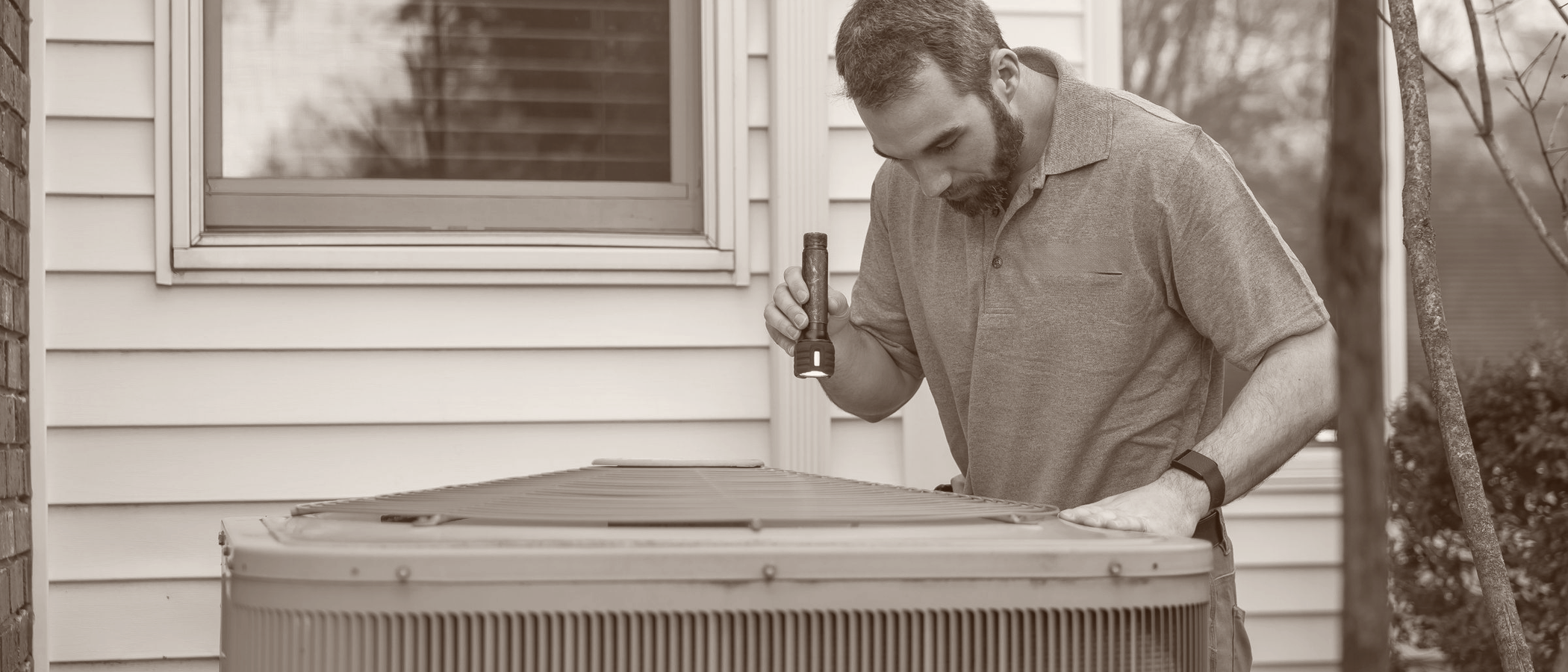
A tech pulls into a strip center at 7:40 on a Monday. The work order says "RTU not cooling, Suite 210." The roof hatch turns out to be in a back stockroom belonging to Suite 214, a nail salon that does not open until ten. The property manager who called is two states away and does not know who holds the hatch key. There are nine units on that roof and nothing on any of them but a manufacturer's badge. At 8:35 the tech leaves having looked at a padlock.
Not one minute of that was a technical problem. It was an intake problem. Every fact that would have prevented it was available on the phone the previous Friday, and nobody asked.
Residential intake and commercial rooftop intake look similar on a call sheet and behave nothing alike. On a house call, the person who answers the door owns the equipment, controls the money, and can let you in. On a rooftop unit, those are frequently three different people, one of whom has never seen the building.
Why rooftop work is a bigger share of the board than shops assume
The Energy Information Administration's 2018 Commercial Buildings Energy Consumption Survey found that 55% of commercial buildings with cooling used packaged air-conditioning units, rising to 66% of air-conditioned buildings in the hot or very hot climate zone. CBECS does not separate out how many of those sit on a roof, so treat the number as the size of the packaged-equipment world rather than a rooftop count. Anyone who has driven past a shopping center knows which way that skews.
For a contractor, the practical version is this: light commercial packaged equipment is common, it is concentrated in exactly the retail and office stock that uses third-party property management, and the calls arrive from people who are managing a building rather than living in one. That changes what you have to ask.
Which unit, and how many are up there
"The AC is out" is a complete description of a house. On a roof with nine units it tells you nothing about what goes on the truck.
How many rooftop units serve this building, and how many serve the affected space? A single 5-ton unit over a dental office is one job. Four units over an open-plan office where one zone is warm is a different job, and the caller often does not know which one is theirs.
Is there a unit tag, asset number, or suite marking on the curb? Buildings with a maintenance program usually have units numbered. Buildings without one have nine identical beige boxes. If the units are unmarked, say so on the ticket, because the tech will spend the first twenty minutes on the roof mapping thermostats to units.
What does the data plate say? Model number, serial number, tonnage, voltage and phase, and refrigerant type. Ask the caller for a photo of the plate if anyone can get to the roof safely before the visit. A model and serial gives your parts person the unit age, the coil configuration, and the compressor before the tech is standing next to it.
Gas heat, electric heat, or heat pump? A gas/electric package unit with an ignition fault in November is a different truck than a straight-cool unit in July.
Does the unit have economizer, and does the building have any controls beyond a thermostat? A rooftop tied into a building automation system means somebody has to give your tech access to the front end, or at least a phone number for the controls vendor. That is a second appointment nobody scheduled.
What is the symptom, in the caller's words, and when did it start? Then the follow-ups that matter on packaged equipment: is the supply fan running, is the condenser fan running, has a breaker or disconnect been reset, and is the space warm everywhere or only at the far end of the duct run. The no-cooling intake questions that work on residential systems still apply. They just are not sufficient.
Refrigerant type deserves its own line on the form. What is in the unit shapes what your tech can carry, what the repair conversation sounds like, and whether the honest answer is a replacement quote. Get it from the data plate rather than from memory, and let your supplier tell you what is currently available for that circuit.
Roof access is a scheduling fact
This is the section that keeps trucks from being wasted, and it is the section most intake scripts skip entirely.
How does a person physically get on the roof? Interior hatch, exterior fixed ladder, or the tech brings his own extension ladder. Each answer changes the truck and sometimes the tech.
Who holds the key to the hatch, the ladder cage, or the gate, and will that person be on site at the appointment time? Ask for a name and a mobile number, not a company. "Property management has a key" has stranded more techs than any other sentence in this trade.
Are there hours when roof access is allowed or forbidden? Some centers require roof work outside tenant hours. Some require the opposite because the only interior hatch runs through a space that locks at six. A restaurant landlord may not want a ladder through the dining room at noon.
Does anyone need to be notified before your crew walks the membrane? Many commercial roofs carry a warranty with terms about who is allowed on the surface and what happens if a penetration is made. Do not guess at those terms and do not tell the customer what their warranty says. Ask whether one exists, note the answer, and let the building owner confirm with their roofer before your tech opens a curb.
What is the roof surface and is there a walkway to the unit? Membrane, ballasted gravel, standing seam, and tile all handle differently, and a tech who knows before he arrives brings the right footwear and the right pads.
Where is the unit relative to the roof edge, and are there guardrails, anchor points, skylights, or unprotected openings nearby? Frame this as fact-gathering, not as a legal conclusion. Your safety program, your insurer, and your own competent person decide what protection a given rooftop requires. The job of intake is to capture the site conditions so that decision gets made in the shop at 4pm instead of by a tech alone on a roof at 7am. If the answers are unknown, that itself is the useful output: send someone to look before you commit to a same-day repair.
Is a crane, boom, or lift going to be needed, and is there space to set it? Only relevant on replacements and heavy components, but it is a phone question, not a discovery.
Who is actually authorizing the work
A commercial rooftop call usually involves a person with the problem, a person who can approve spending, and a person who pays the invoice. Sometimes that is one human. Often it is not, and getting this wrong is how a completed repair sits unpaid for ninety days.
Capture all of it on the first call:
- Caller's role. Tenant employee, tenant owner, on-site property manager, regional property manager, building owner, or a national facility maintenance company dispatching on behalf of a brand.
- Who the invoice goes to. The legal billing entity and the AP contact, which is frequently not the person on the phone.
- Work order number. If the call came through a facility maintenance platform, the work order number is the thing that makes payment possible. No number, no payment, regardless of how good the repair was.
- PO number and NTE limit. Get both, in writing, before dispatch. An email confirming "PO 44812, NTE $850" takes the property manager ninety seconds and settles the argument that would otherwise happen after the work.
- Whether the NTE includes the diagnostic fee and the trip charge. These get argued about constantly. Ask on the phone.
- What happens when the repair exceeds NTE. The usual answer is stop and quote. Confirm it, and confirm who your tech calls from the roof for the increase, with a number that gets picked up during business hours.
- Who signs the ticket on site. If nobody will be there, ask whether an unsigned ticket delays payment. For a lot of management companies it does.
The tenant-versus-manager split is worth a rule of its own. A tenant can describe the problem and let you into the space. A tenant usually cannot authorize spend on landlord-owned rooftop equipment, and a tenant certainly cannot promise you the roof hatch. When a tenant calls, the intake goal is a warm handoff: get the management company name and get permission to contact them, then confirm authorization before scheduling. Booking the visit off the tenant's word alone is how you end up on a roof doing work nobody agreed to pay for.
After-hours calls and what "emergency" means at this site
After-hours rooftop work has two failure modes. The first is an approved overtime call to a building nobody can unlock at 9pm. The second is a caller who agrees to your emergency rate without having the authority to agree to anything.
Ask three things before dispatching after hours. Can the site be accessed at that hour, and by whom. Does the person on the phone have authority to approve overtime, or only daytime work. And what specifically is at risk right now.
That last one is the sorting question. "The office is warm and we open at eight" is a first-thing-tomorrow call. A restaurant losing its makeup air mid-service, a server room climbing, a grocery tenant whose refrigeration is fighting an 88-degree sales floor, a medical suite with temperature-controlled stock: those are tonight. Write your own list of what counts at your accounts, because commercial urgency is defined by what is inside the building rather than by how loudly the caller describes it.
If the site is under a service agreement, the response window is already written down. Whoever answers the phone should be able to see that in the customer record rather than reconstructing it from memory at 10pm.
The dispatch checklist
Nothing rolls to a commercial roof until three fields are filled: who unlocks the roof, which unit is down, and who is paying. If any one of them is blank, the correct next action is a callback, not a truck.
The full set to capture:
Site: building address and suite, cross street or entrance to use, gate or badge requirements, on-site contact name and mobile, hours access is permitted.
Roof access: hatch or fixed ladder or bring your own, key holder name and mobile, confirmed availability at the appointment window, roof surface, walkway to the unit, guardrails and openings noted, roof warranty existence flagged for the owner to confirm.
Equipment: number of units on the roof, unit tag and which space it serves, model and serial from the data plate, tonnage, voltage and phase, refrigerant type, heat type, economizer and controls, photos if available.
Symptom: caller's description, start time, supply fan and condenser fan status, resets already attempted, whether the whole space or one zone is affected.
Authorization: caller role, billing entity and AP contact, work order number, PO number, NTE amount, whether diagnostic and trip are inside the NTE, escalation contact for overages, ticket signer.
Timing: requested window, after-hours approval and by whom, what is at risk, contract response window if applicable.
Where an AI receptionist fits
Most of that list is the same question asked the same way on every commercial call. It is exactly the kind of work a person does badly at 4:55 on a Friday and a voice system does identically at any hour.
Answara answers the calls your dispatcher cannot get to, runs the rooftop question set in a fixed order including access, unit identification, and authorization, then writes a structured ticket instead of a voicemail. Calls that carry a real emergency marker route to a human immediately. What it does not do is decide whether your crew can safely work eight feet from an unguarded roof edge, or judge whether a 12-year-old unit is worth a compressor. Those stay with your people. A trained answering service can run the same list if the operators are working from your actual form rather than taking messages, which is the difference covered in what an HVAC answering service does.