A homeowner calls about “the deck and the fence out back.” One photo shows gray deck boards under a maple tree. It misses the painted railings, composite replacement boards by the stairs, peeling solid stain, gate beside the garage, ivy on the neighbor-facing fence, and grill that has nowhere obvious to go.
A useful deck and fence washing quote call creates a separate record for each surface. Capture the material and manufacturer if known, age, existing finish, visible condition, dimensions, included faces and components, stains, nearby plants and property, water, drainage, and crew access. The office can organize those facts. A trained contractor should choose the cleaner, pressure, protection plan, and test area.
Separate the deck from the fence
Start by asking which structures the customer wants washed. “Deck” may mean the walking surface alone, or it may include railings, balusters, posts, stairs, risers, fascia, benches, a privacy screen, and the accessible underside. A second-story deck can add support posts and an area below that holds furniture, a patio, or a basement door.
A fence needs its own boundary. Record the material, approximate length and height, number of gates, and whether the quote includes one face or both. Ask who controls the far side. A shared property line, dense hedge, locked neighboring yard, pool enclosure, or narrow strip behind a shed can make the unseen face inaccessible during an estimate and on the workday.
Ask whether the deck and fence meet. Runoff from the upper surface may cross lower fence boards, plants, pavers, or siding. A connected privacy screen might look like part of the deck in photos but carry a different coating and exposure history.
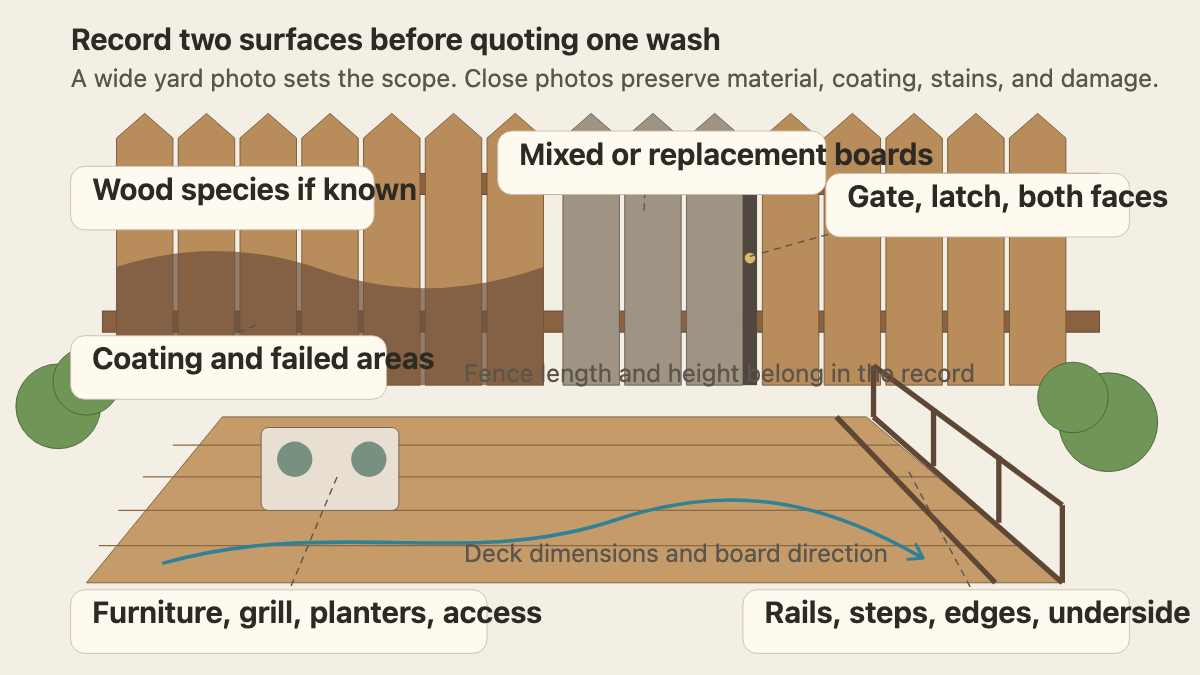
Dimensions can be approximate at intake. Ask for deck length and width, the number and width of stair runs, fence length and height, and gate count. Mark each figure as customer-reported. A wide photo from the yard should show how the surfaces relate; close photos should show material, coating, stains, fasteners, and damage.
Identify the boards before discussing a method
Ask whether each surface is wood, capped composite, uncapped composite, PVC, vinyl, metal, masonry, or a mix. For wood, record the species if the owner knows it, such as pressure-treated pine, cedar, redwood, or a tropical hardwood. Do not ask the caller to identify a species from color alone. Old finish, weather, dirt, and prior repairs can hide the grain.
Composite also needs a name. Request the brand, product line, approximate installation year, receipt, warranty document, or photo of a label if one is already accessible. Do not tell someone to pull up a board. Product generation can matter as much as the logo.
Trex care guidance gives different instructions for current high-performance lines and early-generation products. It allows gentle pressure washing under stated conditions for some lines and advises against a pressure washer on early-generation decking. Fiberon publishes its own care instructions, with product-specific cautions about pressure, tip distance, and spray direction.
Those manufacturer differences are why reception should avoid saying, “We use the same safe setting on every deck.” The call record should preserve the product identity and uncertainty. Field procedure and current manufacturer literature control the method.
Mixed surfaces deserve a line of their own. A wood deck may have composite replacement boards, vinyl railing sleeves, metal balusters, painted stair stringers, and concrete footings. A wood fence may include a vinyl gate or metal posts. Ask the customer to photograph every change in material.
Record the finish and what is failing
Ask what is on the surface now: penetrating stain, solid-color stain, paint, clear water repellent, sealer, factory cap, unknown coating, or bare weathered wood. Then ask when it was last applied and whether the customer knows the product. A can label or invoice is more useful than a guess such as “brown waterproofing stuff.”
The USDA Forest Products Laboratory guide to wood deck finishes distinguishes penetrating treatments from film-forming finishes such as paint and solid-color stain. It also warns that aggressive scrubbing or power washing can remove wood from the surface, especially on softer wood such as western redcedar.
That guidance changes the intake conversation. Note peeling sheets, flaking edges, shiny patches, lap marks, bare traffic lanes, fuzzy grain, splinters, checks, cupping, soft spots, and dark areas around fasteners. Reception should not decide whether the issue is coating failure, surface wear, decay, or pressure damage. Describe where it appears and request a close daylight photo.
Ask what the customer expects after washing. Are they seeking routine cleaning, preparation for a new finish, removal of a failed coating, or a brighter bare-wood appearance? Cleaning and coating removal are different scopes. A gray weathered board may stay gray after dirt is removed, and an old solid stain may need separate preparation. Avoid promising “like new” color from a phone description.
The American Wood Protection Association’s homeowner guidance explains that outdoor wood is selected for different service conditions and points owners to Forest Products Laboratory finish research. The useful office takeaway is narrow: treated wood, finish, and visible condition are separate fields. One should not be used as a guess for another.
Describe stains without naming them
Use the caller’s observations. Ask about color, texture, pattern, location, and timing. Green film below a planter, black dots under trees, orange streaks near hardware, white crust beside a sprinkler, greasy marks by a grill, and pale traffic lanes are better notes than “mold everywhere.”
Record shade, irrigation spray, roof and gutter discharge, leaf buildup, tree sap, food spills, grill grease, pool splash, planter runoff, pet use, road dust, and nearby metal. Ask whether the mark changes when wet and whether it returns in the same season. These details help the estimator choose what to inspect. They do not prove a cause.
Find out what has already been tried. Capture the product name, label photo, approximate date, application area, and visible result. Include prior pressure washing, brushing, sanding, bleach, deck cleaner, brightener, degreaser, stain remover, paint stripper, and unknown contractor treatments. The office should not improvise a chemical recipe or advise the caller to test a household mixture.
Visible damage needs a separate route. Loose railings, broken boards, protruding fasteners, rotten-looking posts, leaning fence sections, failed gates, exposed wiring, and unstable stairs should be flagged before a wash appointment is confirmed. A photo cannot establish structural safety.
Map every face, edge, and obstacle
For the deck, read the scope back by component. Include or exclude the walking surface, rails, balusters, posts, stairs, risers, fascia, lattice, benches, privacy screen, and underside. Ask whether anything is attached to the boards: a pergola, awning, lighting, cable railing, child gate, outdoor kitchen, or hot-tub surround.
For the fence, confirm the street face, yard face, post faces, caps, gates, lattice top, and short returns beside the house. Ask about vegetation woven through the boards, soil piled against the bottom, sprinklers, low-voltage wire, lights, signs, birdhouses, and vines rooted on the far side. Do not tell the customer to pull established vines before the contractor reviews them.
List moveable and fixed objects. Tables, rugs, grills, planters, storage boxes, toys, umbrellas, firewood, hoses, and pet equipment may require customer preparation or crew handling under company policy. Built-in seating, heavy ceramic pots, pool equipment, condensers, glass panels, and freshly painted siding may need a protection plan.
Access belongs in the quote record. Note gate width, stairs from the driveway, steep grades, soft lawn, narrow side yards, retaining walls, locked yards, parking restrictions, and hose routes through occupied space. Ask whether children or pets use the yard and who will unlock the gate.
Confirm water, drainage, timing, and handoff
Ask where the working hose bib is and whether the property uses municipal water, a private well, or a shared supply. Record reported low flow, an inaccessible shutoff, a hose bib inside a garage, or a source that is unavailable during certain hours. The contractor can decide whether a flow check or alternate water plan is needed.
Trace where wash water can travel. Note gaps between deck boards, an occupied patio below, basement doors, window wells, a pool, pond, vegetable bed, storm drain, neighboring property, and low ground beside the foundation. Local requirements and product labels govern runoff and disposal. Reception should document the site without promising a compliance method.
Ask about a staining appointment, property listing, event, pool opening, freezing weather, community work hours, or neighbor access window. If another contractor will coat the wood, record who owns moisture checks and final surface acceptance. Washing completion does not set the coating schedule by itself.
A quote-ready summary might read: the customer wants a cedar deck and six-foot wood privacy fence washed. The deck includes the walking surface, rails, one stair run, and fascia, but excludes the underside. A solid brown coating is peeling near the grill and bare on the stair treads. Four gray replacement boards may be composite. The fence quote includes the yard face and gate; neighbor-side access is unconfirmed. Ivy covers the rear corner. Furniture and planters remain on the deck, and runoff passes through the boards to a patio and basement door below.
An AI receptionist can collect this record after hours and request the right photo set. It should preserve every unknown. The estimator then receives two surfaces, a bounded scope, and a site map that can support a real method decision.