A homeowner calls and says, “We need everything out of a two-car garage.” Ten minutes later, the office learns that one wall must stay untouched, the cabinets are still full, several boxes belong to a daughter who lives out of state, and the driveway is too steep for the truck.
The useful garage cleanout quote questions follow the physical job. Map all four walls and the floor. Separate hauling from sorting. Name anything that needs disposal approval. Then trace the path between the garage and the truck. If those facts are still uncertain, schedule an onsite estimate or give a clearly qualified range under the company’s policy.
Get a four-wall view before estimating
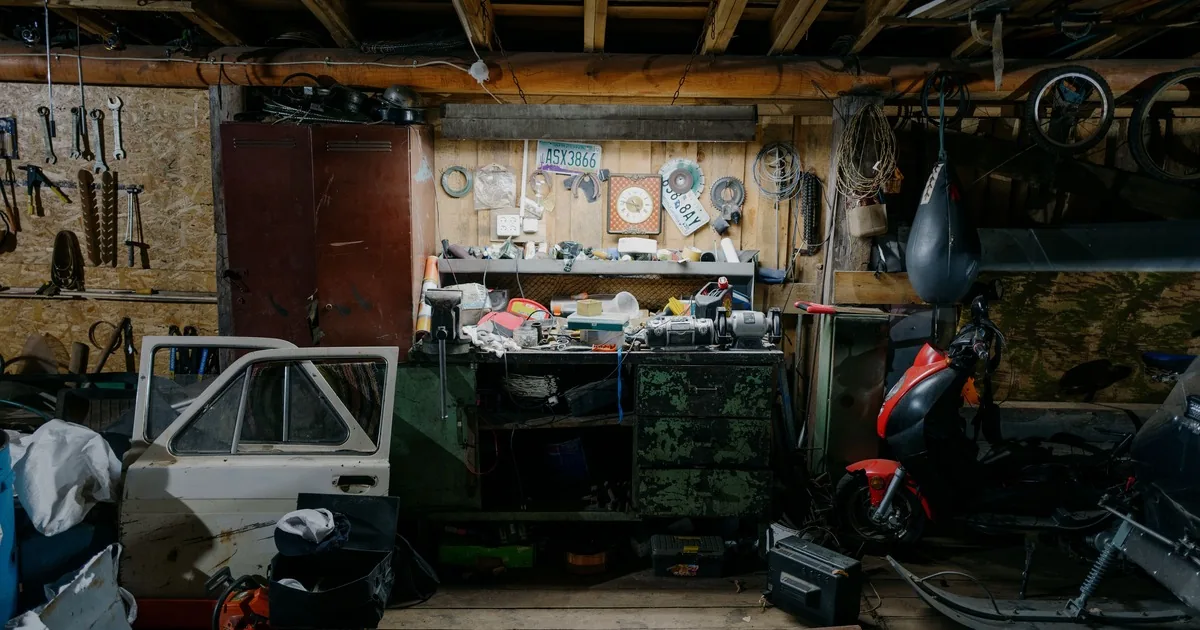
A single photograph from the open garage door often makes the pile look flatter and simpler than it is. Tall shelving runs along the side walls. Cabinets hide paint, automotive fluids, batteries, and small tools. A workbench may be staying while everything under it goes. Overhead racks can hold another layer of boxes outside the camera frame.
Ask the caller to describe the garage clockwise, starting at the left side of the door. What is on the left wall, back wall, right wall, and center floor? Are there ceiling racks, a loft, a utility closet, or storage above the door? Which shelves, cabinets, freezers, workbenches, and wall-mounted tools stay with the property?
Photos work best as a short set. Request a doorway view toward the back wall, one view of each side wall, close views of closed storage that will be emptied, and a final shot facing outward toward the driveway. Video can help when the caller can walk slowly and narrate, but still photos are easier for an estimator to inspect later.
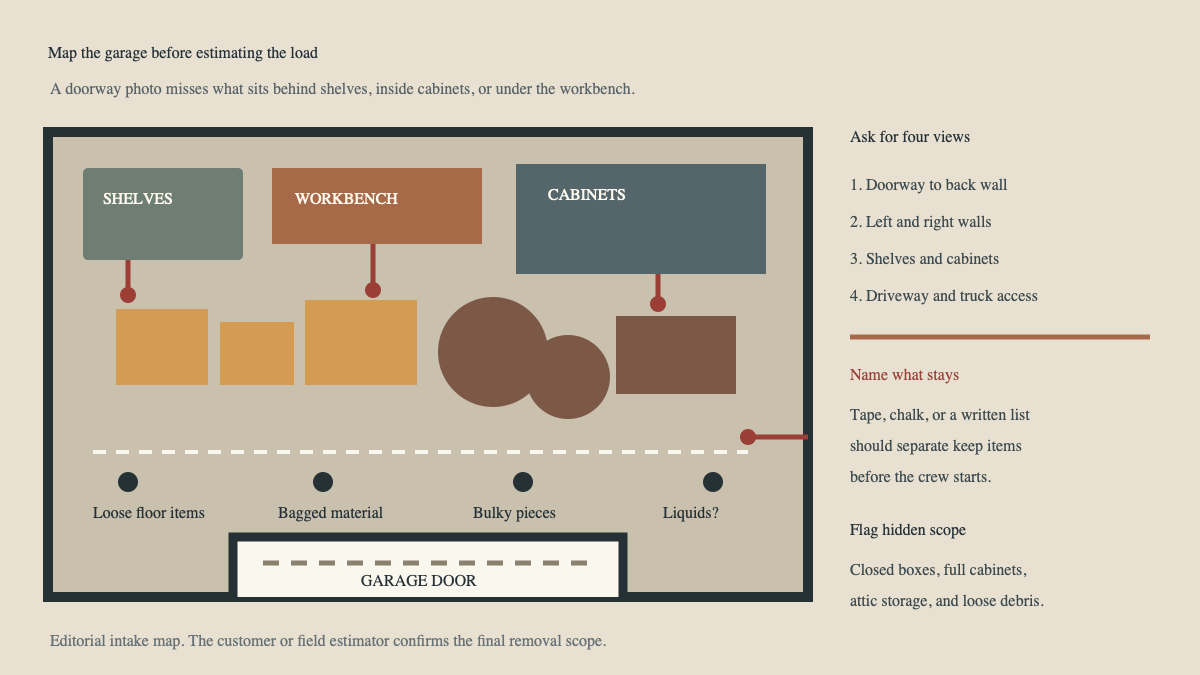
The map is a scoping aid. It cannot confirm truck volume because boxes may be full or empty, cabinets may contain more material, and furniture can stack differently after disassembly. The field team owns the final assessment.
Separate hauling from sorting
“Clean out the garage” can describe two different services. In one, the customer has already identified every removal item. In the other, a crew must open boxes, wait for decisions, make donation piles, protect keep items, and carry away what remains.
Ask who will decide what goes. If the caller is not the property owner, record who has authority to approve removal. If another family member needs to review boxes by video call, that is part of the schedule. A crew should not be expected to infer whether a dusty toolbox, labeled tote, military trunk, or stack of records is unwanted.
A simple sorting system gives the office a cleaner scope:
- Keep: marked items that the crew must protect and leave in place.
- Donate or sell: items the customer will handle, or a separate service the company has agreed to provide.
- Haul: confirmed removal items included in the estimate scope.
- Verify first: material whose acceptance, destination, or handling must be checked before booking.

If the garage is unsorted, say so in the work order. “Crew will sort with homeowner” is work. So are bagging loose material, emptying shelves, breaking down approved furniture, and moving keep items to reach haul items. The estate cleanout intake guide is a better fit when the job spans several rooms, involves keepsakes or documents, or has several decision-makers.
Describe volume without pretending to measure it
Begin with named objects. Ask for the largest pieces first: refrigerator, chest freezer, metal cabinet, workbench, tool chest, shelving unit, tires, lawn mower, bicycles, or a dismantled project car part. Then ask how many boxes, bags, bins, and loose floor piles sit around them.
Container size matters. “Twelve boxes” could mean shoe boxes or large moving cartons. “Six bags” could mean kitchen bags filled with clothes or contractor bags filled with tile. Ask whether containers are full, whether they can be lifted, and what type of material they hold. Dense material deserves its own note even when it occupies little floor space.
The Housecall Pro junk removal pricing guide describes truck volume as a common pricing base and also names labor, disposal fees, heavy items, stairs, specialty disposal, and access as pricing inputs. For a garage call, that means the office should record volume and then keep going. A broad pile of empty shelving is not operationally identical to a compact stack of pavers and automotive parts.
Do not convert a few phone answers into a guaranteed truck fraction unless the company has a documented method for that exact scope. A qualified range can state its assumptions: all haul items are visible in the photographs, cabinets are empty, the marked workbench stays, there are no restricted materials, and the truck can use the driveway. The team confirms the final scope and price before loading.
Screen chemicals, batteries, and connected equipment
Garages collect products that ordinary room cleanouts rarely contain. Ask about paint, stains, solvents, cleaners, pesticides, motor oil, fuel, propane cylinders, pool chemicals, aerosol cans, fluorescent lamps, and batteries. Use the product name and container condition. “A box of chemicals” gives the disposal reviewer very little to work with.
The US Environmental Protection Agency’s household hazardous waste guidance says products such as paints, cleaners, oils, batteries, and pesticides can contain hazardous ingredients and may require special care. EPA advises people to follow product labels and check local environmental, health, or solid waste agencies for collection options. It also warns against mixing leftover products.
Ask whether each container is sealed, labeled, damaged, corroded, or leaking. The call handler should not tell a customer to open, drain, combine, or move questionable material. Route it through the hauler’s acceptance policy and the receiving facility’s rules.
Batteries need a specific question because a caller may say “old tools” and omit the rechargeable packs. EPA’s used household battery guidance says lithium-ion batteries should not go in household garbage or recycling bins. It advises taping terminals or placing batteries in separate plastic bags before taking them to an appropriate recycling or collection point. The hauling company should give only instructions that match its approved policy and local options.
Also ask whether a refrigerator, freezer, air conditioner, water heater, sink, charger, or hardwired cabinet is still connected. The office should never assume the removal crew performs electrical, plumbing, gas, or refrigerant work. Record the connection and route it for field review.
Trace the garage-to-truck path
Garage access sounds easy until the truck arrives. The driveway may be steep, narrow, gated, soft at the edge, blocked by parked cars, or crossed by low branches. An alley garage can have a tight turning radius. A townhouse garage may open into a shared lane where loading time is restricted.
Walk the largest item to the expected truck position. Can it pass between the stored keep items? Does it fit through the garage door or a side door? Are there steps, a raised threshold, a drainage channel, or a sharp turn? Can the customer move vehicles before the appointment? Ask about gate codes, parking permits, loading hours, and pets that must be secured.
For a detached garage, note the surface between the building and driveway. Gravel, mud, grass, and a long uphill carry can affect equipment and labor. The office does not need to design the crew’s safety plan. It needs to expose the route so an estimator can assign the right people, equipment, and appointment type.
The general junk removal pricing-call guide gives a broader method for load, labor, and access questions across household jobs. This garage-specific record should add wall storage, sorting ownership, connected shop equipment, vehicle access, and common garage disposal flags.
Choose an estimate that matches the evidence
A firm phone price may fit a small, documented set of known items under a company’s item-pricing policy. A range may fit a fully photographed garage with an agreed haul list, completed sorting, clear access, and no unresolved disposal questions. State every assumption in the record and to the caller.
An onsite estimate is safer when cabinets remain closed, the owner has not decided what goes, boxes have unknown contents, heavy material is mixed into loose piles, vehicles block the scope, or chemicals and connected equipment need review. The same applies when the photographs do not show the back wall and floor.
Read the completed scope back in plain language: “The two metal shelves and red workbench stay. The crew will remove the refrigerator after the office confirms disconnection requirements, eight large moving boxes, four tires, two bicycles, and the loose pile along the back wall. The homeowner will finish sorting by Friday and send photos of both side walls, the cabinet contents, and the driveway. Paint, oil, batteries, and propane are excluded until acceptance is confirmed. The estimate range assumes the visible list is complete.”
That note gives dispatch a garage the crew can picture. An AI receptionist can collect the same fields after hours, but company policy and the estimator still control acceptance, staffing, equipment, and price.
A clean quote starts when everyone agrees which objects cross the garage door.
Sources
- Housecall Pro: Junk Removal Pricing Guide
- US EPA: Household Hazardous Waste
- US EPA: Used Household Batteries