A homeowner calls about “an old shed and swing set” that need to disappear before a fence crew arrives. The shed is still full. One corner has sunk into the soil. An extension cord runs through a hole in the siding, and the playset posts vanish into concrete below the mulch. The only route out is a side gate the caller describes as “normal size.”
That is a demolition and access call, not a routine curbside pickup. Before offering a slot, identify each structure, its condition, its supports or anchors, any utility connection, everything still inside, and the complete route to the truck. Unknown utilities, unstable framing, buried anchors, a slab, or unresolved local approval should trigger review by the person who scopes the work.
Separate the cleanout from the dismantling
Start by asking what the customer expects the crew to do. “Shed removal” can describe three different jobs: emptying contents from a shed that stays, hauling panels the homeowner already dismantled, or taking down the structure and removing the debris. A playset request can likewise mean hauling loose pieces, disassembling an intact unit, or extracting posts and footings from the ground.
Write those scopes separately. The contents may include garden tools, shelving, lumber, fuel cans, pesticides, a mower, batteries, or ordinary household clutter. Each item follows the company’s acceptance policy. The structure has its own material, condition, attachment, and demolition questions. The ground work is a third scope when posts, anchors, footings, or a slab must come out.
Ask whether anything will remain. A customer may want the shed removed but keep a concrete pad for a replacement. They may want the playset gone but leave the timber border and mulch. “Clear the yard” is too vague. Name the structure, contents, base, anchors, surrounding material, and cleanup boundary in the work order.
The same discipline helps with adjacent debris. A collapsed shed tangled in vines may include a yard-waste hauling scope, but branches and demolition material still need separate descriptions.
Record the structure as it stands today
Ask for approximate length, width, and height, then identify the main material. Common answers include wood framing with siding, thin metal panels, molded resin, or a mixed structure with roofing felt, shingles, windows, and built-in shelving. For a playset, record towers, swings, slides, climbing walls, monkey bars, canopies, and any sandbox or landscape border attached to it.
Condition matters more than age. Ask whether the structure leans, racks when touched, has a sagging roof, missing wall sections, soft wood, sharp rusted edges, broken glass, loose hardware, fire damage, or visible insect activity. Do not ask the caller to push on a doubtful wall, climb onto a roof, remove a panel, or test an anchor. Photos should be taken from stable ground.
OSHA’s demolition preparatory standard requires an engineering survey by a competent person before employees start demolition. The survey addresses framing, floors, walls, and the possibility of an unplanned collapse. A phone intake does not replace that assessment. It tells the company which calls need a field review before anyone treats the structure as ordinary light demolition.
Request a full view from each accessible side, plus the roofline, doorway, interior from the entrance, and the points where the structure meets the ground. Keep people outside an unstable shed. A close photo of one rotten board cannot establish the condition of the rest.
Find out what happens at the ground line
A shed may sit on skids, concrete blocks, piers, a slab, buried posts, or a foundation the caller cannot see. A playset may rest on the surface, use screw anchors, have posts set in concrete, or be incorporated into a retaining border. Those details affect labor, equipment, ground disturbance, debris, and what the yard looks like afterward.
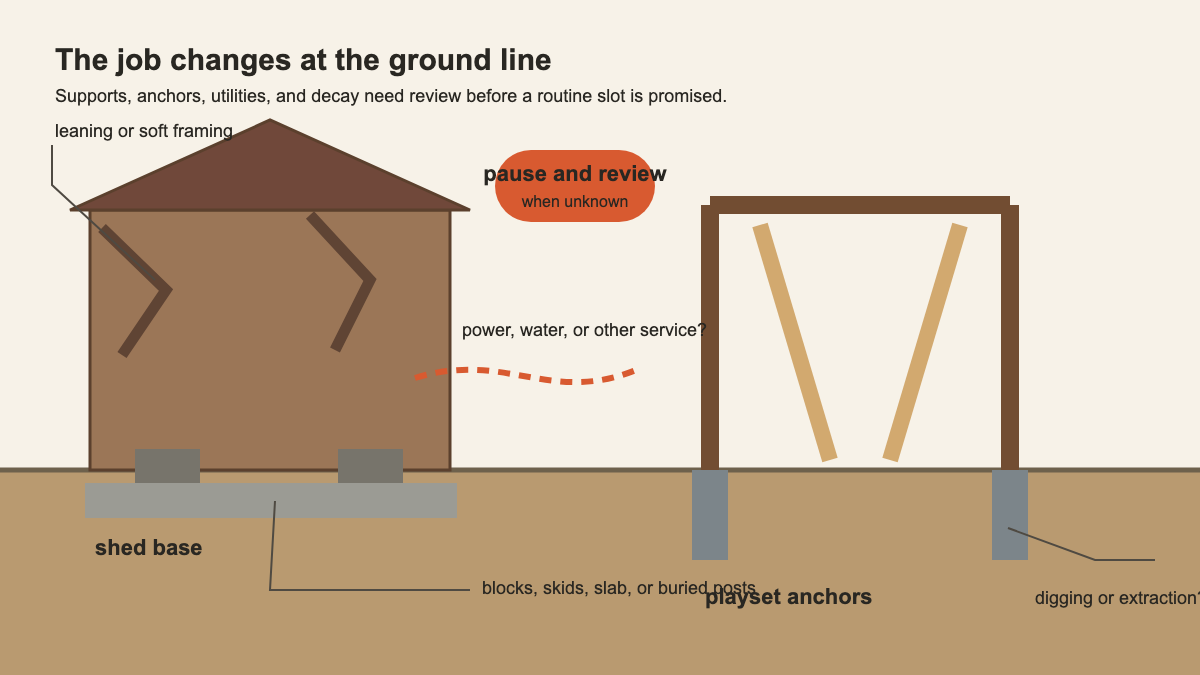
Ask the caller what is visible. Are there blocks at the corners? Does concrete extend beyond the walls? Do posts continue into the soil? Are metal straps or anchors exposed? Has anyone already loosened or cut part of the structure? Record uncertainty plainly. “Caller cannot see the base along the rear wall” is useful. “Shed sits on blocks” is false if only the front corners are visible.
If the scope may involve digging or extracting buried footings, identify who owns the utility-location step. 811 Before You Dig advises people planning to dig to request markings a few business days before work, wait for utilities to respond, and use the exact work area in the request. State rules and notice periods vary, so the office should follow its local process and written company policy.
Screen utilities and stored hazards before scheduling
Ask whether the shed has electrical service, lighting, outlets, plumbing, gas, a heater, an air conditioner, solar equipment, a buried cable, or an extension cord. A cord that can be unplugged is still worth recording. A hardwired circuit, buried feed, water line, or other service needs a qualified disconnection and a named owner before demolition begins.
OSHA requires electric, gas, water, sewer, and other service lines to be shut off, capped, or otherwise controlled outside the building line before demolition, with involved utility companies notified in advance. The call handler should capture the observed connection and the responsible party. Do not coach the homeowner through disconnecting it.
Then screen the contents. Ask about fuel, propane cylinders, paint, chemicals, pesticides, batteries, compressed gas, motor oil, sharp scrap, animal waste, droppings, mold-like growth, or unknown containers. Use the company’s acceptance and escalation rules. If the shed is packed, schedule the cleanout assessment before promising that the structure can come down in the same visit.
The garage cleanout intake guide uses the same principle: sort what is present before estimating the load. A shed adds structural and ground conditions that a garage cleanout does not.
Trace every turn to the truck
The carry route begins at the structure, not at the driveway. Ask where the crew will stand and where dismantled material will be staged. Then follow the path across the yard, around pools and garden beds, under branches or wires, through gates, down slopes or steps, along side yards, and out to the truck.
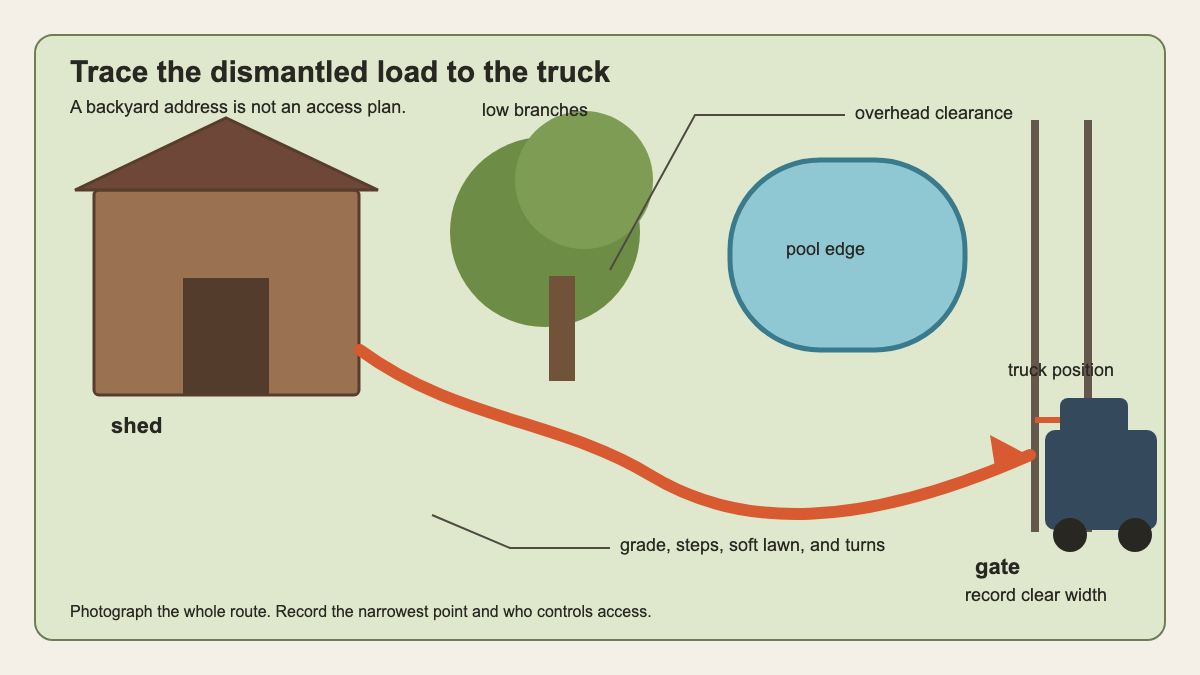
Get the clear gate width with the gate fully open. Record removable posts or panels as possible access changes pending owner approval, not assumptions. Ask about soft lawns, septic areas, irrigation heads, retaining walls, air-conditioning units, pets, locked gates, shared driveways, and neighbor access. If the crew may use a trailer, cart, mini skid steer, or other equipment, dispatch needs the route dimensions and surface condition before selecting it.
Truck placement deserves its own answer. Confirm whether the truck can use the driveway, whether branches or wires limit height, whether the pavement has weight or leak concerns, and whether street parking needs local approval. Add the carry distance when curbside loading is the only option.
Check the local approval boundary
Permit rules vary by location, structure size, foundation, utility connection, and project scope. Seattle’s demolition permit page offers a useful example: it exempts a one-story accessory structure under 120 square feet when the structure is on pier blocks or a slab on grade. That is Seattle’s rule, not a national shortcut.
Ask whether the property owner, building department, homeowners association, landlord, or property manager has imposed a requirement. Record who checked, which office or document supplied the answer, the date, and any permit or approval number. The removal company should follow its own licensing and permit process. A receptionist should never promise that a shed is exempt because it “looks small.”
Read back a dispatch-ready scope
End with a note another person can price and schedule without reopening the entire call:
“Remove one wood shed approximately 8 by 10 feet and one wood playset. Shed contents are excluded pending a separate inventory. Caller reports a leaning rear wall and soft siding at the southwest corner. Front corners appear to sit on blocks; rear support is not visible. A hardwired light is present. Property owner will provide written confirmation from a qualified electrician that the circuit is disconnected before scheduling. Playset has four posts extending into soil; footing type is unknown. Access is through a 42-inch gate, across 55 feet of level lawn, with low branches near the gate. Truck must remain at the curb. Operations will complete a site review and confirm local permit and utility-location requirements.”
That record preserves what is known and assigns every open question. An AI receptionist can collect dimensions, photos, connection details, and access facts after hours. The person responsible for demolition scope still decides whether the structure, ground work, crew, and approval status are ready for a date.
Sources
- OSHA: 1926.850 Preparatory Operations
- 811 Before You Dig
- Seattle Department of Construction and Inspections: Demolition Permit
- 1-800-GOT-JUNK?: Shed Cleanup and Removal