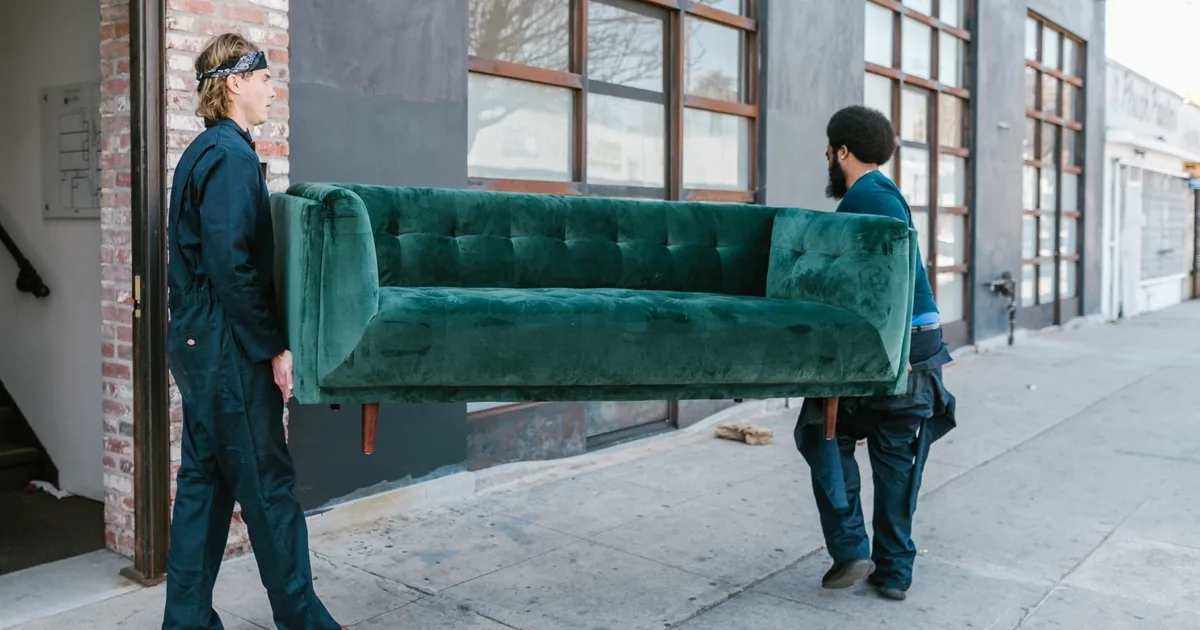
“It's one mattress and a couch upstairs.” That sounds like a small pickup. Then the crew reaches the house and finds a king mattress on an adjustable base, a sleeper sofa with a steel mechanism, a switchback stair, and street parking half a block away.
A useful mattress and furniture removal call captures five things before anyone offers a slot: the exact pieces, their condition, the route out, any disassembly or building controls, and the approved destination. Start with photos. Ask where each piece sits, how it entered the room, and what lies between it and the truck. Record wet fabric, pest concerns, powered parts, wall anchors, glass, stone, and items that still contain belongings.
The item name starts the record. The route makes it dispatchable.
Name every piece before discussing the pickup window
Ask the caller to list items one by one. “Bedroom set” may mean a mattress and metal frame. It can also mean a mattress, box spring, powered adjustable base, headboard, two nightstands, dresser with mirror, and an armoire full of clothes. Those jobs need different labor, tools, truck space, and handling plans.
For a mattress, capture the size and type. Ask whether a box spring, foundation, adjustable base, bed frame, headboard, footboard, slats, or storage drawers are leaving too. A split king has separate components. A foam mattress behaves differently on a turn than a rigid box spring. Dispatch does not need a brand unless company policy uses it. It does need the pieces.
For furniture, use names that tell the crew how the object moves: three-seat sofa, sleeper sofa, reclining loveseat, modular sectional, lift chair, solid-wood dresser, glass dining table, wall unit, or wardrobe. Ask whether drawers and shelves are empty. Confirm whether cushions, leaves, glass tops, mirrors, power cords, remotes, mounting brackets, and loose hardware belong with the pickup.
Recent photos should show the whole piece and the space around it. One close photo of upholstery cannot reveal a narrow doorway, attached chaise, or loaded bookshelf. For a sectional, ask for the number of sections and a photo of the connectors. For a bed, ask for the frame and base as well as the mattress.
Walk the route from the room to the truck
“Upstairs” is a location, not an access plan. Ask the caller to walk the route in order: room, doorway, hall, stair, landing, exterior door, porch or elevator, loading area, and truck position. The tightest point is often a turn rather than a straight opening.
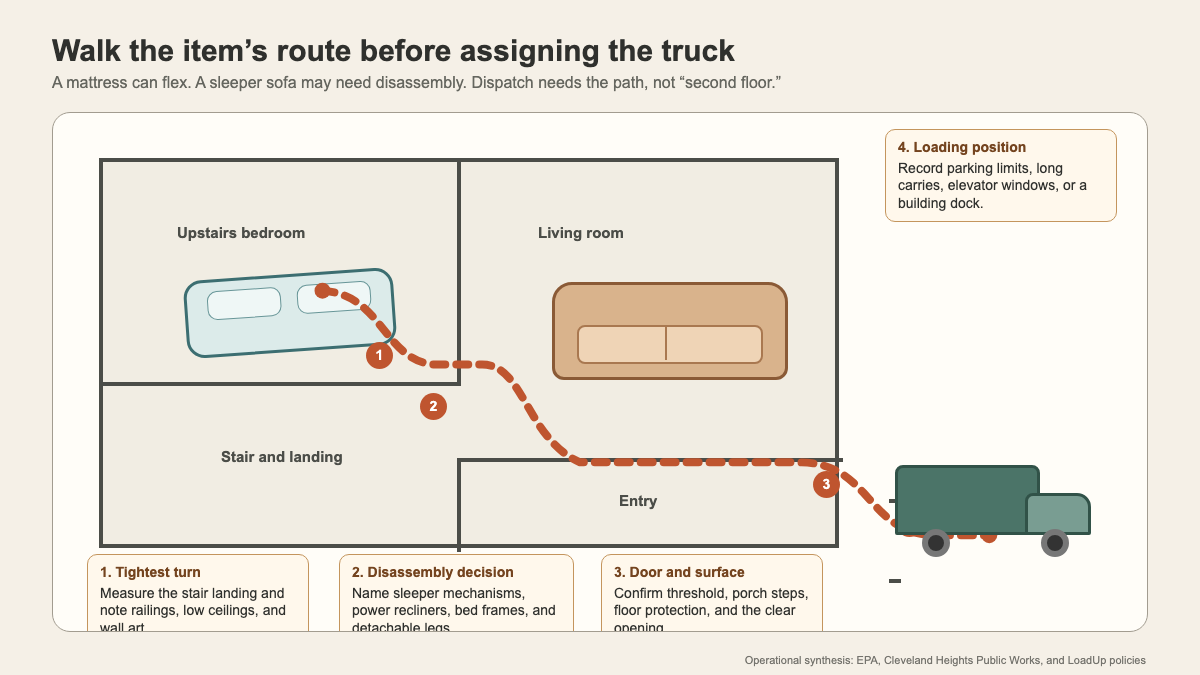
Ask how the item entered the room. A sofa may have arrived before a railing was installed. A wardrobe may have been assembled in place. A basement sleeper sofa may face a low ceiling at the first stair turn. If the caller says, “The movers somehow got it in,” request route photos or schedule a site review under company policy.
Record the floor number, number of stair flights, turn shape, landing size, low ceilings, railings, door closers, porch steps, soft ground, and long carries. In an apartment or condo, add the service entrance, elevator reservation, floor protection, certificate-of-insurance requirement, loading dock, parking limits, and approved work window. The office furniture removal guide covers those controlled-building details.
Then ask where the truck can legally and practically stand. “There is parking out front” may mean a metered space, fire lane, alley with a height limit, or public street that is full by midmorning. Give the crew the actual carry distance and loading instructions.
Separate disassembly from disconnection
A caller may use “take it apart” for very different work. Removing sofa legs or separating factory-connected sectional pieces is ordinary disassembly for some companies. Detaching a wall-mounted cabinet, cutting a built-in, removing a stair rail, disconnecting a powered base, or altering a door belongs behind a separate approval boundary.
Ask what is attached to the item and what is attached to the building. Useful questions include:
- Does the sofa recline, contain a sleeper mechanism, or connect to power?
- Is the bed base powered, and is the remote present?
- Are the headboard, wardrobe, shelving, or anti-tip brackets fastened to a wall?
- Does any piece include glass, stone, a mirror, loose drawers, or removable shelves?
- Was the item assembled inside the room, and does the customer have the hardware or instructions?
- Is the caller asking the crew to remove doors, railings, trim, or anchors?
Do not tell a caller to dismantle a heavy powered mechanism or move an awkward item to the curb for the sake of a faster quote. Record the condition and route it according to the company's scope. If a third-party disconnection or building approval is required, name who must complete it before arrival.
The junk removal pricing-call guide explains why volume, density, labor, and access belong in the same quote record. For furniture, mechanism and disassembly details are part of that access picture.
Ask about condition before promising acceptance
Condition affects handling and destination. Ask whether fabric is dry, whether the item has been outdoors, and whether the caller has seen bed bugs, fleas, rodent activity, mold-like growth, bodily fluids, sharp damage, broken glass, or a strong chemical odor. Use neutral language. “Has anyone reported pests or contamination on this item?” works better than an accusation.
Do not diagnose a pest or mold problem over the phone. Do not promise an ordinary pickup when the company's policy requires photos, containment, treatment, a special route, or a decline. Tell the caller what information is needed for review.
Local setout rules also differ. The U.S. Environmental Protection Agency advises checking with the local solid-waste district for furniture and mattress disposal. Cleveland Heights, Ohio, accepts several bulky furniture items through its municipal program, but its published rules require fabric items to be wrapped and specify placement, timing, and item limits. That is one city's process, not a rule for every address.
The distinction matters when a caller compares a full-service indoor pickup with municipal curb collection. Confirm which service your company offers and what preparation it requires. Avoid borrowing a city's wrapping rule or another hauler's acceptance policy.
Keep donation as a preference until a recipient accepts the piece
A clean sofa or complete bedroom set may look reusable in a photo. The receiving organization still decides whether it accepts the item, and its standards may account for condition, age, stains, odors, pests, current demand, and pickup access.
Ask whether donation is a preference or a condition of the job. If it is a condition, the office needs an approved recipient and a fallback plan before scheduling. If it is a preference, say that the crew can follow the company's donation-review process without promising the outcome. The donation pickup versus junk removal guide gives the office a clean way to hold that line.
Record personal property too. Have the caller empty drawers, storage beds, sleeper-sofa compartments, cabinets, and bags before arrival. A crew should not discover passports, medication, cash, family photographs, or another tenant's belongings after loading has started.
Read back the job as the crew will encounter it
End with a short dispatch read-back:
“Pickup is one king foam mattress, two-piece foundation, metal frame, three-seat sleeper sofa, and empty six-drawer dresser. All items are dry, and no pest activity, odor, broken glass, or bodily-fluid contamination was reported. They are on the second floor. The route has one straight stair flight and a right turn at a 40-inch landing, then a 36-inch front door and three porch steps. The caller sent route and item photos. The sofa legs detach, but the sleeper mechanism stays in place. No item is wall-mounted. The driveway will be clear, with a 25-foot carry to the truck. Donation is a preference pending recipient acceptance. The homeowner will be present and has authority over every item.”
That note tells the crew what is leaving, where it is, how it moves, what may change the route, and which promises were never made. An AI receptionist can collect the same fields after hours when the company supplies its acceptance, escalation, and scheduling rules. The useful record follows the furniture all the way to the truck.
Sources
- U.S. EPA: Furniture and Household Garbage and Demolition
- City of Cleveland Heights: Large and Bulk Items
- LoadUp: Mattress Removal and Disposal
- LoadUp: Furniture Removal and Disposal