A property manager calls at 4:40 on Thursday. Forty desks and a conference table must be gone before the new tenant arrives Monday. The office is on the sixth floor. The caller knows there is an elevator but does not know whether movers may use it, where a truck can stand, or whether the cubicles are attached to power and data.
A useful office furniture removal call intake separates three records: what is leaving, the physical route to the truck, and the building window approved for that route. Ask about disassembly, item condition, decision authority, door and elevator clearances, loading access, parking, and written building rules before offering a crew time.
Build an inventory that a crew can recognize
“Office furniture” can mean six rolling chairs or a complete decommissioning job. Start with the rooms in scope and list each furniture family. Desks need a count and a basic type: straight, L-shaped, sit-stand, reception, executive, or built-in. Record conference tables, bookcases, storage cabinets, lateral files, pedestals, shelving, appliances, whiteboards, cubicle panels, and loose electronics separately.
Ask whether drawers and cabinets are empty. A locked file cabinet full of records is a different object than an empty cabinet. The company also needs to know whether documents, computers, monitors, phones, printers, and network gear are part of the removal. Those items may have separate security, recycling, or ownership rules. Do not promise data destruction because a caller says the hard drives are old.
Condition matters when the caller requests donation or reuse. Ask about broken frames, swollen particleboard, missing hardware, stains, odors, and upholstery damage. Record the requested destination as a preference pending acceptance. A charity, resale partner, recycler, or receiving facility decides what it will take.
Commercial service pages for office junk removal and office furniture removal show that desks, filing cabinets, cubicle panels, cleanouts, and decommissioning all appear under the same broad search intent. The intake has to reveal which job is actually on the phone.
Identify what must change shape
The largest object in the room may become a manageable set of parts. Or it may be a built-in that the removal company does not detach. Ask whether desk legs, work surfaces, table bases, shelving, and cubicle panels can be separated. Find out who installed the system and whether assembly drawings or spare hardware exist.
Cubicles need extra questions. Are panels freestanding or anchored? Do power and data run through them? Has a qualified contractor disconnected those services? Are glass panels, overhead bins, task lights, or acoustic dividers attached? The receptionist should capture the condition without telling the caller how to disconnect electrical or network components.
Mark anything that must leave intact. A one-piece reception desk, stone conference top, fireproof file cabinet, safe, server rack, or oversized copier can control the route. Ask for photographs with a familiar object or tape measure in frame. Get the assembled dimensions and the expected dimensions after approved disassembly.
The appliance pickup intake guide covers a related boundary for break-room refrigerators and other equipment whose disconnection or refrigerant status may need separate handling.
Trace the route to the truck
A freight elevator listed on the building website does not prove that the desk fits through its door. Trace the route in order: item location, suite doorway, corridor turns, security doors, thresholds, elevator opening, elevator cab, lobby or service corridor, loading area, curb, and truck.
At each pinch point, record clear width and height. Ask about tight turns, ramps, stairs, floor transitions, protective coverings, low fixtures, glass doors, card-access doors, and doors that close automatically. Confirm whether the crew may prop any door open. Building management, not the caller’s enthusiasm, controls that answer.
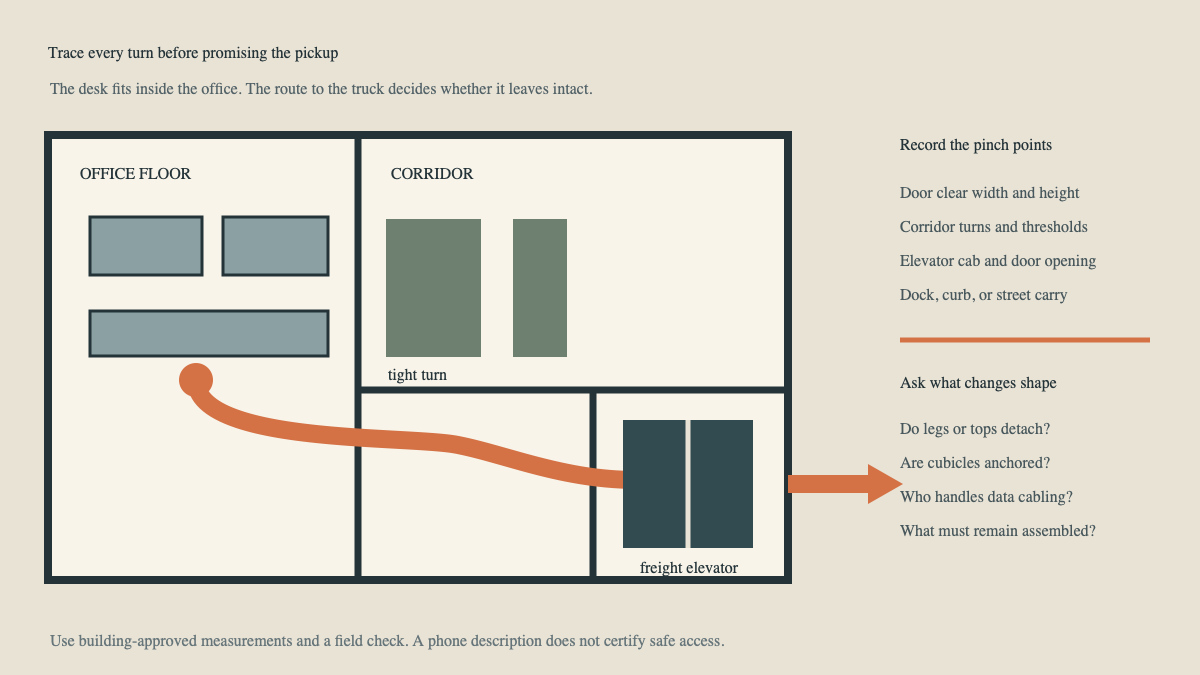
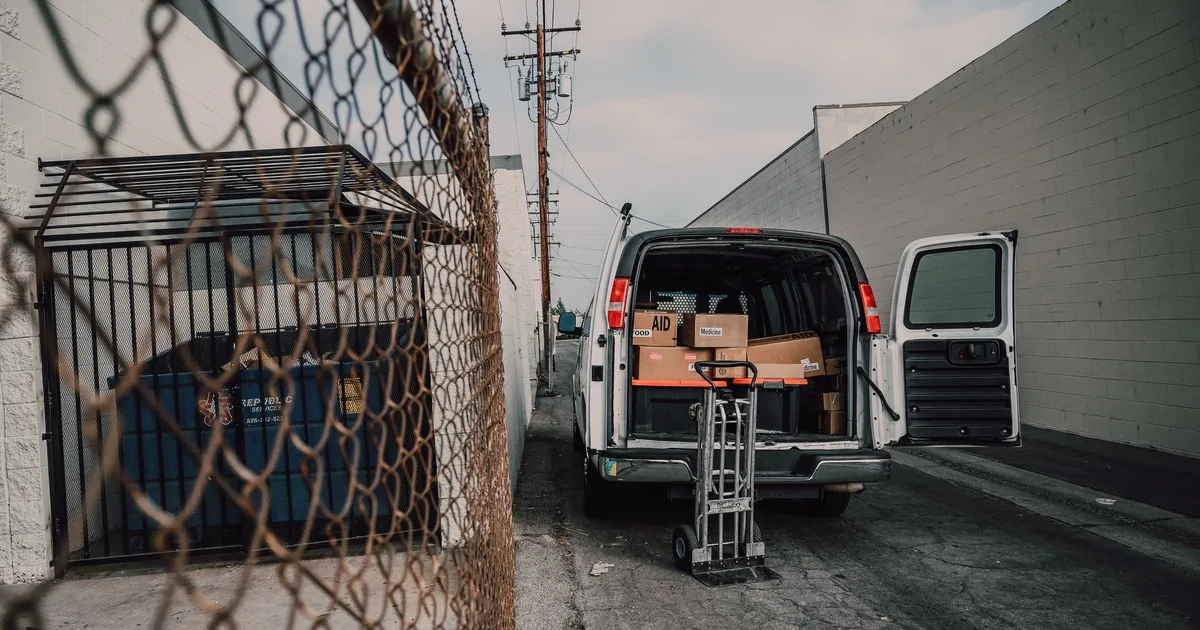
Ask where the truck can load. “There is a dock” still leaves open the dock height, bay availability, truck-size limits, approach clearance, gate procedure, and whether another tenant has it reserved. Street loading brings different questions about legal standing space, meters, permits, cones, traffic, and the carry distance between the building and truck. The office should identify the person responsible for confirming local parking or permit requirements.
Photos should show the entire route, not a close view of the furniture alone. Request the suite doorway, each difficult turn, the elevator door and cab, the service exit, dock or curb, and expected truck position. A field check remains the right next step when dimensions are uncertain or the route is complicated.
Reserve the building before reserving the crew
Many commercial buildings limit moves to certain hours. They may require a freight-elevator reservation, elevator padding, floor protection, a certificate of insurance, security access, a loading-dock booking, or a building engineer. The exact rules vary. Ask for the building contact’s name, email, and phone number, plus any written move policy.
The call handler should record the approved window exactly. “After hours” is too loose. A work order needs the date, earliest entry, elevator start and end, loading access period, required check-in point, keys or access credentials, and the person who will sign off when the route is clear.
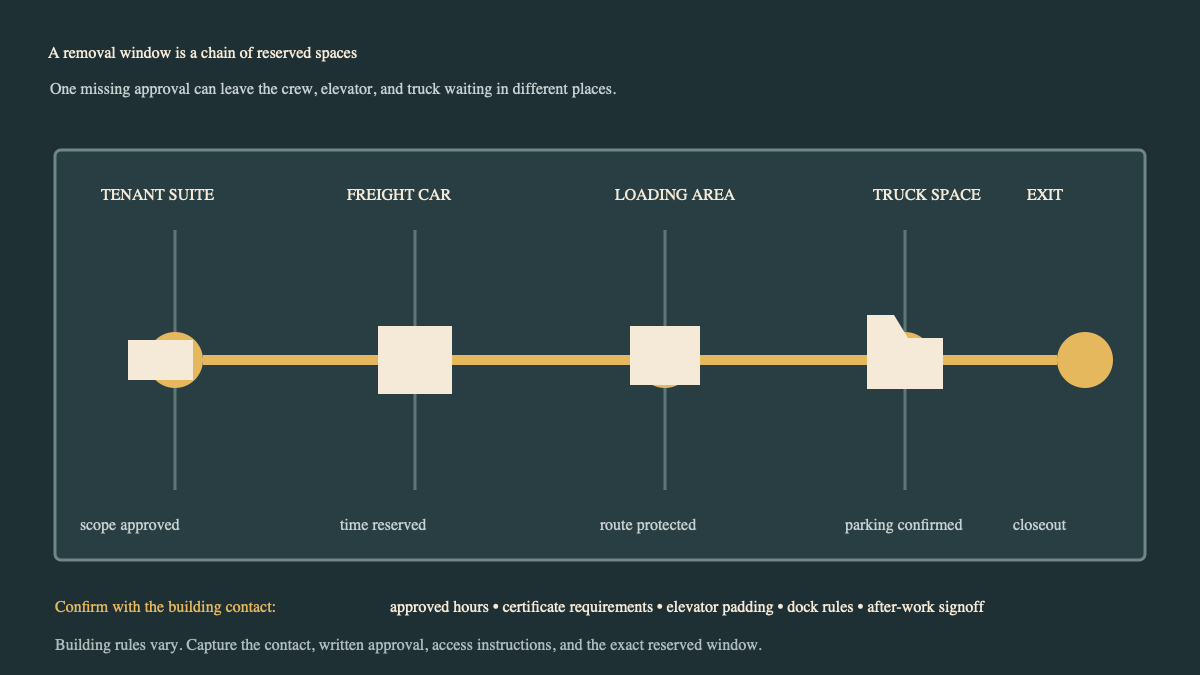
An industry article about dock and elevator clearance for office moves focuses on the same failure points: elevator size, dock access, equipment clearance, building coordination, and schedule restrictions. Treat those as intake fields. Do not infer approval from the presence of a loading dock.
The tenant, property manager, building security, elevator operator, and removal company can each own a different part of the window. Name the owner of every unresolved item. “Caller will check” should become “Marisol Chen, property manager, will email the approved freight-elevator window and certificate requirements before scheduling.”
Set a realistic disposition plan
Ask what the caller wants reused, donated, recycled, returned to a lessor, transferred to another branch, or discarded. Keep those groups labeled in the work order. If employees are claiming desks or chairs, set a cutoff time and identify who produces the final removal list.
EPA guidance on sustainable management of construction and demolition materials describes source reduction, salvaging, reuse, and recycling as ways to keep usable materials in productive use. Office furniture is not identical to structural demolition material, but the planning principle holds: separating items before loading preserves more options than mixing everything at the truck.
Acceptance remains local and item-specific. Ask whether a receiving organization has approved the items, who arranged delivery, and whether it requires photos, dimensions, disassembly, or a scheduled arrival. Do not guarantee donation. A rejected desk still needs an authorized destination.
The general junk removal pricing-call guide explains why volume, labor, access, and disposal belong in the estimate. Office work adds building reservations and system-furniture disassembly to that base.
Read back a dispatch-ready scope
Before ending, read the job back in operational language:
“Remove 18 empty L-shaped desks, 24 chairs, six lateral files, and one conference table from Suite 620. Computers and records stay. The tenant’s installer will disconnect power and data before arrival. Desk returns detach, but the conference top must leave intact. Building management has reserved the freight elevator Friday from 6:00 to 9:00 p.m. The crew checks in at the south security desk. The truck uses Dock 2, subject to the property manager’s written approval. Donation is requested for the chairs and files, pending receiving-party acceptance.”
That note gives dispatch something it can test. The counts are visible. Exclusions are explicit. Disassembly ownership, route, reserved window, truck position, and disposition are attached to named people.
An AI receptionist can collect these fields after hours, but building management still approves access and trained staff still confirm the route. The best office furniture removal call ends with fewer assumptions and one written next step.
Sources
- US EPA: Sustainable Management of Construction and Demolition Materials
- Office Furniture Assemblers: Dock and Elevator Clearance
- LoadUp: Office Junk Removal
- TurboHaul: Office Furniture Removal