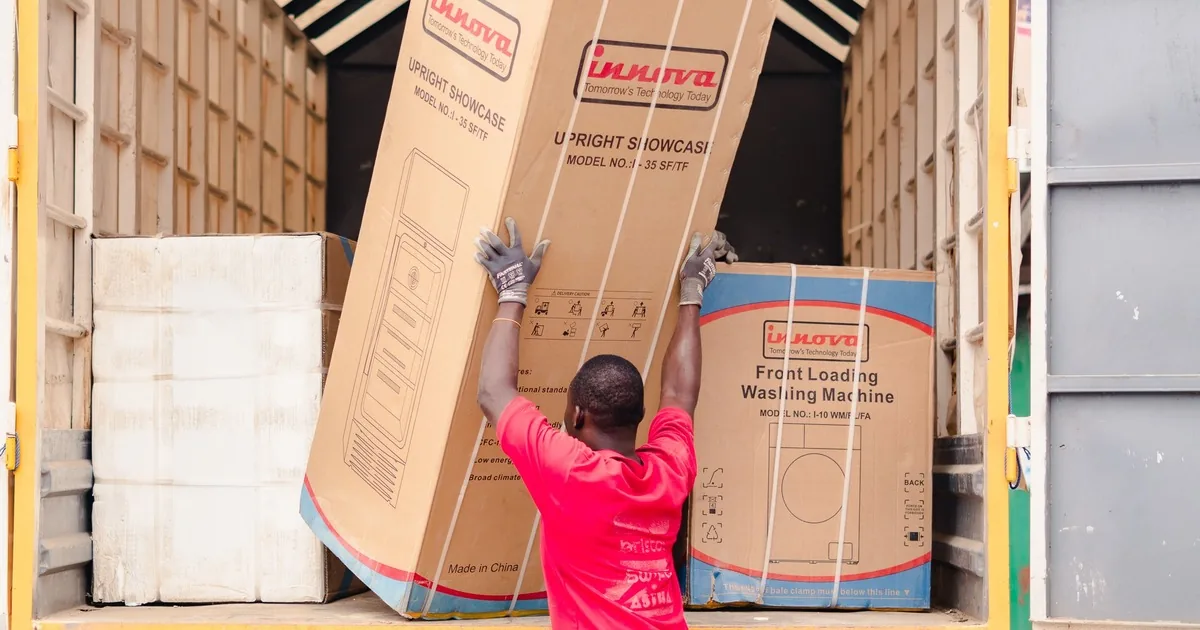
A caller says there are “two old appliances in the basement.” Ten minutes before arrival, the crew learns that one is a chest freezer still packed with food, the other is a gas dryer, and the basement stair turns under a low ceiling. The truck is parked across a lawn that cannot carry a loaded dolly after rain.
A useful appliance pickup call settles four things early: the exact item, its reported connection and contents status, whether it may contain refrigerant, and the complete route to the truck. Those facts decide whether the office can quote under a company rule, needs photos, or must arrange a qualified handoff before pickup. “Standard appliance” is too vague for dispatch.
Identify every item separately
Start with a count, then give each appliance its own line in the job record. “Kitchen set” can mean a refrigerator, range, built-in dishwasher, microwave, and range hood. Each one has different connections, attachments, dimensions, and disposal questions.
Ask for the appliance type, brand, approximate age if known, and model number when the label is visible without moving the unit. Record whether it is freestanding, stacked, built into cabinetry, mounted under a counter, or attached with anti-tip hardware. Photos should show the front, both accessible sides, the surrounding cabinets or wall, and the floor at the base.
Dimensions matter at the hard points. Get the appliance height, width, and depth, then ask whether doors, handles, shelves, pedestals, or stacking hardware can come off under company policy. Do not assume a refrigerator door will be removed on site. The estimator decides which parts may be detached and whether that work belongs in the quoted scope.
Contents deserve a direct question. Is the refrigerator empty? Does the freezer contain food, loose ice, or meltwater? Is there standing water in the washer or dishwasher? A caller may describe a unit as empty while leaving glass shelves, detergent drawers, dryer racks, or an ice bin inside. Record loose parts so the crew does not discover them on the stairs.
Junk King’s appliance removal page lists refrigerators, stoves, dishwashers, washers, dryers, air conditioners, and other household equipment as distinct pickup categories. That is the right level of specificity for intake. The office needs named items, not a single “appliances” quantity.
Give every connection an owner
The receptionist records what the caller reports. Field staff or qualified trades verify the condition required by company policy.
Ask whether the unit is plugged into an outlet, hardwired, connected to a water supply, attached to a drain, supplied by gas, or tied into ducting. Then ask who is responsible for disconnection and when it will be completed. A cord lying behind a washer does not prove that the water hoses and drain are free. A range pulled a few inches from the wall may still have a gas connector attached.
Do not coach a caller through opening a junction box, closing an unfamiliar gas valve, cutting a line, or reaching behind a heavy appliance. If the customer cannot describe the connection safely, mark it unknown. The next step may be a plumber, electrician, appliance installer, gas professional, building maintenance team, or an employee authorized under the company’s licenses and procedures.
The 1-800-GOT-JUNK? appliance removal page states that its customers should disconnect water, gas, and electrical lines before arrival and refers uncertain gas-stove or built-in-dishwasher work to a professional. Other companies may assign that work differently. The useful lesson for intake is the explicit handoff: someone must own disconnection before the office describes the appliance as pickup-ready.
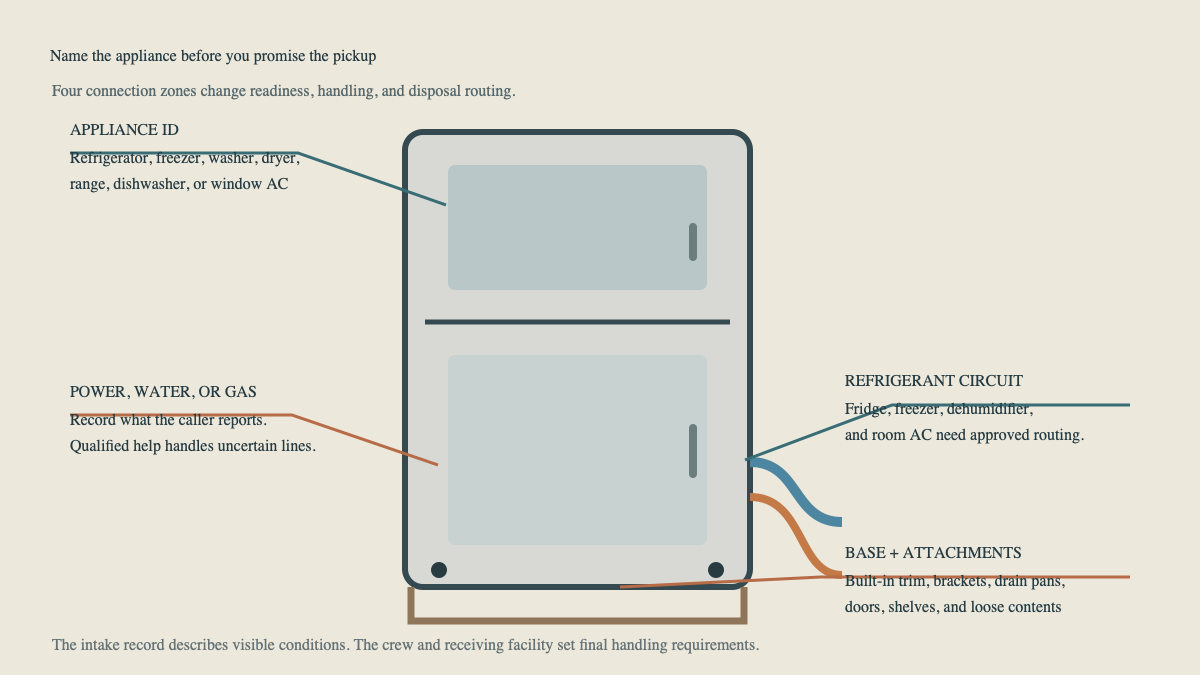
Built-in equipment needs a finish-line question too. If a dishwasher, wall oven, range hood, or compact unit sits inside cabinetry, does the customer expect removal from the opening or pickup after another trade has removed it? Who handles trim, mounting screws, water lines, ductwork, floor damage, or the exposed opening? Put exclusions in the readback.
Flag refrigerant-containing equipment before routing disposal
Refrigerators and freezers are obvious refrigerant flags. Window and portable air conditioners, dehumidifiers, water coolers, and some other cooling appliances also deserve destination review. Ask for the item type and model label. Never tell the caller to puncture tubing, drain a sealed system, or remove a compressor.
The EPA’s stationary refrigeration safe-disposal guidance says household refrigerators, freezers, and window air conditioners commonly enter the waste stream with their refrigerant charge intact. The final person in the disposal chain must ensure that refrigerant is recovered before final disposal. EPA also describes verification duties when equipment reaches the final disposer without a charge.
That changes the office workflow. Confirm that the company’s receiving facility accepts the appliance in its current condition, or that an approved partner handles it. Record any documentation the facility or disposal contract requires. A sticker alone should not be treated as universal proof of refrigerant recovery; the EPA page explains the final disposer’s signed-statement or supplier-contract requirements.
Keep destination language modest. A working refrigerator may qualify for donation under one organization’s rules and fail another’s age, condition, cleanliness, or energy-use criteria. Recycling access varies too. Tell the customer that the company will route the item under local facility rules after its condition is confirmed. Do not promise donation or complete material recovery on the phone.
Walk the appliance through the building
Now trace the route as if the appliance were already on the dolly. Start in the room and finish at the truck. Ask which floor it is on, whether an elevator is available, and whether building management controls elevator reservations, loading hours, hallway protection, or certificates of insurance.
For a house, record the narrowest door opening, tight turns, hallway width, stair count, landing depth, railing position, ceiling height over the stairs, thresholds, porch steps, and exterior surface. Ask about hardwood, tile, carpet, fresh paint, low fixtures, and glass doors. The estimator decides protection and handling. The caller supplies the conditions.
A basement deserves extra care. “Straight stairs” may still end at a ninety-degree kitchen turn. A walkout door may lead to a steep muddy slope. Ask the customer to photograph the appliance facing the stairs, the full staircase from top and bottom, each landing, the exit door, the path outside, and the expected truck position.
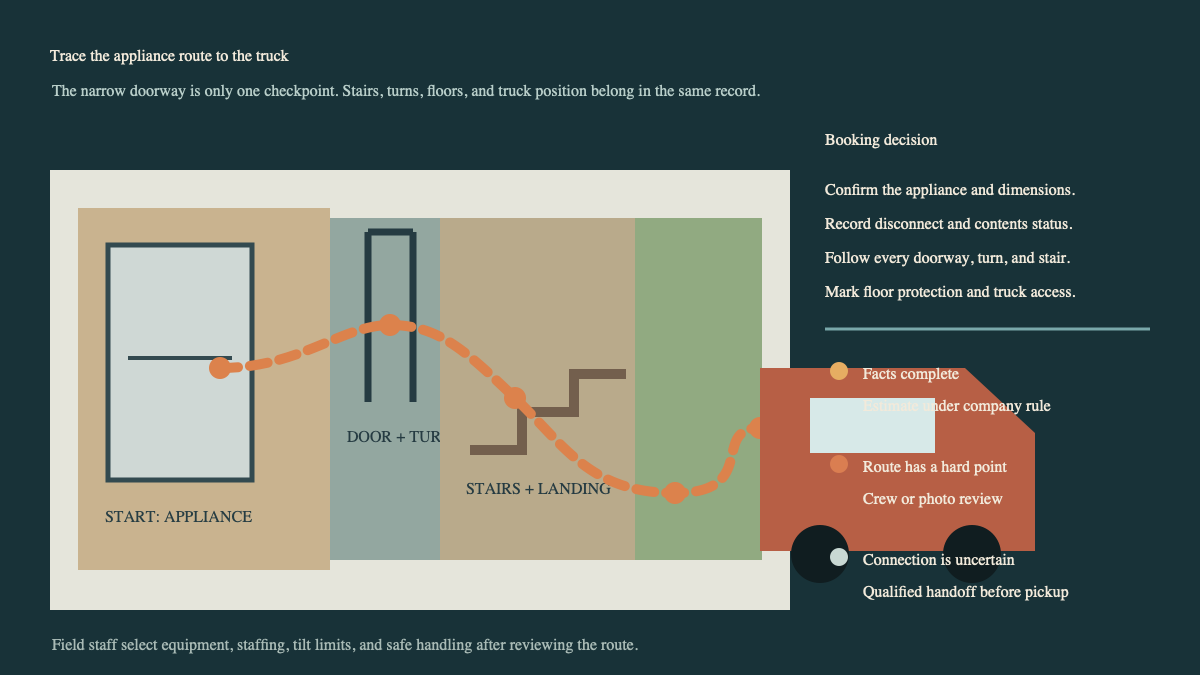
Do not estimate safe handling from a customer’s weight guess. Appliance construction, doors, internal components, trapped water, and the route all matter. The field team selects the dolly, straps, floor protection, crew assignment, and allowable orientation under company procedure and manufacturer guidance.
Confirm authority, timing, and included work
Property access can block a well-scoped job. Record who owns the appliance, who can authorize removal, and who will meet the crew. For a rental, estate, foreclosure, office, or managed building, ask whether the caller has written authority and whether a tenant, executor, property manager, or facilities contact controls entry.
Then define what leaves. A practical intake record covers:
- Each appliance by type, count, location, dimensions, contents, condition, and visible attachments.
- Reported power, water, drain, gas, duct, and refrigerant status, plus the person responsible for each required handoff.
- Doorways, turns, stairs, elevator rules, floors, exterior path, parking, and truck position.
- Included loose parts such as shelves, racks, hoses, pedestals, trim, and packaging, with cabinetry or repair exclusions stated plainly.
- Destination flags, property authority, contact at arrival, deadline, photos received, and the estimate type still subject to confirmation.
Timing should describe readiness, not urgency alone. A same-day request is workable only if authority, disconnection, route, access, and item acceptance can be confirmed in time. The same-day junk removal pickup guide covers that scheduling decision. For mixed household loads, use the junk removal pricing call framework to capture volume, dense materials, carry labor, and disposal flags beyond the appliances.
Read back a crew-ready appliance record
Close the call by separating reported facts from open checks:
“Jordan has one freestanding refrigerator in the basement and one gas dryer on the first floor. Both appliances are empty. The refrigerator measures thirty-six inches wide with its doors attached and is flagged for refrigerant-compliant disposal routing. The customer reports that it is unplugged. The gas dryer remains connected, so pickup is pending disconnection by the customer’s qualified gas professional. The basement route has twelve stairs, a landing turn, one thirty-two-inch doorway, and hardwood between the stairs and front door. Exterior access has three porch steps. The driveway is available for the truck. Shelves and dryer rack are included. Water lines, gas work, cabinetry, and floor repair are excluded. Photos of both units, labels, connections, stairs, landing, doorway, porch, and driveway are attached. Estimator review is required before price and schedule are confirmed.”
An AI receptionist can collect the same fields after hours, but the removal company keeps control of acceptance, trade handoffs, equipment, staffing, destination, and price.
The pickup is ready when the crew knows exactly what is moving and where the first hard turn is.
Sources
- US EPA: Stationary Refrigeration Safe Disposal Requirements
- Junk King: Appliance Removal Services
- 1-800-GOT-JUNK?: Appliance Removal and Responsible Disposal Service