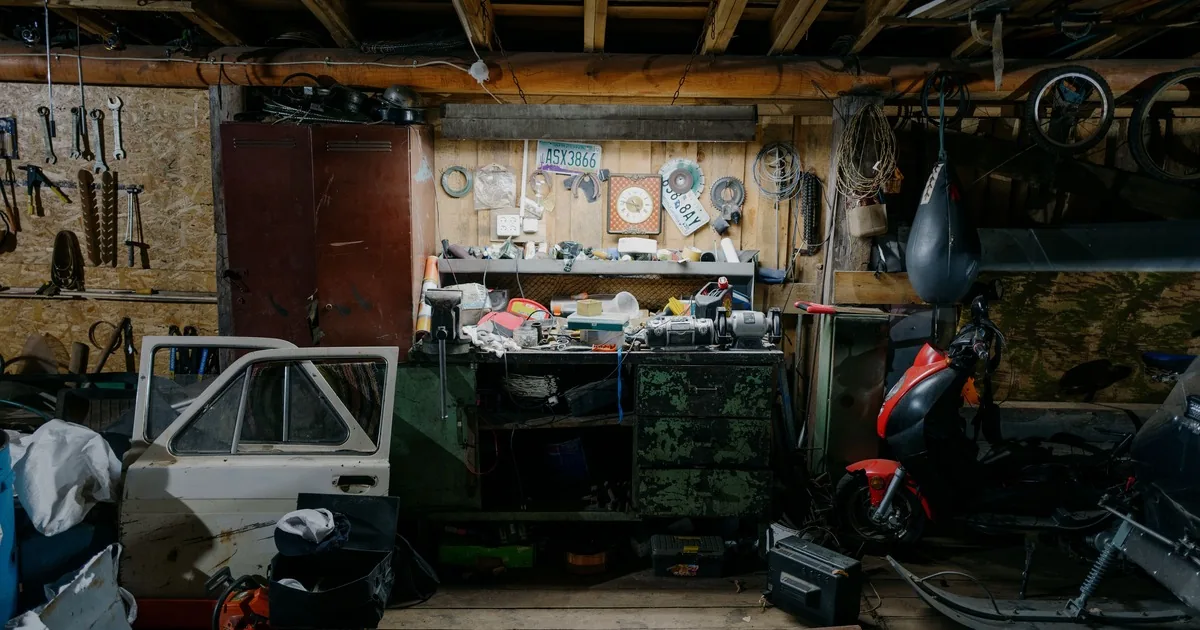
A daughter calls about cleaning out her father’s house. She says there is “a lot of stuff,” then lowers her voice and uses the word hoarding. The office still does not know whether her father wants help, whether she can authorize removal, which rooms are accessible, or whether the home contains sharps, animal waste, chemicals, or damaged utilities.
A useful hoarding cleanup service call intake begins with the requested outcome. Ask who will decide what leaves, map the rooms and crew route, record conditions that need trained review, and choose an estimate process that matches what can actually be seen. Use the caller’s words when practical. Describe the property without labeling the person.
Start with what the caller wants done
“Tell me what you would like the home to be like when the work is finished” is a better opening than asking how bad the hoarding is. One caller may need a path cleared for a repair technician. Another may want a kitchen and bathroom made usable. A family handling an estate may be requesting a full cleanout. Those are different jobs.
Ask which rooms are in scope and which must remain untouched. Is the goal removal only, or does the caller expect sorting, bagging, donation handling, appliance disconnection, cleaning, pest treatment, document review, or storage? A junk removal company should name what it provides and what belongs with another contractor.
The International OCD Foundation’s hoarding education describes hoarding disorder as a clinical condition involving persistent difficulty discarding possessions and clutter that compromises the intended use of living areas. That context matters because forced or careless disposal can carry real distress. It does not give a hauling office permission to diagnose a caller. The work order should say “bedroom doorway blocked by stored boxes” or “caller reports three rooms inaccessible,” not “severe hoarder.”
Neutral notes are also more useful to dispatch. They tell the estimator what can be observed and verified.
Confirm who can authorize removal
Before discussing price, establish who owns the belongings and who can make disposal decisions. The person calling may be the resident, a relative, a landlord, a property manager, an executor, a guardian, or a social-service contact. A key to the house does not by itself answer who can approve removal.
Ask who will be present for the estimate and the work. If the resident will decide item by item, record that. If a relative says everything goes but the resident says otherwise, pause the booking under company policy. Legal authority varies by circumstance and location, so the receptionist should gather names and roles without interpreting documents or giving legal advice.
Sorting can consume more of the appointment than carrying. Ask whether the removal list is complete, whether closed boxes may be opened, and how papers, photographs, medication, cash, jewelry, keys, firearms, identification, and family records should be handled. The office should never assume that an item is unwanted because it appears damaged or buried.
A practical note might read: “Resident will identify removal items in the living room and kitchen. The upstairs bedrooms are outside scope. Daughter will be present but will not approve disposal without resident confirmation. Crew must stop and ask about documents, photographs, medication, and locked containers.”
The estate cleanout intake guide is a closer fit when the resident has died and an executor or family representative is directing a multi-room clearout. This article addresses the added sensitivity and service boundaries that arise when the person and possessions remain part of an active household.
Map the rooms and the route through them
“Three-bedroom house” says little about crew access. Build a room list. For each requested space, ask whether the door opens, whether a person can enter, whether the floor is visible, whether material reaches shelves or ceiling height, and whether closed cabinets, closets, crawlspaces, an attic, a basement, or an attached garage are included.
Then trace the physical route. Which entrance will the crew use? Are the steps, hallway, stair landing, and exterior path open? Can a large item pass without moving possessions that must stay? Are there weak floors, damaged stairs, loose railings, low ceilings, or doors that cannot fully open? Record what the caller reports and leave the safety judgment to a trained field reviewer.
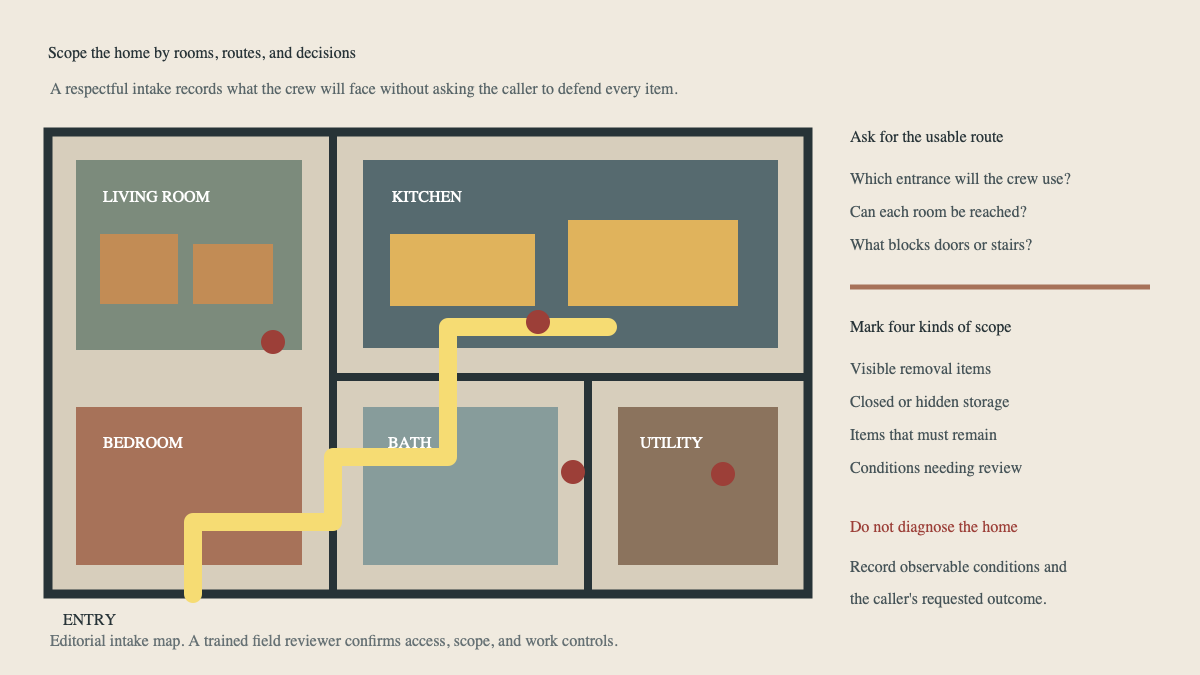
Photos should respect privacy and serve a clear purpose. Ask for a doorway view of each room in scope, the expected carry route, the loading area, and close views of any condition the company needs to review. Do not ask the caller to climb over material, move unstable piles, open leaking containers, handle needles, or enter a room they consider unsafe.
Volume still matters, but do not reduce the home to a truck fraction before sorting and access are understood. Visible bags and furniture may sit in front of full closets. Loose paper can hide dense objects. A narrow route can change the work even when the pile looks modest. The general junk removal pricing-call guide explains how volume, labor, disposal, and access interact across ordinary hauling jobs.
Screen observable conditions without diagnosing them
Use direct, matter-of-fact questions. “Are there any needles or other sharp objects?” is clearer than asking whether the home is hazardous. Ask about human or animal waste, dead animals, heavy rodent or insect activity, mold-like growth, strong chemical odors, leaking containers, fuel, propane, pesticides, paint, batteries, firearms, ammunition, spoiled food, broken glass, standing water, sewage, disconnected utilities, and structural damage.
The purpose is routing. A general hauling crew may accept some conditions under a documented policy and refer others to a trained remediation provider. The call handler should not decide exposure controls during the call.
OSHA’s bloodborne pathogens overview notes that needlesticks and other sharps-related injuries can expose workers to bloodborne pathogens. If a caller reports loose needles, do not tell them to pick them up for the crew. Record the location, keep the area undisturbed, and route the inquiry through the company’s trained review process.
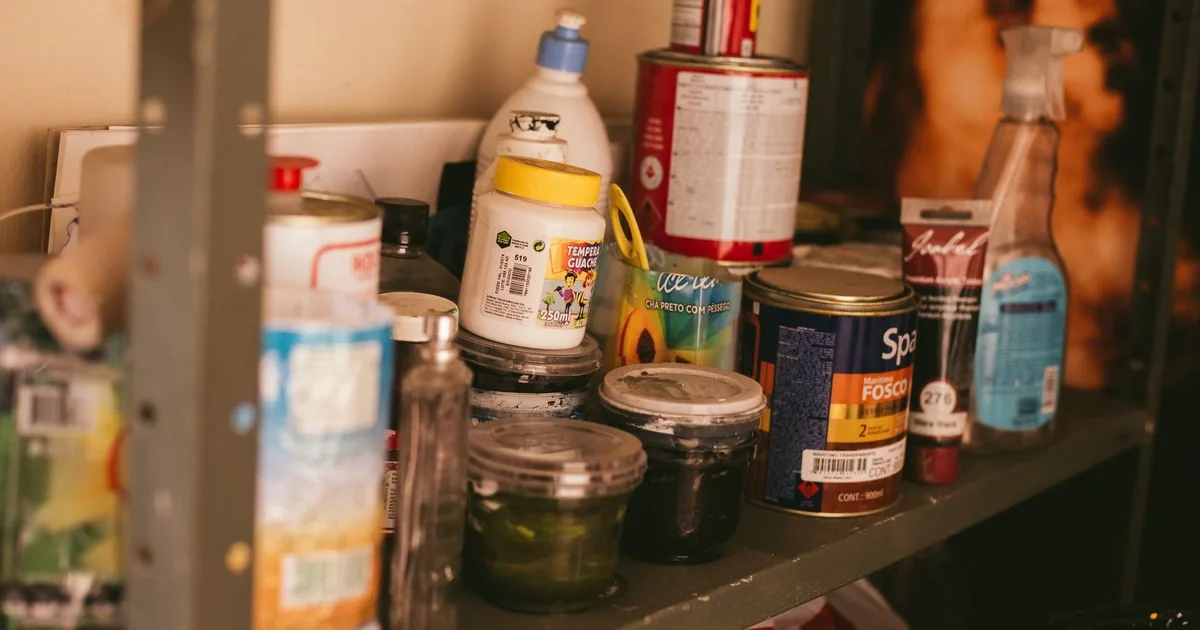
The EPA household hazardous waste page identifies paints, cleaners, oils, batteries, and pesticides as products that may contain hazardous ingredients and require special care. Local programs and receiving facilities set their own acceptance rules. A receptionist should capture the product name, container condition, and visible leak, then confirm policy before promising removal. Never advise the caller to mix, drain, or consolidate unknown products.
CDC publishes specific precautions for cleaning areas contaminated by rodents. That is enough reason to keep heavy droppings, nests, dead rodents, or contaminated insulation outside an ordinary phone promise until a qualified reviewer determines the service and controls required.
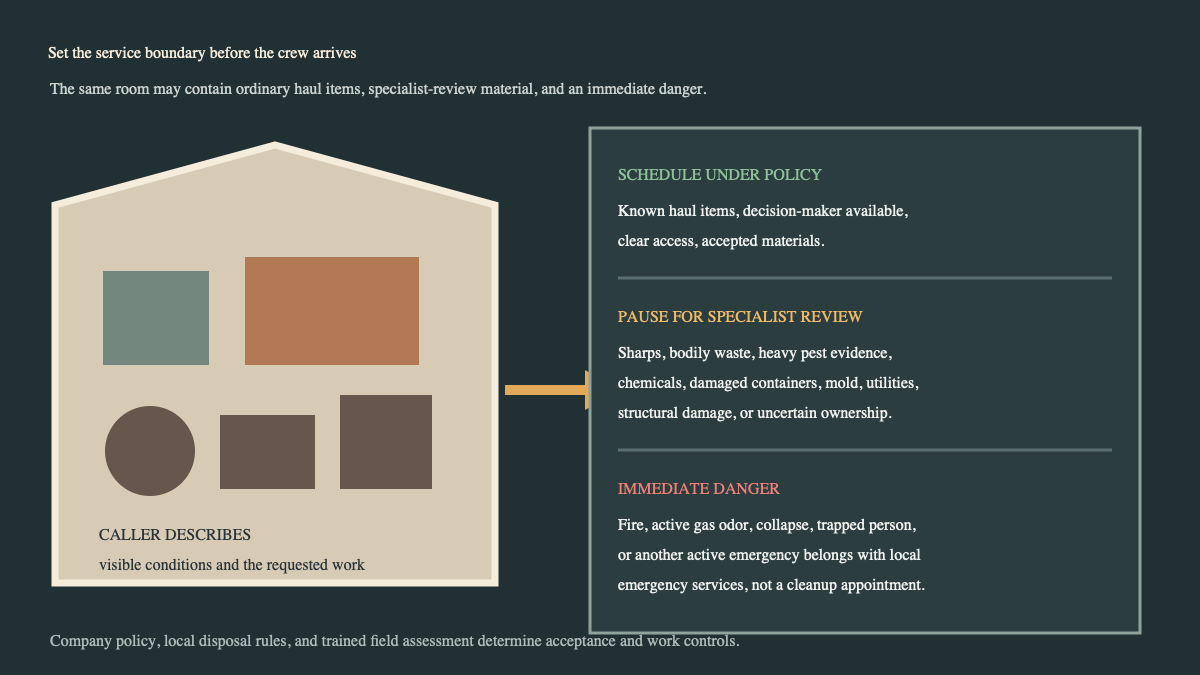
An active emergency has a separate path. Fire, a strong gas odor, an ongoing collapse, a person trapped or unable to exit, or another immediate threat belongs with local emergency services. Do not turn it into the next available cleanup slot.
Choose an estimate process that protects everyone
A small, clearly separated removal list may support a phone or photo estimate under the company’s normal policy. Whole-home work usually deserves a field assessment when access is limited, possessions remain undecided, hidden storage is substantial, or specialist-review conditions are present.
Set expectations before the visit. Explain who needs to attend, which rooms the estimator must see, what photos or authority documents the company requests, and which conditions remain subject to review. If the business does not provide deep cleaning, pest treatment, biohazard remediation, document sorting, or utility disconnection, say so plainly.
Read the scope back without judgment: “You are requesting an onsite assessment for the living room, kitchen, hallway, and attached garage. Your father will decide what leaves and will be present. The bedrooms are outside scope. The front path is open, but the kitchen doorway is partly blocked. You reported rodent droppings in the garage, two boxes of paint, and loose medication. Those items and conditions need review before we confirm acceptance or schedule the crew.”
That record gives the field reviewer a usable starting point. It also gives the caller control over the next step.
An AI receptionist can collect the same neutral fields after hours, but a person with the right authority still decides what leaves. Company policy and trained field staff decide how the work proceeds.
The best first call leaves the caller with one clear appointment, a written scope, and no surprises about the company’s boundaries.
Sources
- International OCD Foundation: About Hoarding
- US EPA: Household Hazardous Waste
- OSHA: Bloodborne Pathogens
- CDC: Cleaning Up After Rodents