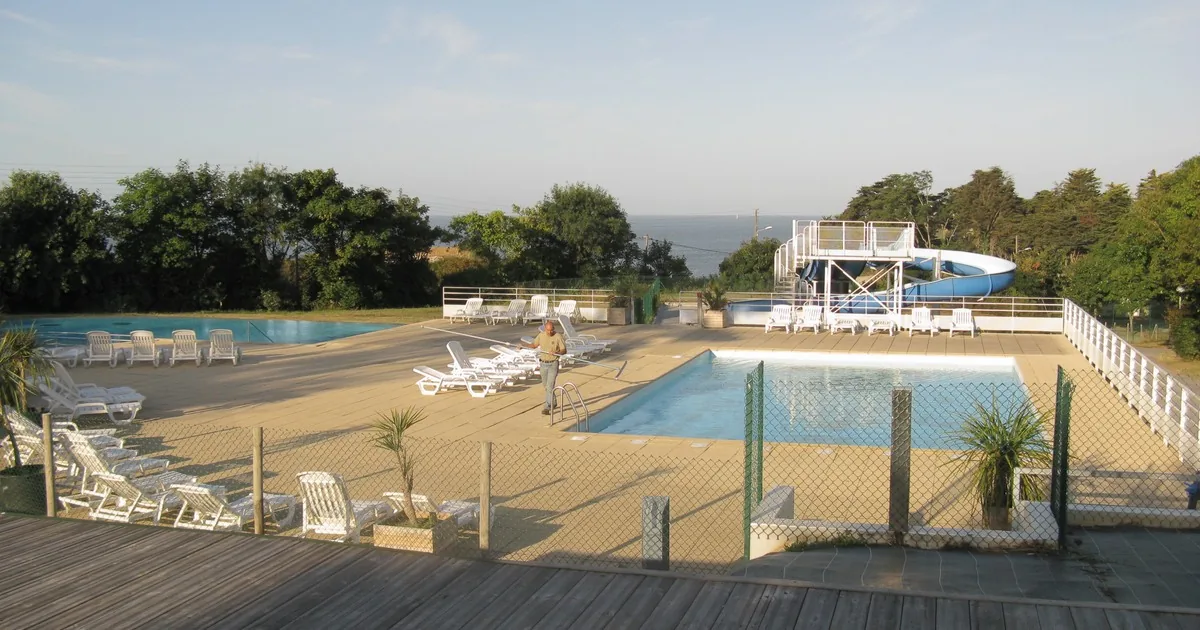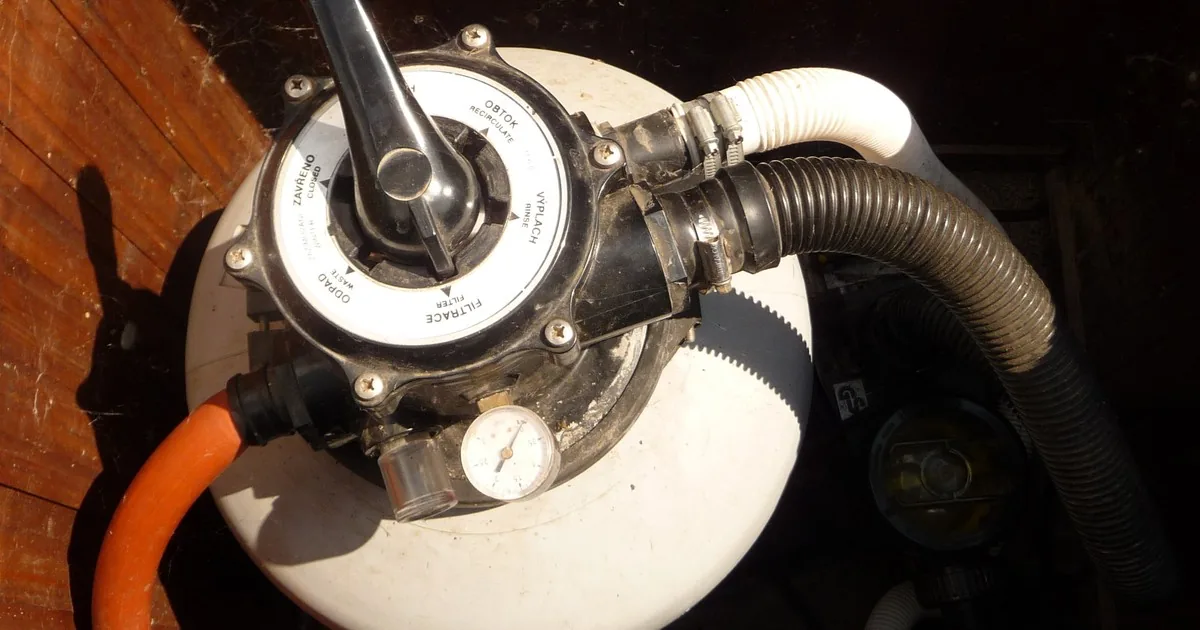
The caller says, “My pool pump stopped working,” but that can describe very different appointments. The motor may be silent. It may hum without moving water. The pump could run while the filter gauge climbs, or water may spray from the equipment pad as soon as the timer starts. Sometimes the pump is fine and a closed valve is the whole problem.
A pool service office should gather the symptom, equipment identity, recent work, water condition, and any immediate safety concern before choosing a time slot. Do not diagnose the failure or coach the caller through opening a pressurized filter. The useful outcome is a work order that tells the technician what is happening and which manuals, tools, and likely parts belong in the truck.
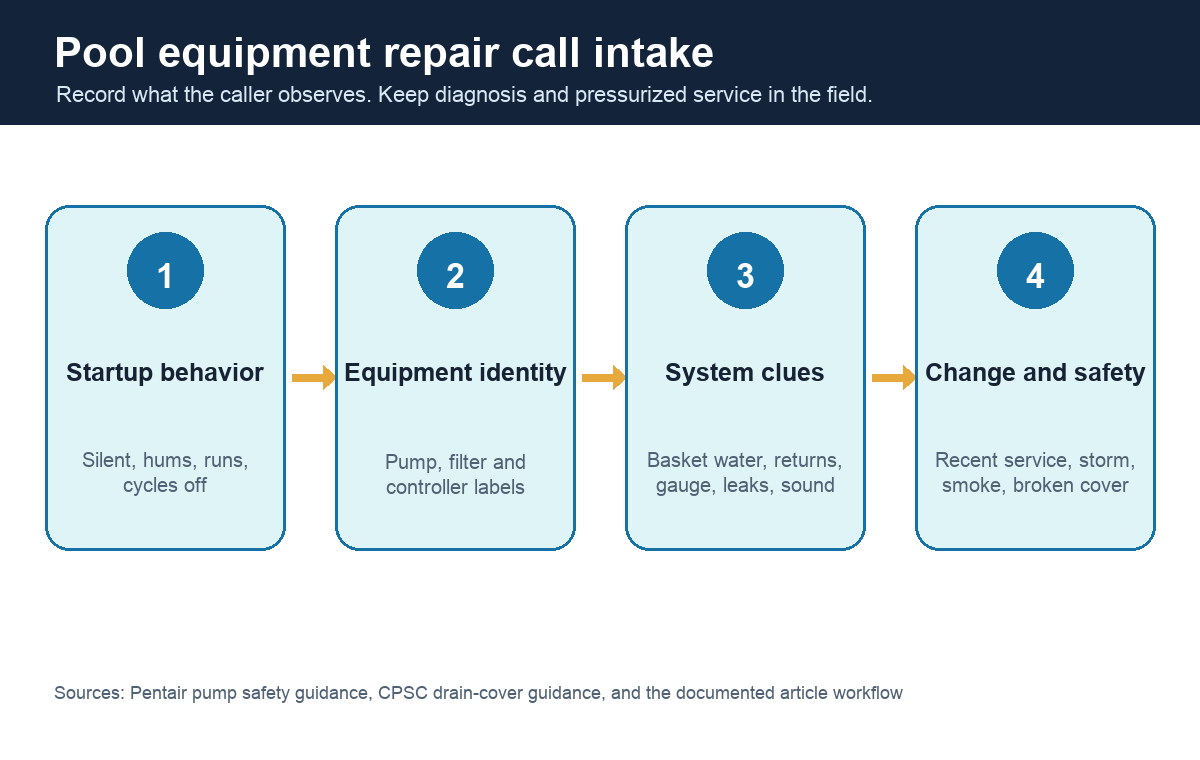
Start with what the equipment is doing right now
“Is the pump broken?” produces a yes or no answer with little value. Ask the caller to describe what happens when the system is scheduled to run.
First, find out whether the pump has power. Is the display lit? Does the timer show an active schedule? Did a breaker or ground-fault device trip? A silent pump with a dark control panel belongs in a different diagnostic lane than a motor that starts and shuts itself off. Office staff can record what the caller sees. They should not tell someone to reset a breaker repeatedly or remove an electrical cover.
If the motor runs, ask about water movement. Can the caller see water entering the pump basket? Are the return jets moving water? Is there a steady stream of bubbles from the returns? A basket that stays mostly empty while the motor runs points the technician toward a priming or suction-side investigation, but the ticket should preserve the observation: “motor runs, basket does not fill.” That is better than an office-made diagnosis such as “bad pump.”
Sound matters too. Humming, grinding, rattling, screeching, and ordinary motor noise are distinct field clues. Ask when the sound began and whether it changes after startup. Then ask the caller to turn the system off if there is smoke, a burning smell, sparking, or water reaching electrical equipment. Route that ticket for prompt review.
Separate a pump symptom from a filter symptom
The pump moves water. The filter adds resistance as it catches material. Callers often use either name for the whole equipment pad, so intake has to establish which behavior they noticed.
Ask what the filter pressure gauge reads while the pump is running, if it is safe to view from a distance. Record the number and the pump speed shown on the controller. A pressure reading without the operating speed can mislead a technician on a variable-speed system. Also ask whether the gauge returns to zero when the pump is off. Do not ask the caller to loosen the gauge, clamp, lid, or air-relief assembly.
The most useful comparison is the customer’s normal clean-filter reading at the same pump speed. A gauge above that baseline, paired with weak return flow, gives the technician a different starting point than a low reading with air visible in the pump basket. If the caller has no baseline, write “unknown.” Manufactured precision is worse than a blank field.
Identify the filter type. Cartridge filters contain removable elements. Sand filters and diatomaceous earth filters commonly have a multiport or backwash valve, though configurations vary. Ask whether the filter was recently cleaned, backwashed, opened, or reassembled. Problems that start immediately after service deserve that detail near the top of the ticket.
Filters operate under pressure. Pentair’s pump installation guidance directs users to shut off power, open the manual air-relief valve, wait for system pressure to be relieved, and stand clear during startup. That is a service procedure, not a phone experiment. If the caller reports a leaking clamp, bulging tank, damaged lid, or pressure that does not release normally, have them stop the pump and wait for a qualified technician under your company’s safety policy.
Get the labels before the technician gets the keys
A photo of the equipment pad often saves more time than a long description. Request one wide shot that shows the plumbing and valves, then close photos of the pump label, filter label, controller display, pressure gauge, and the exact leak or damaged area. The technician needs readable model numbers, not a photo taken across the yard.
Capture these details in the work order:
- Pump manufacturer, model, horsepower or service-factor label information, and whether it is single-speed or variable-speed
- Filter manufacturer, model, and type: cartridge, sand, or diatomaceous earth
- Controller, timer, or automation brand and any displayed error code
- Current gauge reading, normal clean-filter reading if known, and displayed pump speed
- Visible water in the pump basket, bubbles at the returns, and any leak location
- Sound or smell reported at startup
- Date of the last filter service and what work was performed
- Attached spa, heater, salt system, cleaner booster pump, or water features on the same pad
- Photos received and which labels remain unreadable
Model numbers matter because lids, seals, baskets, cartridges, motors, drives, and clamp assemblies are not interchangeable across every product family. “Blue filter tank” does not help at the parts counter. A sharp label photo does.
Ask what changed before the failure
Equipment calls become easier to scope when the office captures the last normal day and the first abnormal one. Ask whether the problem followed a storm, power outage, freeze, pool opening, filter cleaning, plumbing repair, or automation change. If a landscaper worked near the pad or someone moved valves, record that too.
Recent service is especially important. A pump that lost prime after the basket lid was opened may call for one line of investigation. A filter that leaked after its elements were cleaned raises another. Keep the language neutral. The office is building a timeline, not assigning blame.
Ask whether the pool water level is normal and whether skimmer openings appear blocked by leaves. The caller can answer from the deck. Do not direct anyone to reach into a suction fitting, remove a drain cover, or enter cloudy water. The Consumer Product Safety Commission explains that pool and spa drain covers are subject to federal entrapment-protection requirements. A loose, broken, or missing suction cover should be treated as a safety issue. Keep swimmers out and escalate the call according to company policy.
Decide whether this is an equipment repair or a larger recovery visit
A failed circulation system affects more than the equipment pad when it has been down for days. Ask how long the pump has been off and what the water looks like now. Clear water with a pump that failed this morning is a focused equipment appointment. Cloudy water, visible algae, heavy debris, or a pool that has sat without circulation may require water testing, cleanup, and follow-up after the mechanical repair.
Do not promise that replacing one component will make the water ready for swimming. CDC guidance for public aquatic venues calls for filtration and recirculation systems to be maintained according to manufacturer recommendations. Residential pools differ in their oversight, but the operating principle still holds: circulation, filtration, and water treatment work together.
If the water is already green, route the caller through your recovery intake as well. The related guide on green-pool recovery service calls covers visibility, recent chemical additions, sanitation equipment, and event deadlines. Combining both sets of notes keeps the technician from arriving for a motor swap and discovering an opaque pool that needs a separate plan.
Quote the visit you can defend
Equipment labels and symptoms improve preparation. They do not turn phone intake into a confirmed repair estimate.
Explain what the first appointment includes under your actual policy: diagnostic time, any service-call charge, and the approval process before parts are installed. If the company applies the diagnostic charge to approved work, say so exactly as written in policy. If it does not, leave that promise out. The same rule applies to warranty coverage. Record the purchase date, installer, and any warranty documents the customer has, then let the manufacturer or authorized servicer decide coverage.
Avoid promising a pump, motor, drive, seal, gauge, or filter element before inspection. Two callers can report weak flow and need different repairs. One has an air leak at the pump lid. The other has a loaded filter and a damaged gauge. A useful phone answer is plain: “We’ll document the model and symptoms so the technician can diagnose the system on site. They will explain the repair and price before approved work begins.”
Scheduling should account for access. Confirm the service address, gate process, pets, equipment-pad location, and whether an adult or authorized property contact must be present. Ask whether the pool serves a single home, apartment community, hotel, school, or other commercial property because approval and closure procedures differ.
Build the ticket around observable facts
The best pump-and-filter ticket reads like a short field report. “Variable-speed pump display lit. Motor hums, basket stays half full, bubbles at returns. Gauge reading and pump speed captured; customer does not know the clean-filter baseline. Problem began after basket cleaning. Customer reports no leak, smoke, or burning smell. Photos attached.” A technician can work with that.
A generic note that says “pool pump broken” forces a second intake call, usually while the technician is loading the truck. Human receptionists and AI receptionists can follow the same safe question path, but the handoff should preserve the customer’s observations and mark unknowns honestly.
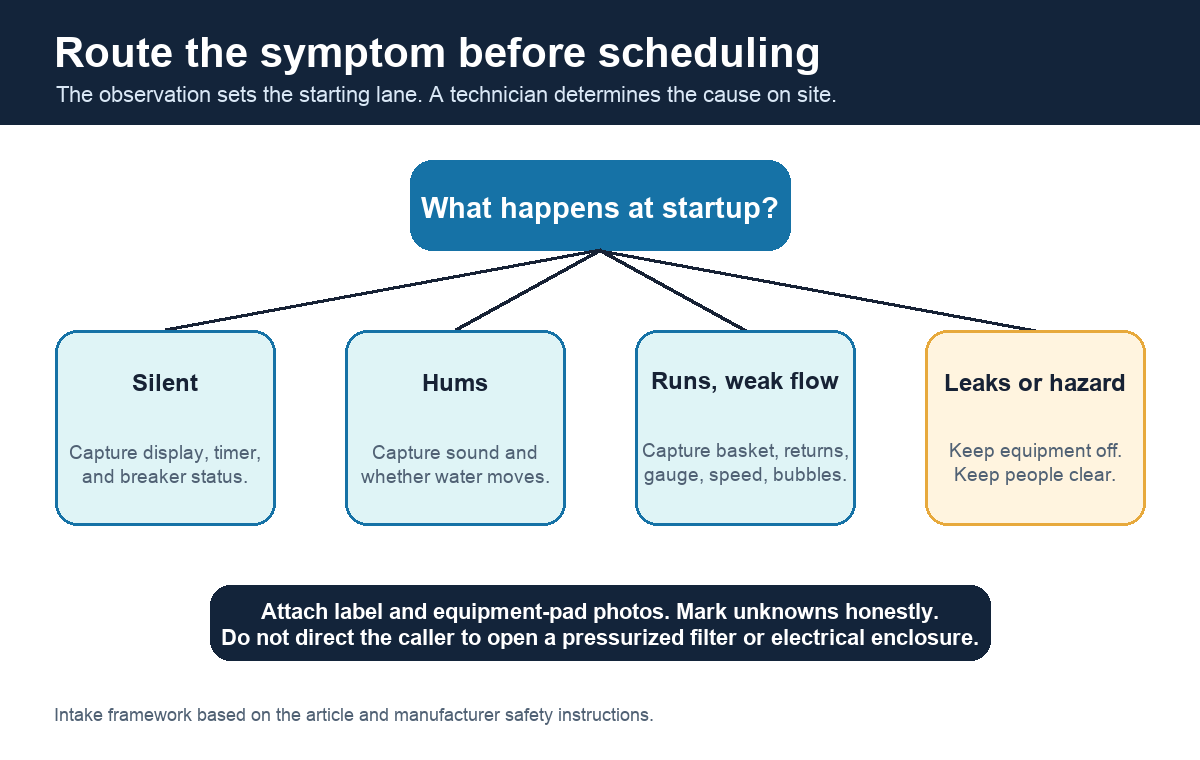
When the next caller says the pump “just quit,” start with the startup behavior. By the time the call ends, the technician should know what the system did, what equipment is installed, what changed, and whether anyone needs to stay away from the pool or equipment pad until help arrives.