A homeowner calls on Saturday morning and says, “The pool was clear yesterday. Now it looks milky, and we have people coming over.” The office should answer the safety question first: if the caller cannot clearly see the deepest part of the pool floor, nobody should swim until the water has been assessed.
Then slow the call down. Cloudy water can come from chemistry, circulation, filtration, suspended air, algae, debris, or a recent product addition. The right booking questions build a timeline and map visible clues to the pool’s circulation loop. Reception can do that in five minutes without trying to diagnose the water or prescribe a chemical dose.
Start with visibility and keep swimmers out
Ask the caller to stand on the deck and look toward the deepest point. Can they see the main drain, a contrasting floor fitting, or the tile pattern clearly? Record the answer in plain words. “Drain outline visible but screws are not” tells the technician more than “a little cloudy.”
The Pool Water Treatment Advisory Group’s cloudy-water technical note uses deepest-point visibility as the first test of whether a pool should remain in use. Its guidance is written for operators, often at public facilities, but the visibility problem applies at a home too: a person under the water is harder to see when the bottom disappears.
Do not ask the caller to enter the pool for a closer look. Keep children, guests, and pets away from the water while visibility is poor. If there has been a chemical spill, strong fumes, eye or breathing irritation, electrical trouble, or a person in distress, stop ordinary scheduling and follow the company’s emergency escalation policy.
Color belongs on the ticket, but it does not settle the cause. Ask whether the water looks white, gray, pale blue, greenish, or brown. Note whether the change affects the whole basin or forms a cloud near one return jet. Ask whether particles settle when the pump is off. Photos taken from the same deck position in daylight are useful.
Build a timeline before discussing causes
The best intake question is simple: “When did you last see the water clear?” Anchor the rest of the call to that time.
Ask what happened next. A crowded swim day, heavy rain, windblown dirt, landscaping dust, a refill, a long power outage, filter service, or a chemical addition can narrow the technician’s first checks. The CDC notes that sunlight and contaminants carried by swimmers, including sweat and dirt, can reduce chlorine concentration. Those facts do not prove why this pool turned cloudy. They tell the office which recent events matter.
Capture these details in order:
- Last known clear time, first cloudy time, and whether the change was sudden or gradual
- Recent rain, dust, construction, heavy use, refill water, power loss, or equipment work
- Every product added during the previous few days, with the label name, amount if known, and time added
- Whether the pump was running before, during, and after the change
- Any green film, slippery steps, wall spots, floating debris, unusual odor, foam, or visible scale
- What the customer already tried and whether the appearance changed afterward
A caller may say, “I shocked it twice.” Ask for a photo of the container and record the stated amount. “Shock” can refer to different products. The office should not translate that phrase into an assumed ingredient or concentration.
This timeline also separates cloudy water from a true green-pool recovery. If the water is green, surfaces show algae, debris is heavy, or the pool has sat without circulation, use the green-pool recovery intake. A blue or gray pool with a sudden haze may need a different first visit.
Map the circulation loop from the phone
Pool water leaves through the skimmer and floor suction points, passes through the pump and filter, then returns to the basin. A useful cloudy-pool ticket follows that route.
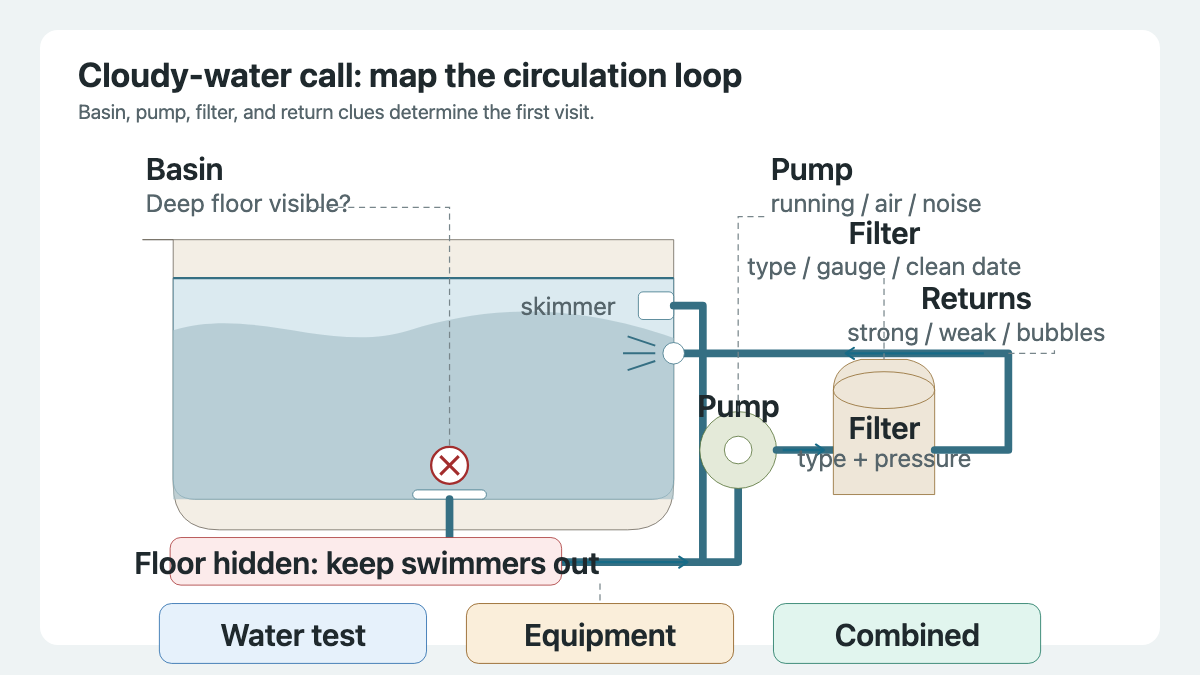
Start at the basin. Ask whether the water level reaches the usual point on the skimmer opening and whether skimmer baskets are visibly packed with leaves. Do not coach the caller to remove lids, reach into suction points, or operate unfamiliar valves.
Move to the pump. Is it running now? Does the clear lid, if safely visible from outside the equipment area, appear full of water or full of air? Has the caller noticed rattling, grinding, cycling, leaks, or a pump that lost prime? A silent pump after a breaker trip belongs on the work order, not inside a chemistry-only appointment.
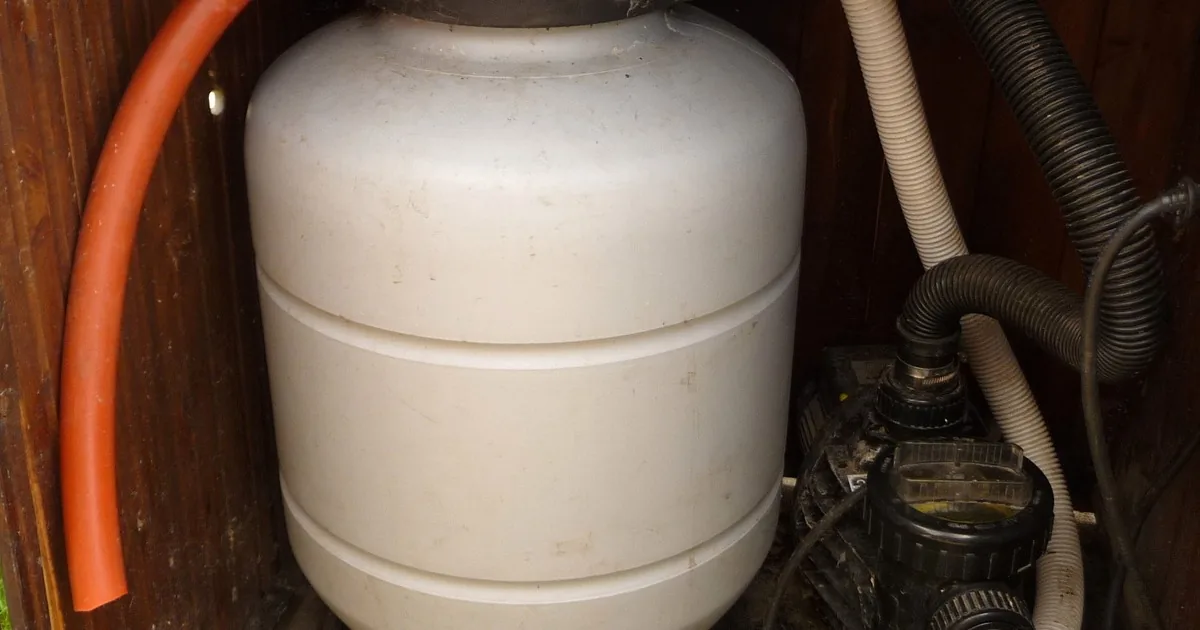
Next comes the filter. Record whether it is cartridge, sand, or diatomaceous earth if the caller knows. Ask for a wide equipment-pad photo and a close photo of the filter label and pressure gauge. Capture the current reading without judging it against a universal number. A pressure value becomes meaningful when the technician can compare it with that system’s clean baseline and current flow.
Finish at the returns. Ask whether water movement feels normal, weak, uneven, bubbly, or absent, provided the caller can observe it safely from the deck. Cloudiness concentrated near a return can be especially useful to photograph. PWTAG lists circulation failure, excessive air, scale precipitation, algae, and inadequate filtration among separate causes of cloudy water. One appearance can reach the pool through very different mechanisms.
If the pump will not prime, route the ticket through the pool pump priming intake. If the complaint centers on a leaking filter, damaged tank, failed gauge, or silent pump, add the pump and filter repair questions.
Record chemistry without prescribing a dose
Ask whether the caller has current free chlorine and pH readings. Record the numbers, sample time, test method, and who performed the test. A strip result, drop kit, digital reader, and store printout should not be treated as interchangeable evidence.
CDC home pool treatment and testing guidance recommends routine chlorine and pH testing. It also warns that chlorine above 10 ppm can partially or fully bleach some tests, which can create a false low or zero reading. That is a good reason to preserve the method and circumstances instead of copying two numbers into the ticket without context.
Request a photo of any recent test result and product label. Record whether the pool uses stabilized chlorine, a salt system, bromine, another sanitizer, or an automatic feeder. Note whether the feeder is empty, displaying an alarm, or switched off. Reception should not tell the caller to mix products, change controller settings, open a pressurized filter, or add “one more bag” before the technician arrives.
Pool volume matters for treatment, but a rough phone estimate is still useful for dispatch. Ask for length, width, shape, and depth range, or the known gallon volume. Mark it as customer-reported. The technician can verify what is needed on site.
Route the first visit by evidence
A water-test visit fits a pool with normal-looking circulation, no equipment symptom, and a clear recent-event timeline. The technician still decides the treatment after testing. Reception only selects the appointment lane.
An equipment-diagnostic visit fits a pump that will not run or prime, weak or absent returns, persistent air, an abnormal gauge complaint, a leak, or a filter problem. Water chemistry may need attention too, but the ticket should carry the tools and time for mechanical diagnosis.
Book a combined appointment when poor visibility arrives with equipment trouble, when the history is uncertain, or when the caller expects the technician to restore clarity and investigate why it was lost. Avoid promising one visit. Suspended material may need continued circulation, filter service, retesting, or a return after the first correction.
The final ticket should read like this:
“Water turned milky blue between Friday evening and Saturday morning after a pool party and overnight rain. Deep-end drain outline is visible; detail is not. No swimming advised. Pump runs, lid shows intermittent bubbles, and two returns feel weaker than usual. Cartridge filter; gauge reads 18 psi, clean baseline unknown, last cleaned six weeks ago per customer. Free chlorine and pH strip photos attached. Customer added one labeled bag of calcium hypochlorite at 8 p.m. Friday. Combined water test and circulation diagnosis booked. Rear gate code confirmed; dog will be inside.”
That note gives the technician a starting point before the truck reaches the driveway. It also gives the customer a sober expectation: observe first, test on site, and match the repair to the system that is actually there.