A customer says the pool cleaner “just sits there.” That could describe a suction-side cleaner with weak flow, a pressure-side unit whose booster pump never starts, or a robotic cleaner showing a red light beside the pool. The symptom sounds identical. The service routes are different.
Start with the cleaner type and exact behavior. Ask for the brand and model, whether a hose or electrical cable is attached, where it connects, and what else in the pool is running normally. Then record whether the cleaner is completely still, moves slowly, starts and stops, travels in circles, or moves without collecting debris. Those answers give dispatch a usable ticket without asking reception to diagnose a turbine, wheel drive, motor, or pool pump.
Identify what makes this cleaner move
Many callers use “pool vacuum,” “robot,” and “automatic cleaner” interchangeably. Do not build the appointment around the customer’s label. A few physical details identify the family.
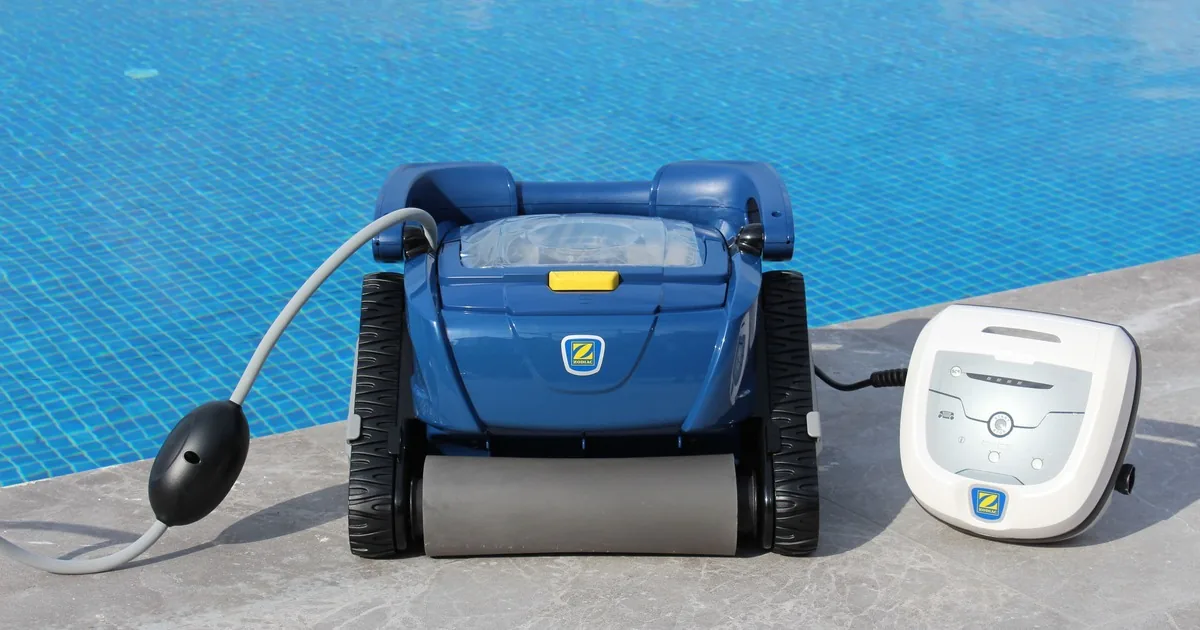
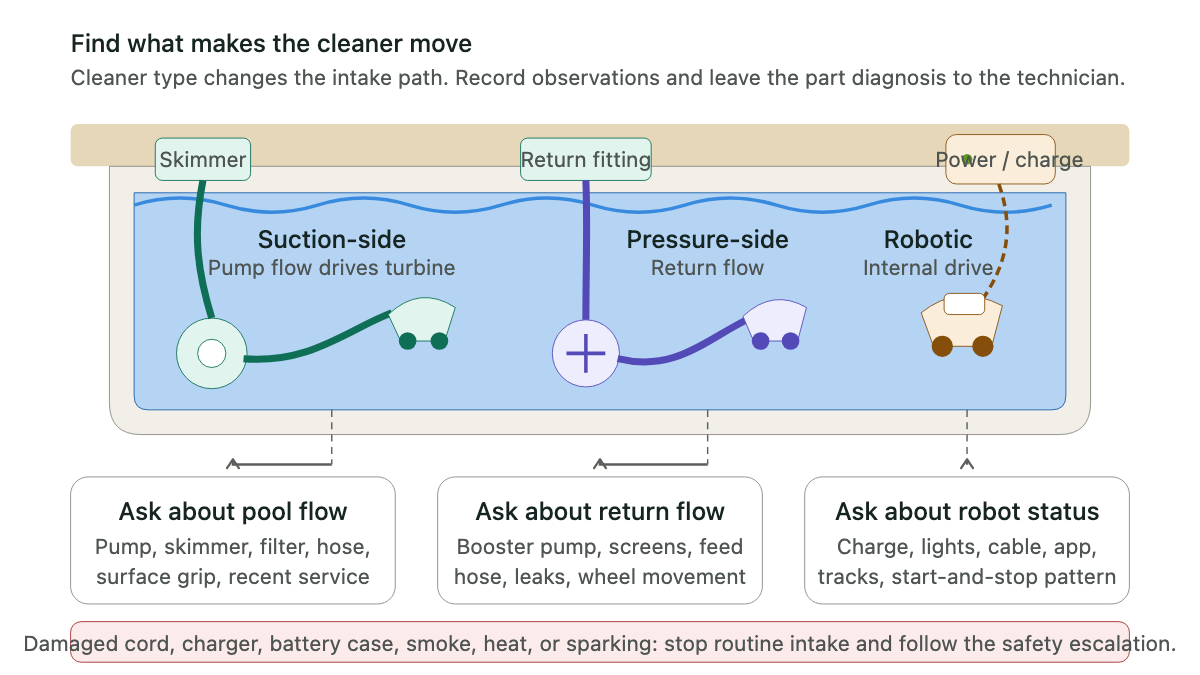
A suction-side cleaner connects by hose to a skimmer or dedicated suction port. Water pulled toward the pool pump drives the cleaner. A pressure-side cleaner connects to a return fitting and uses water sent back toward the pool; some systems include a separate booster pump. A robotic cleaner has its own drive system and uses a power supply, floating cable, or onboard battery.
Ask the caller to describe the connection without removing it. Useful questions include:
- Is there a flexible hose leading to the skimmer, a wall fitting, or a deck-side unit?
- Does a separate switch or timer normally start a booster pump?
- Is there an electrical cable, charging connector, battery indicator, app, or power-supply box?
- What brand and model appear on the cleaner and any deck-side power equipment?
A safe photo usually settles the question. Request one wide view of the cleaner in the pool and one close view of the exterior model label. The caller should stay on a dry, stable surface and should not pull, disconnect, open, or lift equipment merely to take the picture.
Turn “not moving” into a precise symptom
Ask what happened during the most recent normal cleaning cycle. Did the cleaner remain still from the start, travel a few feet and stop, creep more slowly than usual, or repeatedly return to the same corner? Does it move only when the main pool pump runs? Does the robot show a light or message before it stops?
Movement and cleaning performance also need separate fields. A cleaner may travel normally while leaving debris behind. Another may collect debris but fail to climb a wall. Circling, one-direction travel, tangled hose, poor wall climbing, weak pickup, and complete loss of motion are distinct complaints in manufacturer manuals. A ticket that says “cleaner moves, but the basket stays empty” is much more useful than “vacuum broken.”
Capture when the problem began and whether it followed a storm, pool opening, filter cleaning, equipment-pad repair, hose replacement, app update, battery storage, or heavy leaf load. Record the change as timing, not proof of cause.
If the caller has already tried something, write down exactly what. “Reset cleaner” reveals little. “Customer turned the robotic cleaner off, charged it until all charge indicators were green, placed it in the water, and it stopped after ten seconds with a red light” preserves the sequence a technician can use.
For suction-side cleaners, record the pool’s flow picture
Hayward explains that its suction cleaners need enough water flow past the turbine to operate. Its official support guidance also names worn shoes, a slippery pool surface, internal debris, and drivetrain wear as possible movement problems. Those details explain why the office needs observations before choosing a route. They do not give reception a universal repair script.
Ask whether the main pool pump is running and whether water appears to return to the pool normally. Find out whether the skimmer basket or pump basket was recently emptied and whether the filter was serviced. Ask if the hose looks flattened, split, loose, kinked, or full of air. Do not tell the caller to put a hand over an open suction line or reach into the skimmer while equipment is operating.
Pool condition belongs in the notes too. If the cleaner slips on one surface, cannot leave the deep end, or started struggling during an algae problem, state that plainly. Include the surface type if the customer knows it. Plaster, tile, vinyl, and fiberglass can use different cleaner shoes or components on some models.
A broader circulation complaint may belong with a pool pump and filter service call. If the pump has lost prime, returns are weak, or air is visible throughout the system, avoid promising that cleaner service alone will solve it.
For pressure-side cleaners, ask about the feed path
Pentair’s Racer LS manual tells owners to consider filter-pump and booster-pump operation when that pressure-side cleaner does not move or moves slowly. Its troubleshooting table also names wall and in-line debris screens, feed-hose leaks, cleaner flow, debris in drive-wheel teeth, and rear-wheel condition. Treat these as categories to document. Exact tests and adjustments remain model-specific.
Ask whether the filter pump and booster pump normally run together and whether either is silent now. Record any pump alarm, breaker trip, unusual noise, visible water leak, or schedule change. Ask whether the cleaner’s feed hose floats as usual and whether water visibly escapes from a split connection or swivel.
If the booster pump will not start, the cleaner itself may be only one part of the visit. If the booster pump runs and the feed hose has obvious pressure but the cleaner remains still, cleaner inspection may be the narrower scope. Phrase both as observations. The field technician still has to confirm the failure.
Do not coach a caller through wall-fitting removal, screen service, valve changes, wheel-speed timing, or flow adjustment unless the company has a model-specific, approved support procedure. One manufacturer’s target does not transfer safely to another cleaner.
For robotic cleaners, preserve power and error evidence
A robotic cleaner has its own motor and control system, so a running pool pump does not prove the robot should move. Start with the power source. Is the unit corded or cordless? Does the power supply turn on? How many charge indicators show? Is there an error light, code, app message, or audible alert? Ask for a photo or screenshot before the customer clears it.
Maytronics’ LIBERTY manual lists an object in the tracks or wheels, debris or hair at the impeller, insufficient charge, out-of-water operation, and a red error indicator among reasons a unit may not start. The same manual says to switch the cleaner off before examining it. It also directs owners to stop using damaged charging cords, batteries, or cleaner hardware.
The office can ask whether the caller sees a branch wrapped around a wheel or a visibly jammed track. Avoid directing anyone to reach into an impeller housing, remove guards, open a power supply, or perform an out-of-water motor test. Product instructions differ, and moving parts can start unexpectedly.
Record the charger or power-supply model along with the cleaner model. For a cordless unit, ask how and where it was stored and whether it accepts a charge. For a corded unit, record visible cable damage, a loose exterior connector, or a power-supply light without asking the caller to handle wet electrical equipment.
Stop routine intake when the scene is unsafe
Ask early about damaged cords, cracked charger cases, swollen or damaged battery housings, smoke, heat, burning odor, sparking, water inside electrical equipment, or repeated protective-device trips. A positive answer moves the call out of ordinary troubleshooting. Follow the company’s electrical or battery safety procedure and keep people away from the affected equipment under that policy.
Also ask whether anyone is in the pool. Manufacturer instructions commonly require removing or switching off a cleaner before examination, and powered equipment should never become a phone experiment while swimmers are present. The office should collect the condition and route it, not supervise hands-on work.
Physical access can change the appointment. Note a steep deck, locked equipment area, submerged cleaner in a deep pool, heavy unit, or customer who cannot safely retrieve it. Tell the customer what the technician needs accessible, but do not make unsafe retrieval a condition of booking.
Book the narrowest honest scope
Read the ticket back before scheduling. A useful summary might say:
“Corded robotic cleaner, model and serial label photographed. Power supply turns on with a red indicator. Cleaner begins moving, stops after about ten seconds, and has repeated the same pattern twice. Customer reports no visible cable damage, heat, odor, smoke, or water inside the power supply. Unit remains switched off. Gated backyard access; adult decision-maker will be home.”
A suction-side summary should name the connection, pump and return behavior, hose condition, pool surface, and exact movement. A pressure-side summary should include filter-pump and booster-pump behavior, visible feed-hose leaks, and whether the cleaner is still or merely slow.
State the diagnostic charge, appointment window, access needs, and whether the company services that brand in the field or requires bench evaluation. Do not promise a replacement motor, turbine, wheel kit, booster pump, cable, battery, or same-day repair before inspection.
The weekly pool maintenance intake guide covers recurring care requests, while the pool service resource hub collects repair and booking guides for the rest of the equipment pad. An AI receptionist can capture the same cleaner type, motion pattern, power or flow source, model evidence, and safety screen after hours. The technician should arrive knowing which machine is stationary and what normally makes it move.
Sources
- Hayward: Why doesn't my cleaner move?
- Pentair: Racer LS Pressure Side Pool Cleaner Installation and User's Guide
- Maytronics: LIBERTY Robotic Pool Cleaner User Instructions