The caller says, “The pool light stopped working,” and wants someone out before a party on Saturday. One wall light may be dark while two others still change color. Every light may have gone out after a power interruption. The caller may also mention flicker, a tripped protective device, or a tingling sensation in the water.
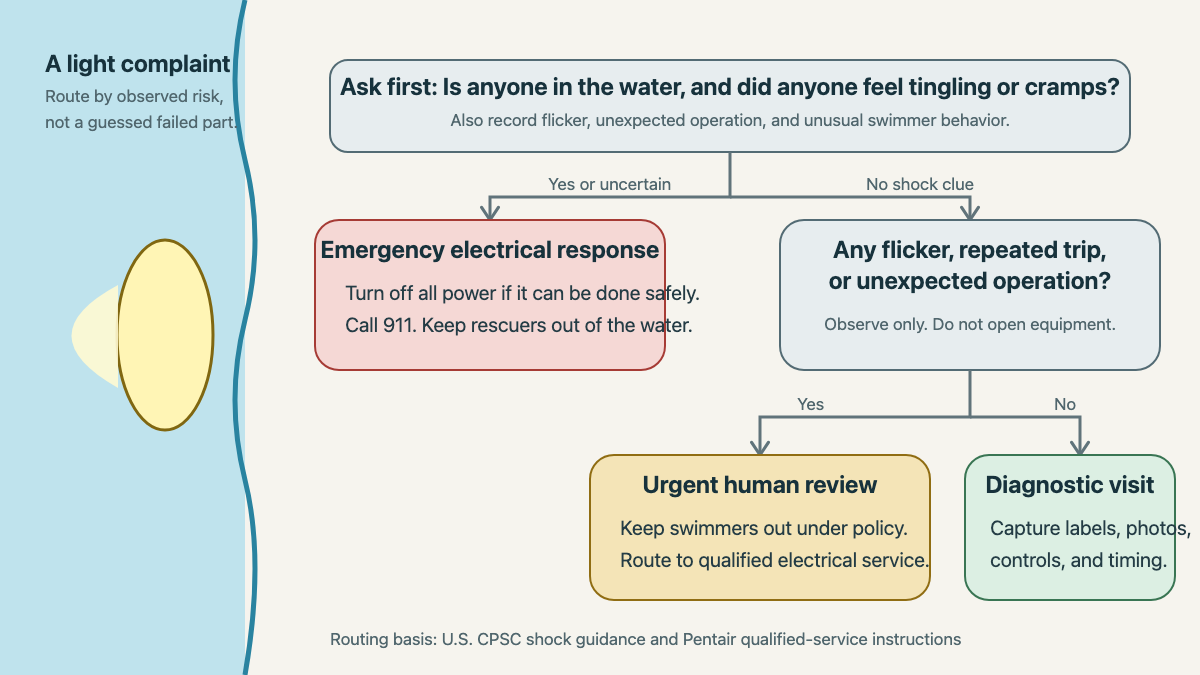
Start with the observed pattern and the safety screen. Ask which lights are affected, what each one does, how the customer controls them, when the problem began, and whether anyone felt tingling or muscle cramps in or near the water. A simple dark-light complaint can enter normal diagnostic intake. Suspected shock, swimmer distress, unexpected operation, repeated trips, or flicker calls for a different response.
Do not diagnose a bulb, LED engine, transformer, controller, seal, or wiring fault by phone. Underwater lighting combines electricity and water. The office’s job is to preserve useful facts, apply the company’s electrical safety rules, and send the right qualified person.
Start with the exact light behavior
“Is the light broken?” produces little more than yes or no. Ask the caller to describe what happens when they use the normal switch, automation panel, remote, or app.
Find out how many pool and spa lights are installed and which ones respond. Give each location a plain name in the ticket: deep-end wall, steps, spa bench, water feature, or landscape light beside the deck. If one underwater fixture stays dark while the others follow the same command, record that pattern. If every light on the system is dark, record that too. The field investigation starts in a different place, but reception should leave the cause open.
Then ask what “not working” means. Does the light remain completely dark? Does it flicker, illuminate only part of the lens, show the wrong color, fall out of sequence with the other lights, or switch on without the expected command? Does the problem appear every time or only after the light has been on for a while? Those descriptions help distinguish a steady failure from an intermittent one without assigning a failed component.
Capture the control behavior in the caller’s words. “App shows the lights on, three pool lights respond, spa light remains dark” is useful. “Bad spa bulb” is a guess. Many modern fixtures are sealed LED assemblies, while older wet-niche lights may use replaceable lamps. The model decides what can be serviced.
Stop the script when the call sounds electrical
The safety question belongs near the start because a lighting complaint can include a shock hazard. The U.S. Consumer Product Safety Commission lists underwater lights among electrical sources around pools. Its pool electrical safety guidance identifies tingling, muscle cramps, difficulty moving, unusual swimmer behavior, and flickering or improperly operating underwater lights as possible warning signs.
If anyone may be receiving an electrical shock, ordinary scheduling stops. Follow the company’s emergency script. CPSC advises turning off all power immediately and calling 911. A rescuer should not enter the water while power may still be present. Keep the response direct and do not turn the call into remote electrical troubleshooting.
Flicker, unexpected operation, visible fixture damage, water or condensation behind a lens, a protective device that trips again, or a customer who reports a shock sensation all need prompt human review under company policy. Tell the caller to keep swimmers out when the approved policy calls for it. Do not ask them to handle wet electrical equipment, remove a fixture, open a junction box, test voltage, or keep resetting a device that will not remain set.
Pentair’s Amerlite underwater-light instructions assign installation and service to a licensed or certified electrician or qualified pool service professional. The manual also requires power disconnection at the circuit breaker before service. That boundary belongs in the call script even when the installed light is another brand.
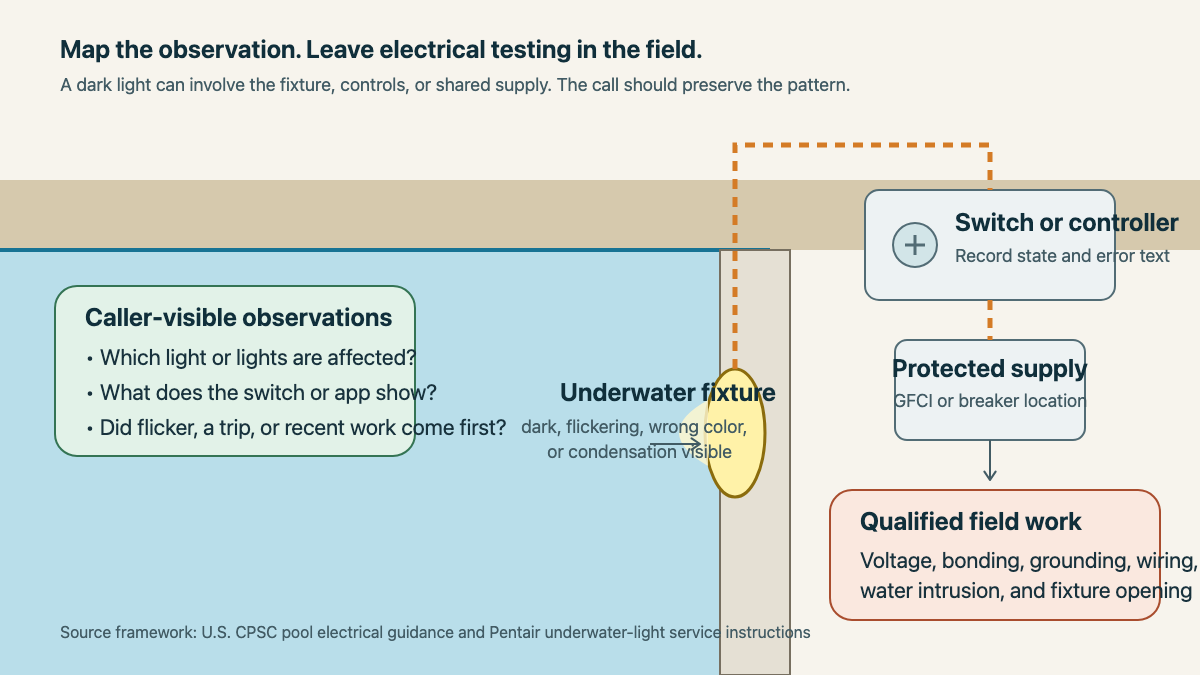
Map the controls without asking for electrical work
A useful ticket identifies how the light is controlled. Ask whether the customer uses a wall switch, a dedicated lighting controller, pool automation, a remote, or an app. If an app or panel displays an error, request a screenshot or photo. Record the exact text. Avoid translating it into your own diagnosis.
Ask whether the affected light shares a command with other lights. Color-changing systems may cycle modes through a switch or controller, and automation can group pool, spa, and landscape circuits. One fixture that remains dark in a group is a different observed pattern from an entire lighting group that does nothing. Again, the pattern guides inspection. It does not confirm whether the fault is in the fixture, shared supply, controls, or wiring.
The caller may know where a GFCI receptacle or breaker is located. Record the location and what they already observed. Pentair’s brief IntelliBrite support answer mentions resetting the GFCI and contacting a licensed pool professional if the light still does not illuminate. Your company should decide whether reception may relay any reset step. Never ask for repeated resets, panel removal, or testing with a meter.
Recent changes matter. Ask whether the failure followed a storm, outage, pool opening, controller update, landscape work, deck work, water-level change, fixture service, or another repair at the equipment pad. Record what changed and when. Keep the note neutral. The goal is a timeline, not blame.
Capture the fixture before the truck leaves
Pool lights that look similar from the deck may use different niches, voltages, controls, cords, seals, or replacement assemblies. Ask for photos before promising that a technician will arrive with a specific part.
Request one wide image of the pool that shows every light location. Add a close photo of the affected lens from the deck, if it can be taken without entering the water, plus readable photos of the automation screen, controller label, transformer label, and any accessible fixture paperwork. The customer should not open a cover or enclosure to get a label.
Capture these details in the work order:
- Pool, spa, and water-feature light count, with the affected location named
- Control method and the exact command used when the failure appears
- Dark, flickering, partial, wrong-color, out-of-sequence, or unexpected operation
- Whether the symptom affects one fixture, a group, or every light
- First occurrence, intermittent pattern, and recent outage, storm, service, or construction
- Any tingling, cramps, swimmer distress, repeated trip, heat, odor, visible damage, or moisture behind a lens
- Manufacturer and model from safe, readable labels or prior invoices
- Photos received, labels still missing, access instructions, and the person authorized to approve work
A fixture photo can reveal the face-ring style and obvious lens condition. It cannot confirm voltage, grounding, bonding, cord condition, or water inside concealed electrical spaces. Those checks belong to qualified personnel using the installed product instructions and local requirements.
Route by risk, then by diagnostic scope
Once the safety screen is clear, decide what kind of appointment the company actually offers. Some pool-service firms replace lamps, gaskets, or complete low-voltage fixtures. Others route underwater lighting to a licensed electrical contractor. Some handle the pool equipment and controls but require a separate electrician for branch-circuit or bonding work. The intake should reflect the real service boundary.
Quote the diagnostic or service-call policy, appointment window, and approval process. Avoid promising a bulb change, controller repair, transformer, new LED fixture, cord pull, or one-visit resolution. A useful phrase is: “I’ve recorded which light is out, how the other lights respond, the control method, and when the problem began. The technician will inspect the system and confirm the repair scope before approved work starts.”
Lighting complaints can overlap with broader equipment or automation work. The pool pump and filter repair intake guide covers circulation equipment, gauge readings, leaks, and motor behavior. For a customer considering a new controller or grouped schedules, the pool automation consultation guide covers system inventory and control goals. Keep this ticket centered on the failed light and its electrical safety screen.
An AI receptionist can follow the same approved path after hours, but the escalation rules must be explicit. The final handoff should tell dispatch whether swimmers were kept out, whether emergency instructions were given, which qualified trade needs the call, and what the customer was promised.
Sources
- U.S. CPSC: Electrical Safety In and Around Pools, Spas and Hot Tubs
- Pentair: Amerlite Underwater Light Installation Instructions
- Pentair: IntelliBrite 5G light will not illuminate
- ePoolSupply: Pool Light Not Working? Here's What To Do