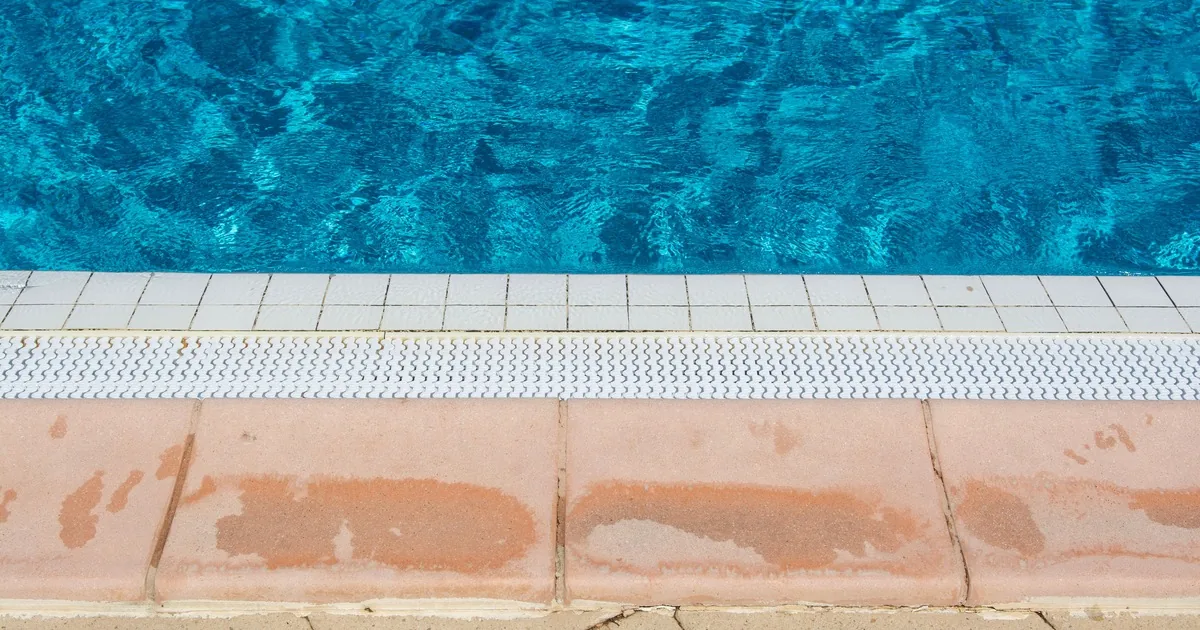
A pool owner calls and says, “The border around the pool is cracking. Can you give me a price?” That description leaves four different components tangled together: the waterline tile, the coping above it, the flexible joint beside the coping, and the surrounding deck. Each can change the work.
Start by naming the damaged part. Then record the pattern, measure the affected run, collect useful photos, and ask about movement or water loss. A good intake can qualify the estimate in several minutes. It cannot prove what is sound beneath the finish, so the office should avoid diagnosing a bond beam or promising a fixed repair price from a phone photo.
Separate tile, coping, and deck before discussing price
Callers often use “tile” for everything they see at the pool edge. Ask them to describe where the damage sits.
Waterline tile is the vertical band at the top of the pool interior. The caller may report missing pieces, cracked grout, staining, a hollow sound, or tiles slipping away from the wall. Coping is the cap along the top edge. It may be precast concrete, brick, natural stone, pavers, or poured cantilever concrete. Beside it, a joint usually separates the pool edge from the deck.
That distinction matters because a loose tile and a rocking coping stone are different estimate requests. A gap at the deck joint may involve another trade or a larger scope. The pool tile and coping cost guide from HomeMending also separates finish work from the deck transition, substrate preparation, and possible shell or beam concerns.
Ask the caller to point a camera at the area while standing on the deck. Have them take one wide photo that shows the pool edge in context, then a close photo with a ruler or another familiar object for scale. Do not ask anyone to enter the water, pull on a loose piece, lift a stone, or remove material for a better look.
Record the failure pattern, not one vague crack
The visible symptom is the start of the ticket. The pattern tells the estimator where to look.
Ask whether the problem affects one piece, one straight run, several corners, an attached spa, or most of the perimeter. A chipped corner on one stable coping unit presents a different question from five pieces that move under light hand pressure. Cracked grout along one tile joint differs from a line that continues through the coping and into the deck.
Capture these observations:
- The first place the caller noticed damage and when it appeared
- Whether the area is growing, returning after an earlier repair, or stable
- Any loose, rocking, raised, sunken, hollow-sounding, sharp, or missing material
- Whether a crack crosses from tile into coping, deck, plaster, a step, or a raised wall
- Open joints, white deposits, rust-colored staining, damp areas, or missing mortar
- Reported water loss, a recent freeze, deck work, drainage trouble, impact, or heavy equipment nearby
- The pool surface material and whether resurfacing or deck work is already planned
Do not turn those observations into a cause on the call. Repeated cracking can be associated with movement, joint failure, moisture, or deteriorated material, but a photograph cannot establish which one is responsible. E-Z Patch's coping repair guide makes the same practical distinction between a stable surface chip and a section that moves, recurs, or hides a weakened substrate.
The office also needs the history of earlier work. Ask what was repaired, approximately when, and whether the same line opened again. Request any old invoice, material name, leftover tile, or coping sample the owner still has. That information can save an estimator from guessing at a discontinued profile or color.
Measure the run and photograph the transitions
A pool tile and coping repair estimate needs more than the pool's length and width. Ask for the approximate length of the affected run in feet, plus the number of corners, curves, steps, skimmers, spillways, raised walls, and attached-spa transitions within it. Mark every measurement as customer-reported.
For a spot repair, capture the size of each damaged area and the count of loose or missing pieces. For a larger replacement inquiry, ask whether the caller means one wall, a partial perimeter, the complete waterline, the complete coping run, or tile and coping together. “About twelve feet along the deep-end wall, including one corner and the skimmer” is useful. “A few tiles” is not.
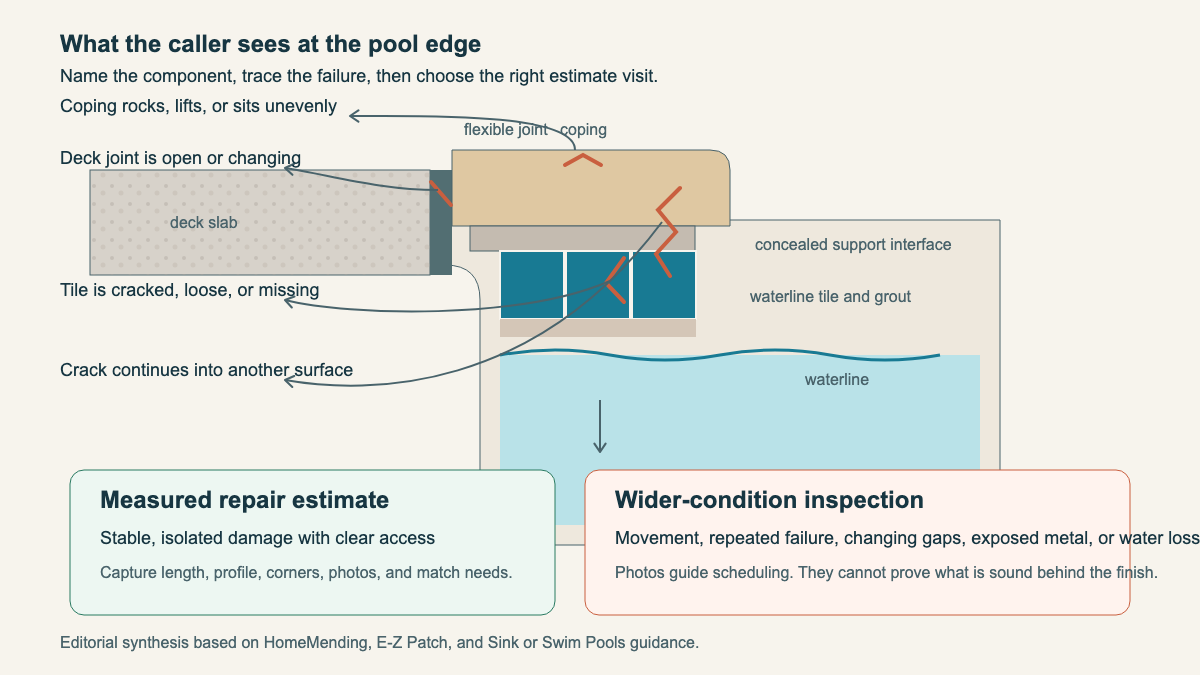
Photo order matters. Ask for a wide view of the whole side, a medium view showing where the damage meets nearby finishes, and a close view of the defect. Add the coping profile from the side if it can be photographed safely. Include the deck joint, waterline, skimmer, corners, and any crack that continues beyond the original piece.
Access belongs in the estimate ticket too. Record gate width, steps, steep grades, screened enclosures, narrow side yards, occupied rental dates, parking restrictions, and the distance between the work area and a practical loading point. Ask whether pets, locked equipment areas, or community access rules affect the visit.
Screen for safety and wider movement
A routine cosmetic estimate can stay in the standard booking lane when damage appears isolated, surrounding material remains stable, and the caller reports no related movement or water loss. The estimator still verifies the condition on site.
Move the request into a priority review lane when coping rocks or rises underfoot, an edge is sharp, reinforcement is visible, several adjacent pieces have shifted, or a crack continues into the shell or deck. Sink or Swim Pools lists loose, rocking, uneven, and sharp coping among the signs that need professional attention in its pool coping repair guide.
Reported water loss deserves its own note. Ask whether the customer measured it, used a bucket test, noticed only normal splash and evaporation, or simply found the water lower than expected. The office should not label a leak from that answer. If water loss is the main complaint, use the pool leak detection intake and connect the edge damage as a related observation.
For a moving or sharp piece, advise the caller to keep people away from that section until it is evaluated. Do not coach them to pry it up, patch around it, or test it by standing on it. If a large section is collapsing, electrical components are involved, or someone is in immediate danger, use the company's emergency escalation procedure rather than an ordinary estimate slot.
Book the estimate with honest boundaries
Before offering a time, ask what result the owner expects. They may want one functional repair, the closest available match, a uniform new waterline, new coping around the whole pool, or coordination with resurfacing. Weathered tile and stone may not match new material exactly. Put that expectation in the ticket.
Confirm whether the estimator will inspect tile, coping, deck transitions, and related water loss, or whether some work requires a separate specialist. State what the visit includes. Avoid promising that the crew can repair the area during an estimate, that one piece can be matched, or that the visible scope will remain unchanged after removal.
A strong booking note might read:
“Three loose travertine coping pieces along the shallow-end wall, about seven feet total. One piece rocks by hand; customer was told not to step on that section. Deck joint is open for about two feet beside the loose pieces. No visible metal. Customer reports no measured water loss. Wide, transition, profile, and close photos attached. Side gate is 36 inches; equipment staging is about 60 feet from the driveway. Owner wants a safe repair and understands an exact color match is uncertain. Wider-condition inspection booked before repair pricing.”
That ticket gives the estimator a location, scale, material, access plan, safety note, and customer expectation. The pool-service resource library has matching intake guides for water, equipment, and seasonal calls. Here, the office's job is narrower: describe the edge accurately enough that the right person arrives ready to inspect what the photos cannot show.