A caller asks for “new sand” because the pool has stayed cloudy since the last backwash. The office could put a sand change on the calendar and hope the truck carries the right material. A better call starts with the equipment label and the reason for the request.
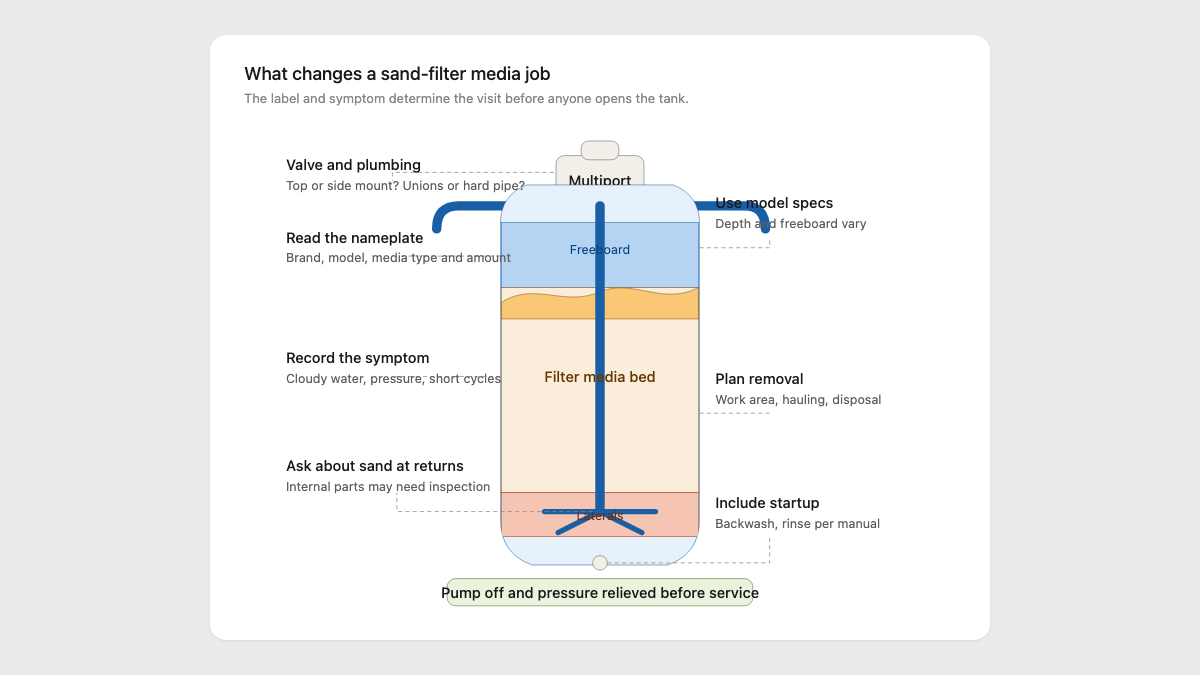
Confirm that the pool has a sand filter. Get a clear photo of the manufacturer and model label, the valve and nearby plumbing, the pressure gauge, and the equipment pad. Then record whether the customer wants planned maintenance or is responding to poor water clarity, pressure that stays high after backwashing, short filter cycles, or sand appearing in the pool. Those symptoms can change the visit from routine media replacement to a broader filter inspection.
Confirm the filter before pricing the job
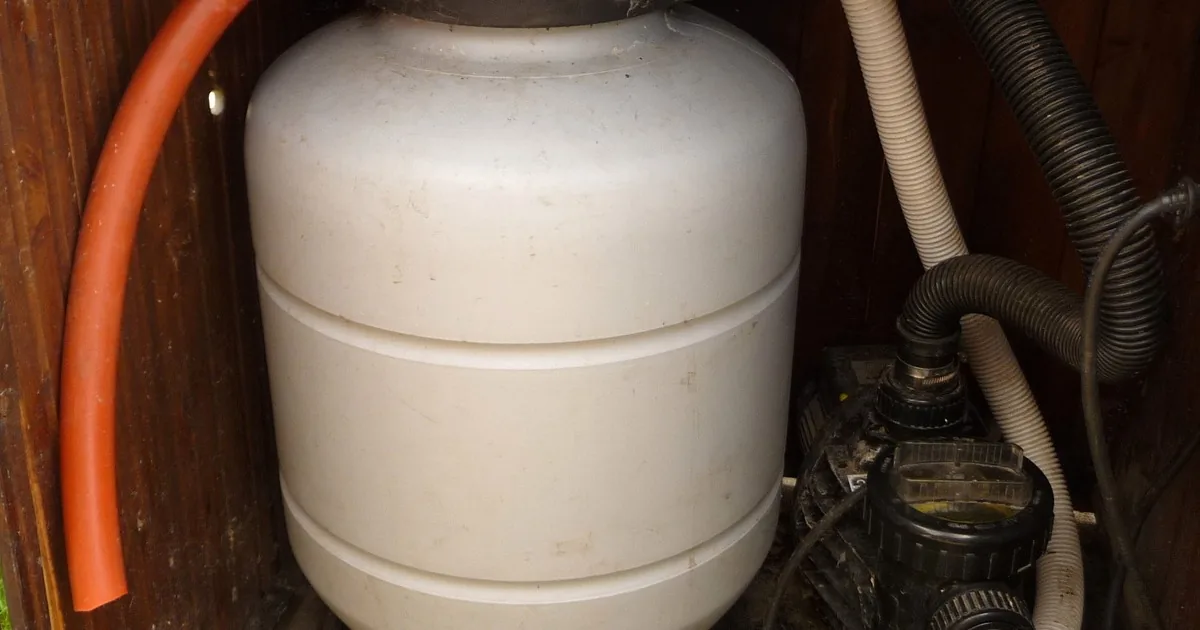
Callers use “sand filter” loosely. Some mean the whole circulation system. Others have a cartridge filter and heard that its elements need replacement. Ask what the filter tank looks like, whether it has a multiport valve, and whether the label says sand, cartridge, or diatomaceous earth. A label photo settles the question faster than a description of a “big tan tank.”
The exact model matters because media quantities vary sharply. Pentair’s Tagelus filter manual lists 125 pounds of sand for one model and 450 pounds for another in the same family. It also specifies a model-dependent freeboard, which is the open distance above the installed media bed. The office should never quote bags from tank color or diameter alone.
Ask for one wide photo before requesting close-ups. The wide view shows whether the valve sits on top or beside the tank, whether plumbing unions are present, and how much working room surrounds the filter. A top-mount valve connected by hard pipe may require a different access plan than a side-mount unit with serviceable unions. Capture the drain location too. Old wet media has to leave the tank and the property somehow.
Ask why the caller wants the media changed
Age is useful context, but it is weak evidence by itself. Ask when the media was last replaced, if known, then move to present behavior.
“What changed after the last backwash?” is the strongest single question. Record whether the gauge returned to the customer’s normal clean-filter pressure, whether return flow improved, and how long the improvement lasted. If the caller does not know the normal baseline, write “unknown.” Do not turn today’s gauge reading into a diagnosis without the pump speed and prior clean reading.
Poor clarity also needs context. Ask whether the water is clear, hazy, visibly green, or carrying fine debris back through the returns. Find out when the problem began and whether it followed an algae cleanup, heavy debris, construction dust, a chemical treatment, or recent filter work. A pool that is already green may need the separate green-pool recovery intake alongside the filter ticket.
Pentair’s Tagelus troubleshooting table separates worn media from several other causes: water chemistry, insufficient circulation time, frequent backwashing, the wrong amount or size of sand, mineral deposits, excessive flow, and internal damage. Reception should preserve those lanes. “Cloudy after backwash; customer requests sand change” is accurate. “Sand is worn out” is an office-made conclusion.
Treat sand returning to the pool as an inspection clue
A caller may report small tan grains near the return fittings or on the pool floor. Ask when they first appeared, whether the material returns after every startup or backwash, and whether the filter or valve was recently opened. Request a close photo of the material and the return area.
Do not promise that fresh media will fix it. Manufacturer troubleshooting guidance notes that sand in the pool can involve a damaged lateral or another internal problem. Laterals are the slotted collectors near the bottom of many sand-filter tanks. They let filtered water enter the return path while holding the media bed in place. Removing old sand may expose a cracked piece, a loose connection, or a standpipe problem that changes parts and labor.
That possibility belongs on the work order before dispatch. The technician can decide whether to bring a lateral assembly, valve seals, a standpipe component, or other model-specific parts. The office still quotes according to company policy, but it explains that internal condition can only be confirmed after the system is safely opened and inspected.
Build the material and access plan from the manual
The installed manual controls the media grade, quantity, fill depth, and startup procedure. For its Sand Dollar and Cristal-Flo II products, Pentair specifies No. 20 standard silica sand with a particle size of 0.45 to 0.55 millimeters. That is a product-family specification, not permission to use the same material in every tank. Alternative glass or mineral media also comes with its own weight, depth, and compatibility requirements.
Ask whether the customer knows what is currently inside the tank. Record “unknown” when they do not. If the company offers an alternative medium, confirm that the technician or service manager has approved it for the exact filter before the office promises the substitution.
A complete booking record should include:
- Service address, site contact, gate instructions, pets, and the person authorized to approve added work
- Pool type, attached spa or water features, filter manufacturer and model, valve arrangement, and readable label photos
- Existing media type and last replacement date, both marked unknown when necessary
- Reason for the request, water appearance, current gauge reading, normal clean reading, pump speed, and result of the latest backwash
- Sand or debris seen at the returns, recent filter work, leaks, damaged fittings, or visible tank concerns
- Working clearance, unions or hard plumbing, filter-drain access, stairs or narrow gates, hauling route, and old-media disposal plan
- Media approved for the model, expected quantity, parts carried for inspection, appointment scope, and approval process for added repairs
The broader pump and filter intake guide is useful when the complaint also includes a silent motor, air in the pump basket, weak return flow, an electrical symptom, or a leak elsewhere on the pad. Keep the sand-change ticket centered on media and the filter vessel.
Keep pressure-vessel work out of the phone call
A sand filter operates under pressure. Reception can ask what the caller sees from a safe distance. It should not coach the caller to remove the valve, loosen a clamp, open the tank, or move a multiport handle while the pump is running.
Pentair’s Sand Dollar and Cristal-Flo II manual requires the pump to be stopped before valve-position changes and includes pressure-relief and stand-clear warnings for startup and service. Follow the installed manual and the company’s safety policy. A leaking clamp, damaged tank, stuck pressure gauge, water near electrical equipment, or pressure that does not release normally deserves technician review before routine scheduling language continues.
The same boundary applies to media removal. An industry sand-change guide from INYOPools shows why the job can involve valve removal, plumbing access, standpipe protection, lateral inspection, new seals, and an initial backwash. Those are service tasks. The caller’s role is to provide access and observations.
Set expectations for the visit and startup
Explain what the booked service includes under the company’s real policy. Does the visit cover media removal, tank cleaning, inspection of accessible internals, approved replacement media, reassembly, startup, and disposal? Say which items are included and which require approval if damage is found.
Avoid promising that the pool will be clear as soon as the new media is installed. Mechanical filtration is one part of pool care. Existing algae, unbalanced water, fine construction dust, circulation settings, or another equipment fault may need separate work.
Startup belongs in the scope. The cited Pentair manuals call for an initial backwash and rinse sequence after media loading, with steps tied to the valve and model. Record who will perform that startup and whether the technician must remain to check for leaks, normal return flow, and a clean-filter pressure baseline.
A good final note sounds concrete: “Pentair Tagelus model label attached. Customer requests media replacement after pressure remained above the normal baseline following backwash. Tan material appears near two returns. Top-mount valve is hard-plumbed; narrow side gate and two steps reach the pad. Technician to inspect internals before confirming routine media-only scope.”
That note gives the technician a job they can prepare for. It also gives the customer an honest reason why a sand-change appointment begins with a label, a symptom, and a look inside the tank.