A property manager calls at 9:10 Monday morning. The guests leave at 10, the cleaner enters at 10:30, and the next family gets its door code at 4. The manager wants the pool “checked between guests.” That sounds like a six-hour opening. It may be a forty-minute slot after parked cars, laundry deliveries, a changed gate code, and an equipment room that only the cleaner can unlock.
Put the guest calendar beside the pool route before offering a visit. Record exact checkout and check-in times, who confirms vacancy, when cleaners or other vendors will be on site, how the technician reaches the pool and equipment, and who can authorize added work. Then separate a routine turnover check from cloudy water, failed circulation, storm debris, or another condition that needs a different appointment.
Put the guest calendar beside the route calendar
“Guests leave Monday” is incomplete. Ask for the listed checkout time and the time when someone can confirm the property is empty. Late checkout happens. So does a guest who leaves the house but keeps a car in the only service parking space.
Build the day in order:
- Exact checkout and check-in times, including the time the next access code becomes active
- Name of the person who confirms departure
- Cleaner, landscaper, linen, repair, or inspection windows that overlap the vacancy
- Earliest time the pool technician may enter and the latest time the service vehicle must be gone
- Person who can change the window and how that update reaches dispatch
- Occupied-property rule if guests remain or arrive early
Do not describe the whole vacancy as available service time. A cleaner may need the side gate for carts and bags. A photographer may be working on the deck. The property manager may want every contractor out before the final inspection. Those constraints belong on the work order.
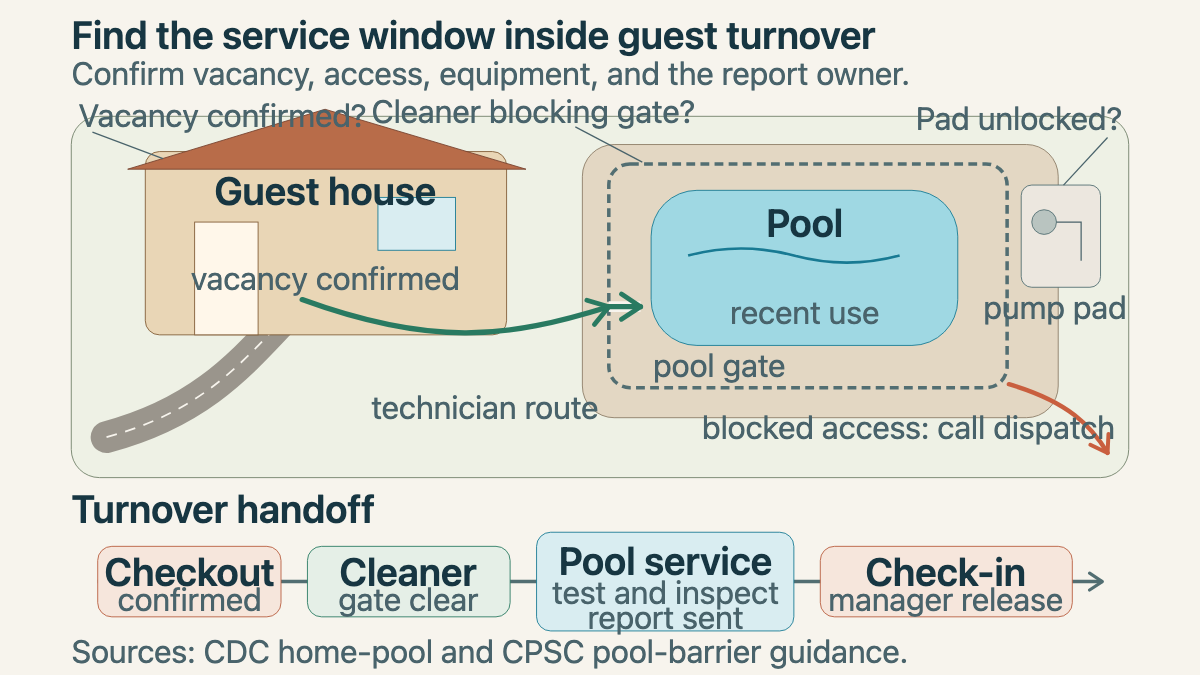
The final booking should use a real window, such as “enter after Morgan confirms vacancy; service access from 11:15 to 1:00; send report to Morgan before leaving.” That note tells dispatch who controls the handoffs. “Anytime before four” does not.
Get access details that survive the next code change
Vacation rentals often have several layers of access: a community gate, driveway, house lock, side gate, pool enclosure, and locked equipment area. Ask about each layer the technician actually needs. Record parking limits, narrow drives, towing rules, pets, alarms, construction, and whether the service vehicle can turn around.
Use an approved secure field for codes and keys. A code copied into an ordinary note can remain visible long after the booking ends. Confirm who updates the service company when a code rotates. If access depends on the cleaner, name the cleaner and a backup contact.
Pool barriers deserve special care. The U.S. Consumer Product Safety Commission’s home-pool barrier guidance recommends layers of protection, including barriers with self-closing and self-latching gates. A technician should never be instructed to prop a pool gate open for convenience. The company’s access procedure should preserve the barrier and secure the property after service. Local requirements vary, so intake staff should record the setup without declaring it compliant.
Ask for useful photos before the first visit: a wide view of the driveway, the side gate, the route to the pool, the equipment pad, and any lock or latch the technician must operate. Avoid asking the caller to open an electrical panel, filter, chemical feeder, or pressurized vessel.
Separate a turnover check from a normal route stop
A turnover visit may supplement regular service, replace a scheduled stop, or respond to a reported problem. Those are different jobs. Ask what the property manager expects the technician to inspect and document. Does the visit include surface debris, baskets, water testing, chemical adjustment under company policy, equipment observation, water level, pool furniture, or completion photos? Put the accepted scope in writing.
Then capture recent use. Ask how many nights the property was occupied, the approximate number of guests, whether the pool or attached spa saw unusually heavy use, and whether anyone reported cloudy water, odor, irritation, debris, low water, an error message, or equipment noise. Guest count is planning context. It is not a chemical formula.
The CDC’s home pool and hot tub guidance recommends regular testing of disinfectant concentration and pH, with more frequent testing during heavy use. That supports asking about occupancy and recent conditions. It does not support promising on Monday morning that one turnover visit will preserve a particular water condition through the next stay.
Route visible trouble honestly. Cloudy water belongs in the cloudy-pool intake workflow. A pump that is off, leaking equipment, a tripped breaker, heavy storm debris, fecal contamination, or a damaged barrier needs the company’s defined escalation path. Do not squeeze recovery work into a routine check because a guest arrives soon.
Give chemical questions a hard boundary
Property managers may have cleaning staff, owners, guests, and pool technicians adding products at different times. That creates a dangerous information gap. Intake should ask what product was added, the label name, amount if known, time added, and who added it. Record any spill, strong odor, visible gas, coughing, eye irritation, or other reported exposure and follow the company’s emergency procedure.
Reception should not invent a dose, recommend combining products, or tell a caller to inspect a feeder. The CDC’s pool chemical safety guidance emphasizes training, safe storage, ventilation, preventive maintenance, and steps that prevent incompatible chemicals from mixing. Product labels, trained personnel, and the company’s safety plan control the response.
Ask where chemicals are stored and whether the technician can reach that area without entering an occupied home. Note who owns the inventory. A pool company may supply every approved product, use owner stock under written terms, or refuse unverified chemicals. The work order should match the actual policy.
Assign one person to approve and receive the report
Remote owners often want updates, while a local manager controls the property. Decide which person can authorize work. Record an approval limit only if the company uses one. Name the contact for an equipment failure, unsafe condition, or service that cannot finish inside the accepted window.
The report recipient matters too. A completed visit might include water readings, tasks, photos, equipment observations, locked-gate confirmation, and a recommended follow-up. Decide who receives it and who answers before check-in. Sending a repair question to an owner on a flight can stall the property manager who is standing beside the pool.
Unexpected water loss deserves a clean note. The EPA’s WaterSense pool guidance identifies leaks, evaporation, splashing, and maintenance practices among the factors that affect pool water use. Record a reported water-level change, recent refill, autofill behavior, and visible wet areas. Leave diagnosis to the field professional and route suspected leaks under company policy.
For the recurring plan itself, use the separate guide to weekly pool maintenance signup calls. The vacation-rental work order should add turnover timing and remote-authorization fields to that base account record.
Build the failed-window plan before route day
Access failures are predictable. Guests stay late. The cleaner parks across the gate. A code rotates overnight. The equipment key disappears. Decide what the technician does in each case: wait for dispatch, perform only accessible work, move to the next stop, return under a new work order, or cancel according to the service agreement.
Set the same boundary for pool condition. If the technician finds cloudy water, stopped circulation, a damaged gate, a chemical concern, or a job larger than the turnover scope, the report should state what was observed and what service lane comes next. The office should never convert “guest arrives at four” into a promise that the pool will be ready at four.
Read the handoff back before ending the call: “Checkout is 10. Morgan confirms vacancy by text. The cleaner uses the driveway until 11. Pool access runs from 11:15 to 1. The side-gate code is in the secure field, the equipment pad is unlocked, and no guests may be present during service. Send the field report to Morgan. If water is cloudy or circulation is off, dispatch will call before assigning recovery work.”
An AI receptionist can collect the same record after hours, but the pool company still owns the route, safety rules, service scope, and release decision. The technician should arrive knowing where to park, which gate to secure, what happened during the last stay, and who will answer when the pool tells a different story.