The pump motor starts, but the clear strainer pot never fills with a steady column of water. The caller hears air, sees the basket churning, and asks whether the pump is dead.
Treat that as a priming complaint until a technician proves otherwise. The most useful first call establishes what the motor does, whether water reaches the strainer pot, what changed before the symptom, and whether the system should remain off. Common categories include low pool water, air entering on the suction side, a closed or restricted valve, debris in a basket or impeller, and a lid seal that is not seated. Those are investigation lanes, not phone diagnoses.
Confirm that the pump is actually failing to prime
Start with the startup behavior. Ask, “When the system calls for the pump, is the motor silent, humming, or running normally?” A silent pump, a dark display, a tripping breaker, and a motor that runs while the basket stays full of air belong on different tickets.
For a true no-prime complaint, the motor usually runs but does not establish stable water flow through the strainer pot. The caller may see little water under the clear lid, froth or large air pockets, weak movement at the return jets, or no return flow. Record the observation exactly. “Basket remains mostly empty while motor runs” is useful. “Bad pump” is a guess.
Also separate a pump that never primes from one that primes and later loses it. Ask whether the basket ever filled completely after startup, how long normal flow lasted, and whether the same problem returns after every shutdown. That timing helps a technician choose the first checks without letting reception declare an air leak, failed seal, or buried-line problem.
The installed manual controls the procedure. Pentair’s IntelliFlo3 installation and maintenance guide, for example, treats suction-side air, inadequate water in the strainer pot, water level, skimmer air intake, the lid O-ring, priming settings, basket blockage, and impeller debris as separate troubleshooting categories. Other pump families can use different controls and limits.
Follow the water path during intake
A priming ticket gets clearer when the questions follow the route water should take. Begin at the pool, move through the skimmer and suction plumbing, then finish at the pump and returns.
Ask the caller where the water sits in relation to the skimmer opening. A low waterline can let the skimmer pull air. Ask whether the skimmer is gulping, whether its weir is stuck, and whether the basket is packed with leaves. The caller can report those details from the deck. Do not ask anyone to reach into a suction fitting or remove a drain cover.
Next, ask about recent valve movement. Did the problem begin after opening the pool, cleaning a basket, switching to spa mode, vacuuming, backwashing, or work at the equipment pad? A valve left in a different position can change the available suction path. Preserve the sequence: “Pump worked before basket cleaning; problem began at restart” tells the technician more than a list of possible parts.
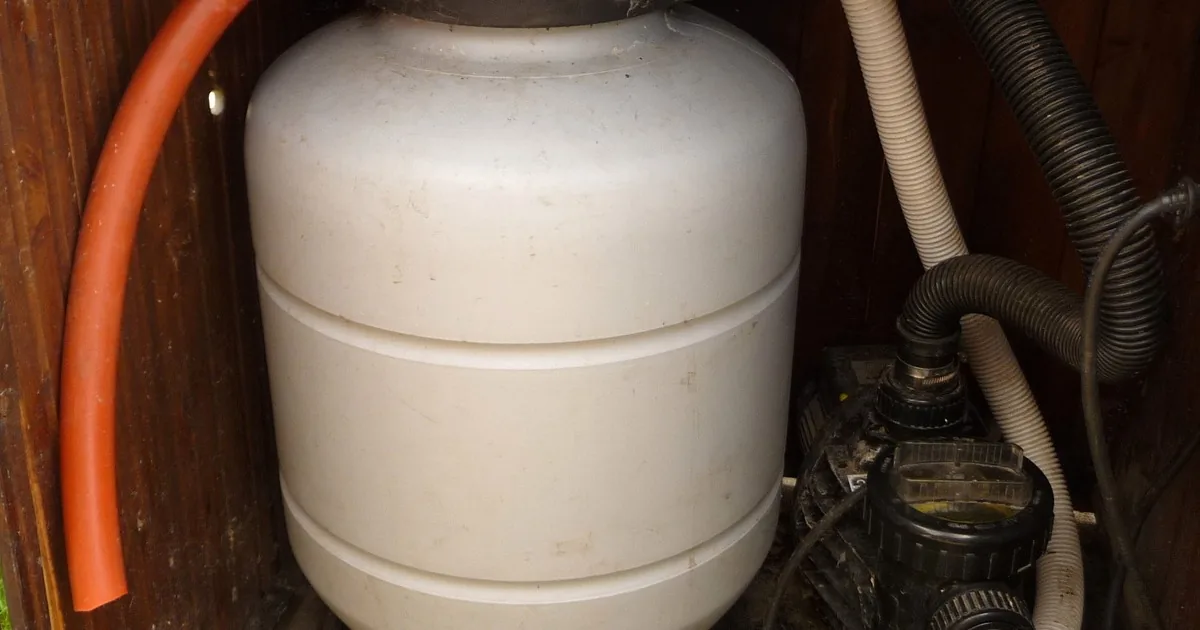
At the pump, ask whether the clear strainer pot is empty, partly full, full of bubbles, or filled with steady water. Then ask about the lid. Was it opened recently? Is the lid visibly seated? Is there debris at the sealing surface? Has the caller noticed a cracked lid, missing gasket, or water around the equipment after shutdown? These are observations. The office should not coach someone through opening a hot pump or loosening pressurized equipment.
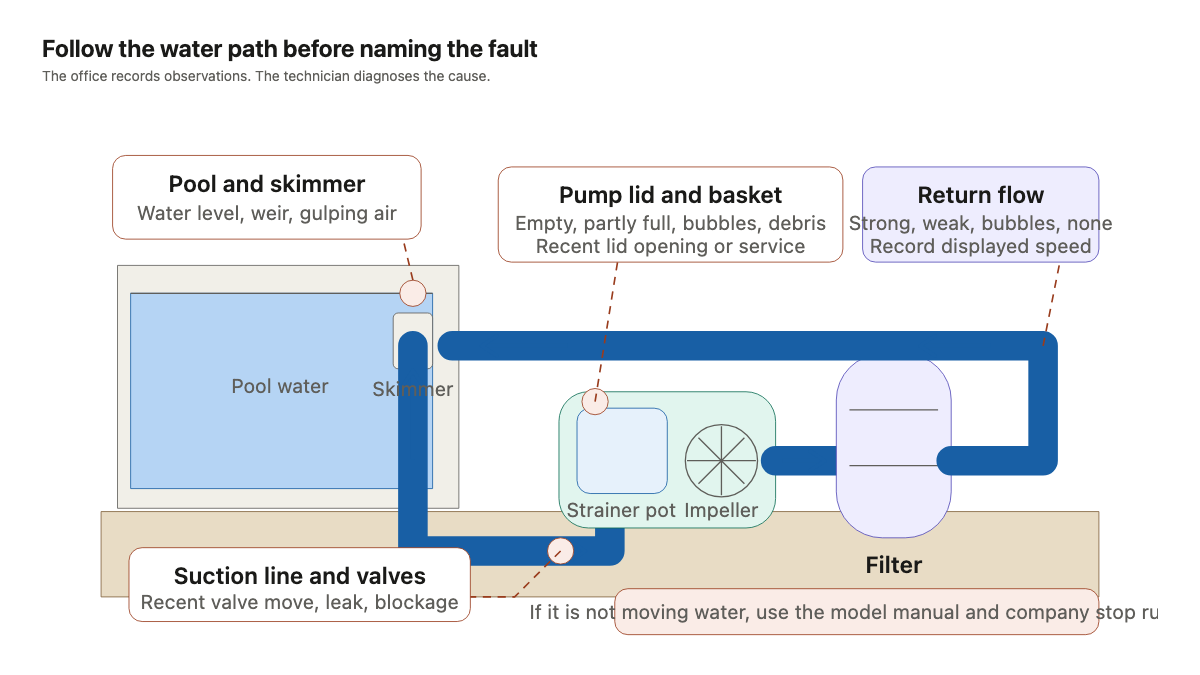
Finish at the returns. Are they moving water strongly, weakly, in surges, or not at all? Are bubbles coming from them? If a variable-speed controller shows a speed, program name, or priming alarm, capture the display in a photo. Flow behavior and the displayed operating state belong together.
Capture what happened before the failure
Priming complaints often follow an event. The date and sequence matter more than the caller’s theory.
Ask when the pump last moved water normally. Then ask whether the pool was recently opened, the water level fell, a storm filled the baskets with debris, the pump lid was removed, the filter was serviced, plumbing work was completed, or automation settings changed. If the equipment sat dry during winter, write that down. If a contractor moved valves, note which work occurred and when without assigning blame.
Request one wide photo of the entire equipment pad. Add clear close photos of the pump label, strainer pot, lid, suction valves, controller display, filter gauge, and any visible leak. A model number keeps the technician from planning around the wrong lid, O-ring, basket, drive, or priming control.
For a broader complaint involving pump power, filter pressure, leaks, or unusual motor noise, use the related pool pump and filter repair intake guide. Keep this ticket centered on the water path and the failure to establish or hold prime.
Screen for conditions that should stop the call script
A pump that is running without water should not be left that way while the office searches for an appointment. Manufacturer guidance warns that dry running can damage the shaft seal and lead to leaking or further pump damage. Apply the company’s stop rule and the installed manual. Avoid inventing one universal time limit across every pump.
The caller should also stop and wait for qualified help if there is smoke, a burning smell, sparking, repeated breaker or GFCI trips, a cracked pump housing, water reaching electrical components, or an unusually hot strainer pot. Do not tell someone to keep resetting a protective device.
Pressure deserves the same boundary. Pentair warns that a pump which failed to prime may contain hot water and vapor pressure. Its service instructions require power isolation and pressure relief before equipment is opened. Reception can tell the caller to leave the system alone under company policy. It should not improvise a lid-opening or filter-bleeding procedure from memory.
Damaged or missing suction-outlet covers are a separate safety escalation. Keep swimmers out and follow the company’s safety protocol. A priming appointment does not override an entrapment hazard.
Build the work order around observable facts
A strong ticket should contain:
- Service address, caller, access instructions, pets, and the person authorized to approve work
- Pool type, attached spa or water feature, pump manufacturer and model, controller brand, and filter type
- Motor behavior at startup and any displayed alarm or error code
- Strainer-pot observation: empty, partly full, bubbles, steady water, or unknown
- Pool water level, skimmer behavior, basket condition, valve position, and visible return flow
- Last normal operation, first failed startup, and any recent opening, cleaning, storm, outage, valve change, or equipment work
- Smoke, heat, electrical trouble, cracked components, leaks, damaged suction covers, or another stop condition
- Photos received and any unreadable label still needed
Read the important details back. “The motor runs, the basket stays mostly empty, the skimmer is pulling air, and the problem started after the water level dropped” is a clean handoff. So is “The pump primes after restart, then the basket fills with air again; bubbles appear at the returns.” The second ticket describes a different pattern without pretending to know why.
Quote only what the office can defend. Explain the service-call or diagnostic policy, the appointment window, and how repair approval works. Do not promise a lid seal, valve repair, impeller cleaning, pump replacement, or underground-line repair before inspection.
An AI receptionist can collect this same structured record after hours, but the script needs the same safety boundaries and model uncertainty as a trained human. The goal is a technician-ready observation trail. The final field should say whether the pump is off, who made that decision, and what the caller was told to do until the visit.