A property manager asks for a price to wash “the storefront.” The photos show six tenant bays, two fabric awnings, a shared sidewalk, a restaurant entrance, grease tracks near a service alley, and a curb inlet downhill. The manager wants the work finished before customers arrive, but nobody has said when deliveries begin or who can shut off the irrigation.
That call is ready for a site walk, not a price. A commercial storefront pressure-washing bid should begin with the decision-maker, exact cleaning zones, surfaces and fixtures, visible stains, water source, runoff path, operating hours, access needs, service frequency, and proposal requirements. Square footage matters later. The boundaries matter first.
Start with authority and property boundaries
Ask who requested the bid and what that person controls. A tenant may authorize its private patio but lack authority over the common sidewalk. A facilities coordinator may gather quotes while the property manager approves vendors. A regional office may require a purchase order, certificate of insurance, vendor packet, or written safety plan before any crew arrives.
Record the legal property name, service address, billing contact, on-site contact, proposal recipient, and final approver. Ask whether the request covers one storefront, a row of tenant bays, the entire shopping center frontage, or a recurring route across several properties. If the caller says “everything out front,” name each zone and read it back.
Commercial scope often breaks at seams that are easy to miss in a phone photo: the tenant threshold, common walkway, curb ramp, breezeway, loading side, public sidewalk, neighboring bay, and service alley. Note who owns or controls each area. The office should never assume that a manager can authorize washing on municipal pavement or another tenant’s frontage.
The guide to house soft-wash quote calls covers exterior materials, stains, water access, and fixture protection in more detail. Storefront work adds another layer: customers, tenants, deliveries, fixtures, and approval chains all occupy the same work area.
Walk every surface and fixture
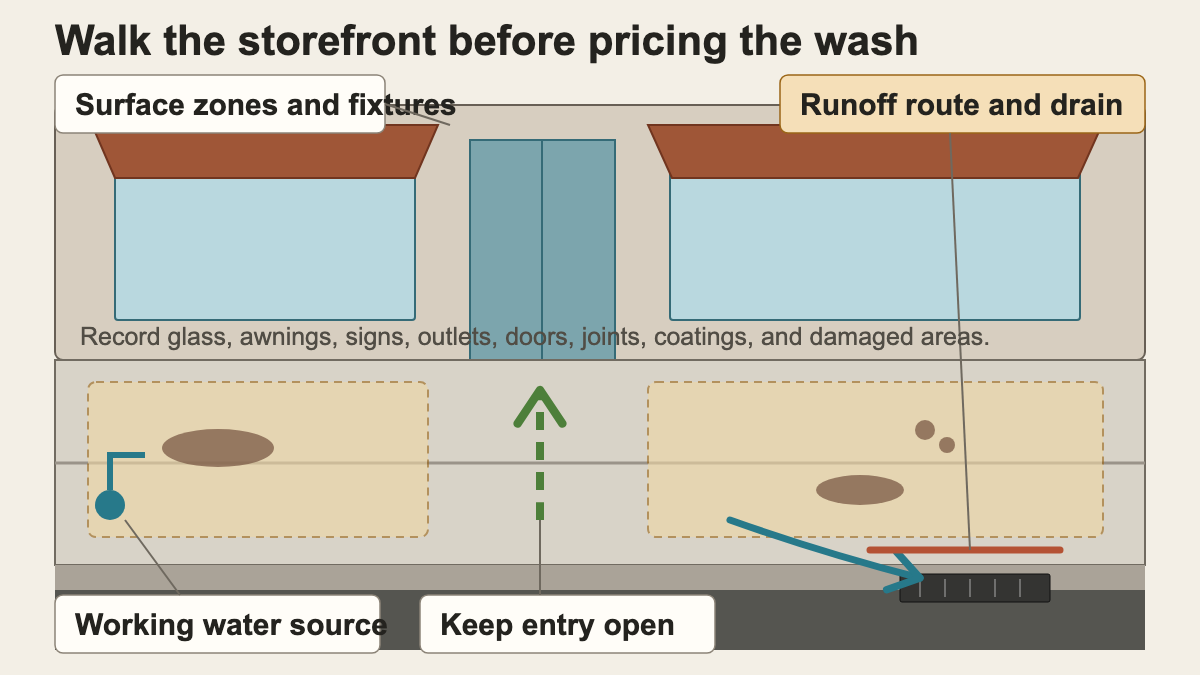
Build the quote as a set of named zones. “Front walk” is too broad when one half is broom-finished concrete and the other is coated tile under an awning. Ask for dimensions or plans when available, then mark every measurement as customer-reported until the estimator verifies it.
For each zone, record the surface: poured concrete, pavers, brick, tile, stone, stucco, painted masonry, metal panel, glass, composite cladding, or another identified material. Capture coatings, sealers, painted markings, accessibility symbols, decorative graphics, anti-slip treatments, caulk joints, and prior repairs. Unknown material stays unknown.
Then move upward. Note windows, doors, awnings, blade signs, channel letters, menu boards, cameras, speakers, lighting, outlets, door controls, alarm equipment, planters, and exposed conduits. Ask whether any fixture is loose, cracked, recently painted, leaking, or awaiting repair. A wide photo of each bay and close photos of vulnerable areas give the estimator something usable.
Stains need location and context. Record gum clusters near the entrance, beverage spills beside outdoor seating, tire marks at pickup spaces, rust below a planter, algae in a shaded joint, bird residue under a sign, or dark tracks leading from a dumpster area. Ask what products or treatments have already been used. Do not promise complete removal or name a chemical from the front desk.
A restaurant or grocery tenant can create a different soil profile than a clothing shop. If food residue, grease, dumpster leakage, or pest activity appears in the request, flag the area for review. Keep service-area scope separate if the bid only covers the customer-facing frontage.
Map water before scheduling
Find the working water source and who controls it. Ask whether the exterior bib is private, shared, locked, metered, inside a tenant space, or available only during certain hours. Record reported low flow, a required key, a backflow device, a long hose route, or a source across a customer walkway. The crew decides whether the supply works for its equipment.
Now trace the ground. Which way does each zone slope? Mark trench drains, curb inlets, catch basins, tree wells, planters, low spots, neighboring property, loading docks, and any place water can cross an active entrance. Ask for photos after rain if ponding or an uncertain drain path is part of the site.
The U.S. EPA’s stormwater overview explains that runoff across streets, parking lots, and rooftops can pick up trash, chemicals, oil, and sediment. It also notes that stormwater programs are commonly administered by states and local authorities. That makes the service address important. Reception should capture the site facts and applicable authority, then let the contractor confirm the required controls.
Local guidance shows why. Sacramento County’s pressure-washing BMP page says wash water should not enter a storm drain and describes drain protection, collection, and disposal options that depend on owner permission and local sewer rules. A regional power-washing fact sheet published by Burlington, Washington calls for dry cleanup, containment, collection, and attention to pedestrian and vehicle traffic.
Those pages are useful examples, not a nationwide disposal script. Ask what is downhill, what pollutants are visible, where a drain sits, and whether the property has an approved collection or disposal location. Avoid promising that wash water can enter a landscape bed, sanitary cleanout, septic system, street, or storm drain until the contractor verifies local rules and site conditions.
Build the work window around real operations
“Before opening” needs a clock. Record tenant hours, employee arrival, bakery or restaurant prep, delivery windows, trash pickup, irrigation cycles, security patrols, quiet-hour limits, and when exterior lights or signs switch on. A plaza that opens at 10 a.m. may receive food deliveries at 5:30.
Ask which entrance must remain usable. Note the accessible route, curb ramp, automatic door, employee entrance, emergency exit, and path to neighboring tenants. Record who can approve a temporary closure or alternate route. The contractor still sets barriers and the work sequence, but the bid should expose the conflict before the crew unloads hoses.
Vehicles matter too. Where can the truck and trailer park? Is there a loading zone, fire lane, parking restriction, garage clearance, gate code, or security check-in? Can equipment reach the far bay without crossing landscaping or entering an occupied space? A site with one narrow service corridor may need a different plan than a freestanding shop with an empty side lot.
Weather and drying expectations belong in the record. Capture any grand opening, inspection, tenant event, outdoor dining service, repainting, sign installation, or morning deadline tied to the request. Do not promise that every surface will be dry or ready for another trade at a specific hour. The estimator should account for material, weather, drainage, and the planned process.
Separate the first clean from recurring service
A one-time cleanup and a recurring route need different proposals. Ask what triggered the request: a new tenant, accumulated gum, seasonal cleanup, ownership inspection, complaint, event, or vendor replacement. Then ask what the property wants to maintain and how it will judge the work.
For recurring service, record which zones repeat and which are occasional add-ons. Note preferred days, blackout dates, contact changes, access credentials, photo-report requirements, and whether each visit needs a work order. Ask who reports spills or new stains between visits. Avoid promising a fixed frequency before the estimator understands traffic, food service, trees, irrigation, and the property’s appearance standard.
The proposal may need separate lines for façade washing, flatwork, gum treatment, awnings, service areas, and after-hours access. It may also need assumptions and exclusions for water, power, traffic control, moving furniture, tenant notices, stain results, delicate surfaces, and waste handling. If cleaning is tied to a repaint, the guide to commercial painting bid calls helps separate preparation, painting scope, tenant coordination, and approval. Intake should collect those facts. Pricing belongs with the estimator.
Send a proposal-ready site record
A clean handoff can use these fields:
- Authority: property name, requester, on-site contact, proposal recipient, approver, billing path, and vendor documents
- Scope: included and excluded bays, façade sections, walks, ramps, alleys, patios, curbs, and customer-reported dimensions
- Surfaces: materials, coatings, repairs, graphics, joints, fixtures, vulnerable areas, and recent work
- Condition: stain type as observed, location, extent, prior treatment, food or grease areas, loose debris, and photos
- Water and runoff: source, access, slope, drains, low points, visible pollutants, neighboring property, and local authority
- Operations: hours, deliveries, entrances, accessible route, vehicles, irrigation, events, closures, security, and recurring needs
Read the summary back in site order. For example: six tenant bays included from the west breezeway through the restaurant entrance; public sidewalk and rear dumpster pad excluded. Frontage is mostly broom-finished concrete with tile at two thresholds, fabric awnings above four bays, and painted accessibility markings near the curb ramp. Gum is concentrated at the restaurant door. Dark tracks run toward the service side. The sidewalk slopes to a curb inlet near the east end.
The on-site contact can unlock a shared bib after 6 p.m. Customer entry must remain open at the center doors until 9 p.m., deliveries begin at 5:30 a.m., and irrigation runs overnight unless management changes the controller. The proposal goes to the facilities coordinator, while the property manager approves scope and vendor documents.
An AI receptionist can collect those fields after hours and request the photo set. The estimator then arrives with the approval chain, storefront zones, traffic window, and water path already marked on one map.