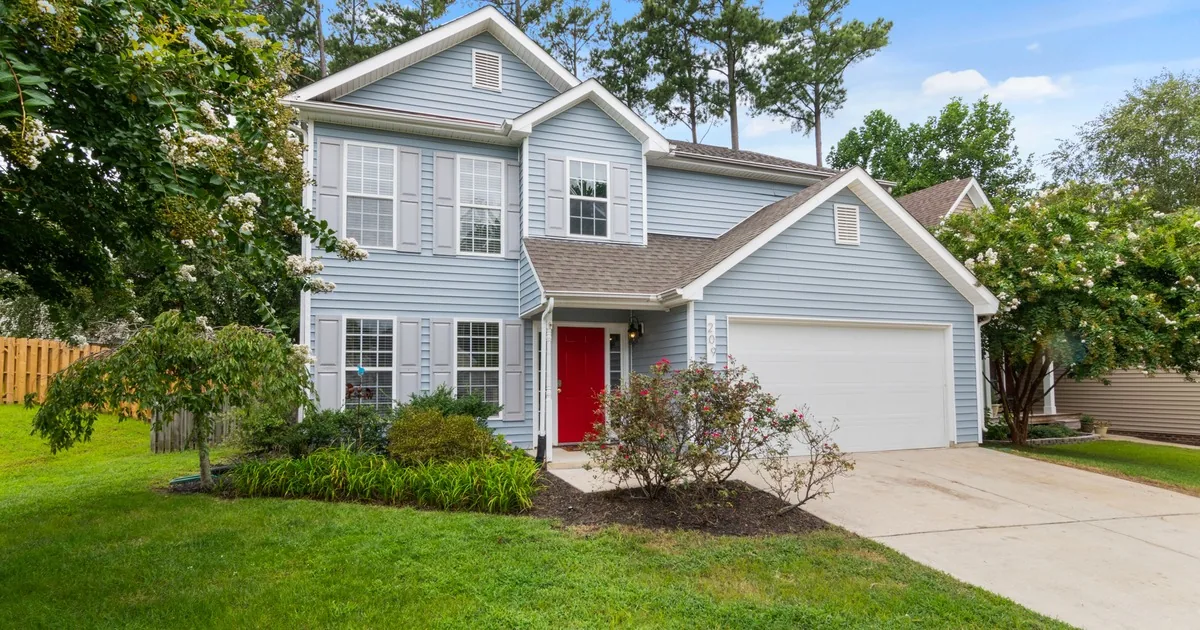
A homeowner asks for “the driveway and front walk.” The driveway starts as poured concrete at the garage, changes to a paver apron near the street, and carries two dark spots where a car parks. The front walk crosses a planting bed, meets a public sidewalk, and slopes toward a curb inlet. A second path beside the house never made it into the caller’s description.
A useful driveway pressure-washing quote call maps the property before anyone discusses a method or result. Record every included pavement section, material, dimensions, visible condition, stains, slope, runoff destination, water source, access limits, and pedestrian needs. Photos help, but the estimator still confirms the surface and field plan.
Draw the boundary of the quote
Start with a plain scope question: “Which paved areas do you want included?” Ask the caller to name each section separately. That may include the main driveway, parking pad, paver apron, front walk, side path, porch landing, steps, curb strip, public sidewalk, patio connection, or short walkway to a gate.
Ownership and scope can split at the property line. A public sidewalk may run across the frontage, while a private walk connects it to the house. An association may control another section. Record what the customer wants priced and who can authorize work there. The office should not assume that a paved strip beside the road belongs to the homeowner.
Dimensions belong in the intake, marked as customer-reported. For a rectangular driveway, length and width are useful. Irregular parking pads, curved walks, circular drives, and several disconnected sections need a sketch or a set of wide photos. Ask the caller to include a fixed reference in each image, such as the garage opening, front steps, curb, or gate. A close photo of one dark patch cannot show the size of the job.
Confirm what is excluded. A caller may want the driveway but not the garage floor, the private walk but not the municipal sidewalk, or the pavers but not the adjoining pool deck. Read those boundaries back. “Main concrete drive, paver apron, and front walk through the gate; garage floor and public sidewalk excluded” is a quote record. “Driveway wash” is a reminder to call again.
Identify every surface change
Ask whether the pavement is poured concrete, concrete pavers, clay brick, natural stone, asphalt, exposed aggregate, stamped concrete, or a mix. Capture the manufacturer and product line for pavers when the owner has an invoice, label, or installation record. Do not identify a material from color alone.
Material matters because care instructions differ. Belgard’s paver cleaning guidance tells owners to check the instructions for their installed product and warns that powerful pressure can damage pavers. It also distinguishes concrete and porcelain care. Reception should preserve the material and manufacturer facts, then leave pressure, cleaner, test area, and technique to trained field staff.
Existing condition needs its own notes. Ask about cracks, spalling, scaling, loose pavers, missing joint sand, sunken edges, patched areas, flaking coatings, sealers, painted markings, exposed aggregate, and prior repairs. Locate each issue by a fixed feature. “Hairline crack in the second panel from the garage, near the right tire path” is much easier to inspect than “some cracks.”
Request one wide photo of the full paved area, then close photos of material transitions, stains, cracks, coatings, and edges. Photos document what the caller can see. They do not prove that a crack is cosmetic, a paver base is stable, or a coating will tolerate the planned process.
Map stains without promising removal
Ask what the customer sees, where it sits, how large the affected area appears, and when it first showed up. Useful descriptions include black tire marks at the garage threshold, an orange streak below a metal downspout, two dark drips under a parked vehicle, green film along a shaded edge, white residue near a sprinkler, or leaf shadows beneath an oak.
Avoid turning those observations into a diagnosis. A dark spot may be oil, another vehicle fluid, decayed leaves, a prior treatment, or something the caller cannot identify. Record any product already used, the date, the treated area, and what changed. A photograph of the container label is more useful than “industrial degreaser.”
Set the expectation carefully: stain removal depends on the material, stain, age, prior treatments, and current condition. The estimator can discuss a test area and likely scope after reviewing the surface. The office should not guarantee that every mark will disappear or tell the customer to apply a chemical before the visit.
Sealed and coated pavement deserves a separate line. Ask when the coating was applied, whether the customer knows the product, and whether it looks glossy, cloudy, worn, peeling, or uneven. Note decorative color, stamped texture, painted game lines, address numbers, accessibility markings, and any surface the customer wants preserved.
Trace slope, runoff, and nearby property
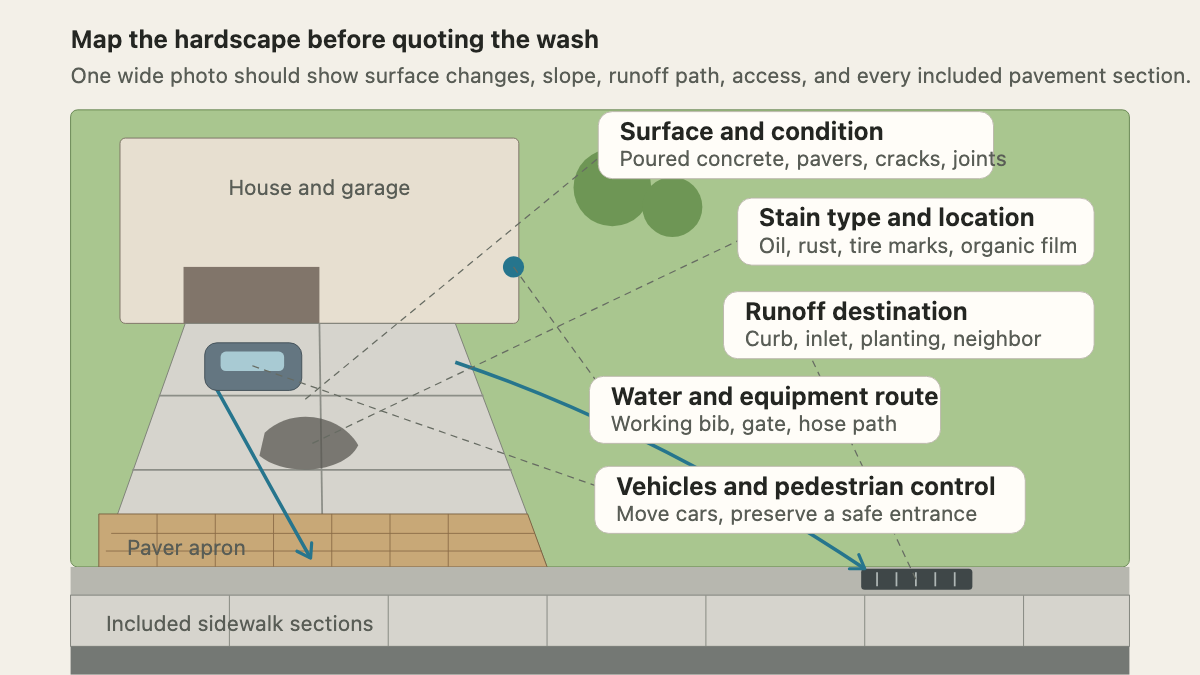
A driveway is a drainage surface. Ask which way it slopes and what lies downhill: the garage, street, curb inlet, lawn, rain garden, neighboring lot, retaining wall, basement door, pool, pond, or planting bed. Note downspouts, trench drains, cracks that hold water, low spots, and areas where runoff crosses a public walk.
Local requirements control wash-water handling. The City of San Diego’s pressure-washing guidance tells operators to determine where water will drain, protect storm drains, contain the work area, and collect polluted wash water for proper disposal. Portland Environmental Services likewise directs operators to keep wash water from leaving the work area or entering storm drains and describes collection and disposal steps under its local rules.
Those two cities have their own requirements. The intake lesson travels well: map the drainage before scheduling. Do not promise that water can go into a curb, storm inlet, landscape bed, sanitary drain, or septic system until the contractor checks the site and the applicable rules.
Ask about visible oil, grease, paint residue, loose coating, sediment, fertilizer, pet waste, food residue, and chemicals in the work area. These details can affect containment and disposal planning. The caller should not sweep questionable material toward the street before the visit.
Nearby property matters too. Note garage doors, siding, low windows, electrical equipment, pool enclosures, landscape lighting, irrigation heads, vehicles, neighboring walls, fresh paint, and delicate plants. Ask whether runoff can cross a shared drive or enter a neighbor’s yard.
Confirm water, parking, and a safe route
Find the working exterior hose bib and ask whether it is available on the workday. Record a private well, shared water source, reported low flow, locked utility room, broken handle, or bib inside the garage. Field staff can decide whether a flow check or alternate supply plan is needed.
Then map access. Where can the service vehicle park? Can equipment reach the far end without crossing a planted bed or entering the house? Note gates, steps, steep side yards, narrow passages, gravel transitions, overhead branches, community parking rules, and long hose routes.
The pavement must be clear under the company’s preparation policy. Ask about cars, trailers, basketball hoops, trash bins, planters, benches, delivery boxes, toys, hoses, and temporary ramps. Record who will move them and when. Heavy or fixed objects belong in the estimator’s notes, not in a casual promise that the crew will handle everything.
Pedestrian access deserves the same care. Does the front walk serve the only entrance? Will residents, tenants, customers, mail carriers, or delivery drivers need a route through the area? Ask about children, pets, mobility equipment, clinic hours, school pickup, or an event. A commercial storefront and an occupied home may need different staging even when the pavement is identical.
Weather and timing close the call. Record a property listing, event date, coating appointment, association work window, municipal restriction, or tenant notice deadline. Avoid promising that the surface will be ready for sealing or traffic at a specific time. The contractor should set that expectation after reviewing the material, process, weather, and follow-on product requirements.
Send the estimator a property map, not a paragraph
A clean work order can use six fields:
- Scope: included and excluded pavement sections, boundaries, customer-reported dimensions
- Surface: material, manufacturer if known, coating, repairs, cracks, joints, and transitions
- Stains: appearance, location, age, prior products, and close photos
- Water path: slope, low points, drains, curb inlet, neighboring property, and nearby sensitive areas
- Access: hose bib, parking, gates, equipment route, vehicles, objects, and people who need entry
- Timing: work windows, events, follow-on coating, and decision-maker availability
A quote-ready summary might read: two-car poured-concrete drive with four panels, brick paver apron, and private front walk included; public sidewalk excluded pending owner confirmation. Dark drips sit in the right parking lane, orange staining appears below a metal downspout, and the paver joints look low in two areas. The drive slopes to the street, where a curb inlet sits downhill. One working bib is inside the garage. Two vehicles and a portable hoop must move, while the front door needs a pedestrian route until noon.
An AI receptionist can collect that record after hours and request the right photo set. It should preserve every unknown. The estimator opens the job with the pavement, water path, and access already visible on one map.