The phone rings while the estimator is walking another site. A general contractor needs a painting number for a medical-office renovation, the drawings are in a plan room, and bids close Friday. The caller gives the project name and hangs up expecting an email confirmation. If the office records this as “commercial repaint, call back,” the opportunity is already in trouble.
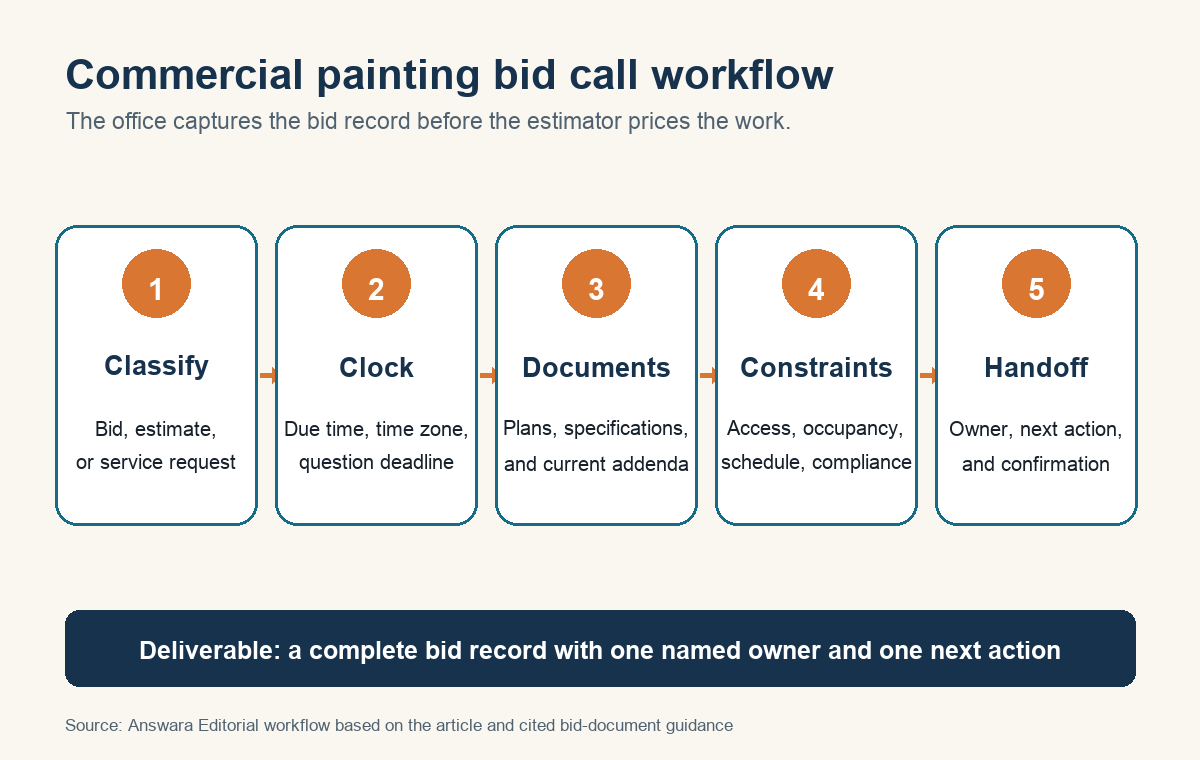
A useful commercial bid call must produce a bid record, not a vague lead. Capture the decision deadline, document location, scope, site-walk details, contact chain, access conditions, and contract requirements before anyone promises to price the work. Then give one person ownership of the next action. That is the core workflow.
First decide whether this is a bid, an estimate, or a service request
Commercial callers use “quote,” “estimate,” and “bid” loosely. The office should sort out what they mean before routing the call.
A bid invitation usually comes with drawings, specifications, a formal due date, and submission instructions. The painting contractor may be pricing as a subcontractor to one or more general contractors. An estimate may be a less formal proposal for a property manager or business owner who can arrange a walkthrough and discuss the scope directly. A service request is smaller and more immediate: repaint one damaged corridor, remove graffiti, or touch up a vacant suite before a tenant moves in.
Ask, “Do you have bid documents or a written scope we should review?” The answer separates a document-driven opportunity from a site visit that the office can schedule through its regular painting estimate process.
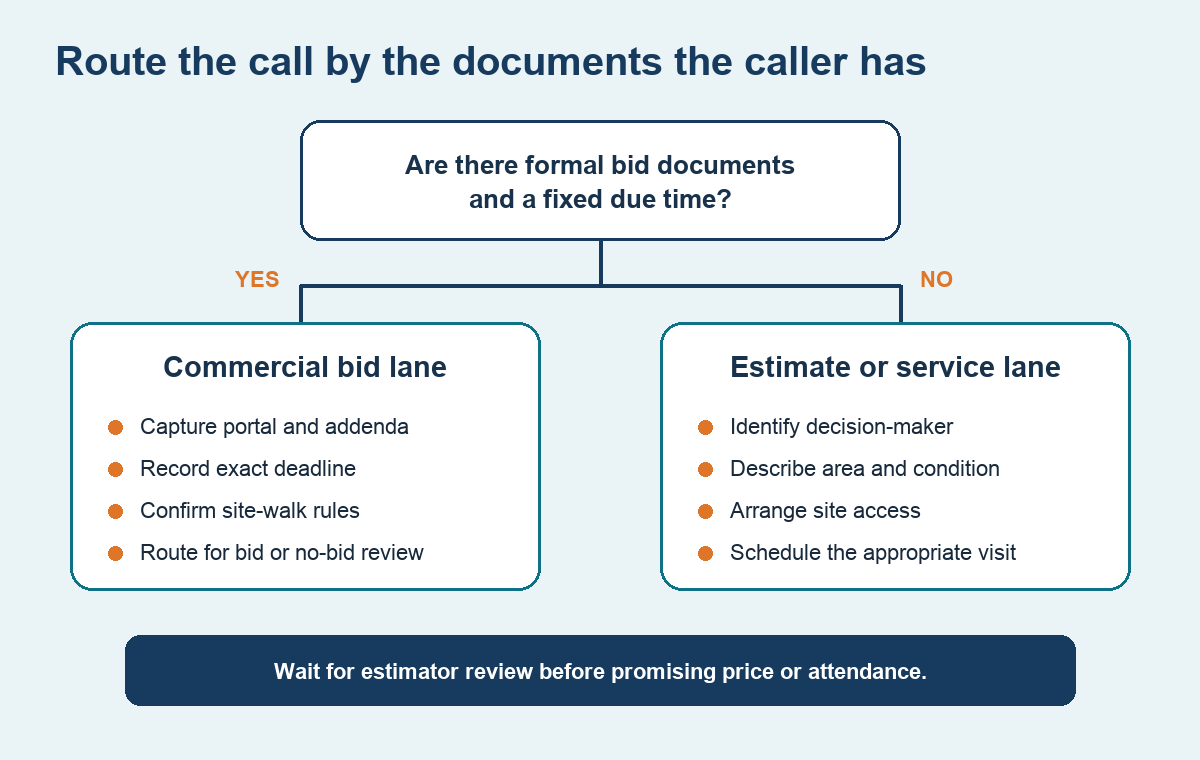
Also identify who is calling. A building owner, property manager, facilities director, general contractor, and tenant may describe the same project differently, but they do not have the same authority or documents. Record the company, role, email address, direct number, project name, and job address. If the caller is a tenant, ask who approves the work and who controls building access.
Put the deadline at the top of the record
Commercial bids expire by the clock. “Due Friday” is incomplete. The estimator needs the date, exact time, time zone, submission method, and recipient. A portal upload may require an account. A sealed public bid has different handling from an emailed proposal. A general contractor may also set an internal subcontractor deadline ahead of the owner’s bid.
Read the details back:
“Your subcontractor bid is due by 2 p.m. Central on Friday through the plan-room portal, and questions have to reach Maria by Wednesday at noon. Is that correct?”
That short confirmation catches a surprising number of calendar errors. It also exposes the second deadline that matters: the last day for requests for information. A painter who finds a coating conflict after questions close may have to carry an assumption or decline the bid.
The office should record any mandatory pre-bid meeting or site walk at the same time. Capture whether attendance is required, where attendees check in, what identification or personal protective equipment the site requires, and who must be notified in advance. Do not promise attendance until the estimator confirms availability.
Get the documents before discussing price
A commercial painting number depends on the written scope and current addenda. A room count delivered by phone cannot replace the finish schedule, coating specification, reflected ceiling plan, elevations, or alternates.
Ask the caller to send the invitation and document link while the call is active. Confirm that the office received it. The bid record should show:
- Project name and address
- Bid due date, time, time zone, and delivery method
- Drawing and specification location, plus plan-room access instructions
- Current addenda and the person who issues future addenda
- Site-walk date, attendance rule, and access contact
- Scope contact for questions and the question deadline
- General contractor, owner, architect, or property manager involved
- Requested alternates, allowances, unit prices, or bid form
Do not let the receptionist interpret the drawings. “Division 09 is in the package” is a document note. It is not confirmation that every painting-related item sits there, or that the painter owns wallcovering removal, fireproofing touch-up, traffic coatings, sealants, or specialty finishes. The estimator decides scope after reviewing the complete package.
Commercial bidding guides from ServiceTitan and Benjamin Moore make the same practical point: labor and material assumptions follow the actual surfaces, preparation, products, access, and schedule. The phone call should collect the path to those facts.
Ask enough about the site to expose the expensive variables
Plans can show square footage and still miss the conditions that shape production. A working hotel corridor cannot be treated like an empty shell. A warehouse ceiling over active racking creates a different access problem from a cleared floor. A school may restrict work to breaks or overnight hours.
Ask what the building is used for and whether it will remain occupied. Then cover the conditions that determine whether the opportunity fits your operation:
Surfaces and condition. Which areas and substrates are included? Is this new drywall, previously coated masonry, structural steel, wood trim, concrete floor, or a mix? Are coatings peeling, chalking, stained, corroded, or damaged? The caller’s answer is preliminary, but it tells the estimator where uncertainty lives.
Access. Are lifts, scaffolds, swing stages, roof access, or traffic control likely? Who provides them? Are there loading-dock hours, elevator reservations, security escorts, badging, or parking restrictions? Note nearby overhead electrical lines or energized equipment without offering a work method over the phone. OSHA advises employers to identify overhead power lines and maintain safe practices around ladders and equipment; the crew’s competent person must assess the actual site.
Operating constraints. Can areas be closed, or must crews work around customers and staff? Are there quiet hours, odor restrictions, infection-control rules, food-production requirements, or daily cleanup standards? Ask who approves shutdowns and who can move furniture, inventory, vehicles, or equipment.
Schedule. What is the expected start date, substantial-completion date, and work window? Ask whether the painting sequence depends on drywall, mechanical work, flooring, tenant turnover, or another trade. A deadline without the available work hours tells only half the story.
Products and appearance. Does the specification name manufacturers, systems, colors, sheen, dry-film requirements, mockups, or samples? Has the owner approved colors? Record the answer without suggesting substitutions. Product review belongs with the estimator and, when required, the design team.
Flag compliance questions without giving legal advice
The intake call should surface contract obligations for review. It should never announce that a project is compliant, exempt, or safe.
Ask whether the invitation mentions prevailing wages, certified payroll, bonding, special insurance limits, background checks, licenses, permits, or subcontracting restrictions. For federal construction work, wage determinations are published through SAM.gov, but applicability and the correct determination must be confirmed from the solicitation and contract documents. State and local public-work rules may add separate requirements. Route every such item to whoever reviews contracts before the company commits to bid.
Older buildings need a careful question too. Ask the building’s construction date, current use, and whether the documents identify lead or other hazardous materials. The federal EPA Renovation, Repair and Painting rule covers qualifying work in pre-1978 housing and child-occupied facilities. A commercial office or store is not automatically covered by that rule, while a child-occupied facility within a commercial building may be. State requirements can be broader. Record the facts and send them for qualified review.
Coatings and solvents bring their own communication duties. OSHA’s Hazard Communication standard addresses labels, safety data sheets, employee information, and training for hazardous chemicals in the workplace. During intake, ask whether the owner requires product submittals or safety data sheets before materials arrive. The office can coordinate documents. Product selection, ventilation, respiratory protection, containment, and other controls must come from the people responsible for the work and site safety.
Use a clear bid or no-bid handoff
The receptionist should not decide whether a project is worth pursuing. But the estimator should receive enough information to decide quickly.
Send one internal summary with the project name in the subject line. Put the bid deadline first, followed by the document link, scope description, site-walk details, caller information, and every condition that needs review. Assign an owner and a response time according to company policy. The owner’s first action should be explicit: download documents, register for the walk, ask for missing specifications, or decline.
A clean decline matters. If the project falls outside the service area, requires credentials the company does not hold, conflicts with the schedule, or contains a scope the crew does not perform, tell the inviter promptly. Do not leave the bid sitting in an inbox until the deadline passes. General contractors remember subcontractors who communicate.
For accepted opportunities, create a revision trail. Save addenda with the bid record, note when they arrived, and require the estimator to acknowledge each one. If a caller changes the due time or sends a revised finish schedule, the update should reach the bid owner instead of living in somebody’s voicemail.
A phone script that keeps the opportunity moving
The best script sounds like an organized coordinator, not an interrogation:
“Thanks for calling about the Riverside Medical Offices project. I’ll get the bid details to our estimator. Who is issuing the invitation, and are we bidding to you directly? What is the exact due date, time, time zone, and submission method? Please send the plan-room link and current addenda to our bid inbox while we’re on the phone. Is there a required site walk or a deadline for questions? Before I let you go, does the package call out occupied work, restricted hours, prevailing wages, bonding, or special access?”
Then read back the email address and deadline. State what happens next without promising a price: “Our estimator will review the documents and confirm whether we can submit.”
A trained office coordinator can run this workflow. An AI receptionist can also capture the same fields after hours and route the record to the bid owner. Either way, the standard should be identical. When Friday arrives, the estimator should be working from the current documents, with the right deadline on the calendar and no mystery about who expects the bid.