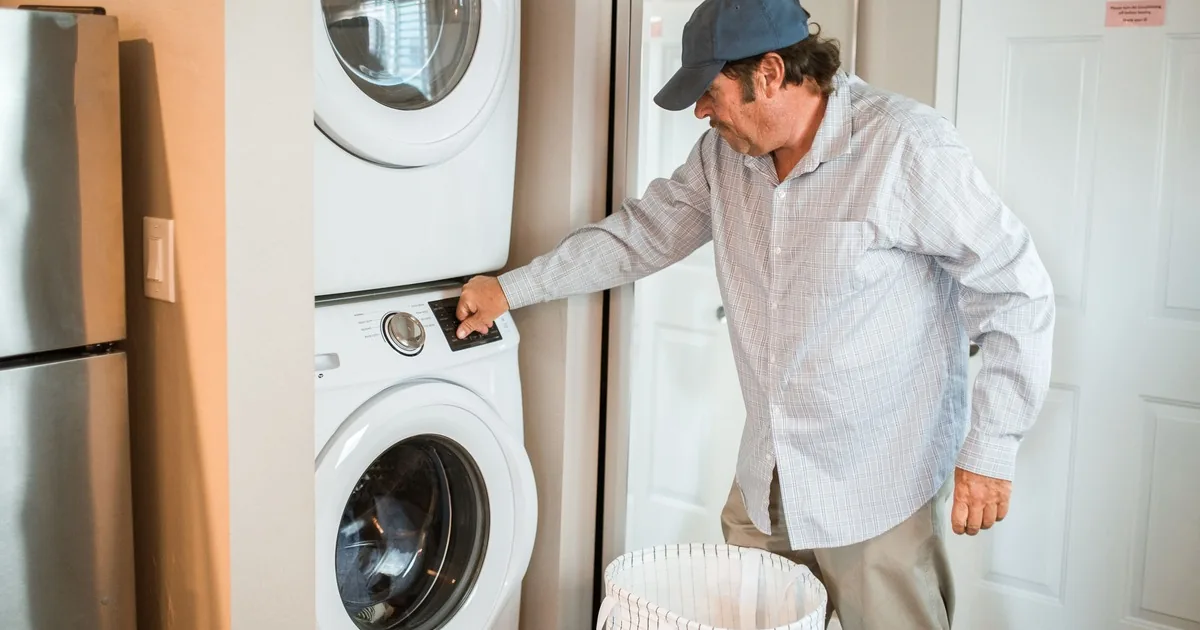
A homeowner calls and says, “The dryer needs two cycles now. Can you clean the vent on Friday?” That sounds ready to book. Then the technician arrives at a second-floor laundry closet, learns that the exhaust ends on a steep roof, and finds that the dryer cannot be pulled forward without removing a door.
Good dryer vent cleaning booking questions prevent that surprise. Confirm the appliance is vented, record the exact symptom, screen for an active safety concern, map the likely exhaust route, locate the termination, and document access. Keep diagnosis and repair scope open until a qualified person inspects the system.
Confirm there is a vented dryer to service
Start with the appliance. Ask whether the caller has a separate clothes dryer, a stacked pair, an all-in-one unit, or a compact machine. Get the manufacturer and model when available. A clear photo of the model label can help the office confirm the dryer type without asking the customer to move the appliance.
This distinction matters because some dryers do not use an exterior exhaust duct. ENERGY STAR explains that a conventional vented dryer sends warm, moist air outside, while a heat-pump dryer uses a closed-loop system and collects or drains condensed water. If the caller has a ventless model, the request may belong with an appliance service company, filter maintenance procedure, or manufacturer support rather than a dryer-vent cleaning route.
For a vented dryer, record whether it is gas or electric. The fuel does not tell reception what is wrong, but it can affect company routing, technician qualifications, and the questions used when there is a gas odor. Note whether the appliance belongs to the homeowner, landlord, condominium association, or laundry operator. Rental and multi-unit work may require authorization before anyone moves equipment or enters a common area.
Ask what prompted the call in the customer’s own words. Useful descriptions include longer drying time, clothes that feel hotter than before, a warning displayed by the dryer, lint around the connection, weak movement at the outdoor flap, or a routine maintenance request. “Towels now need a second cycle” is better than “vent clogged.” The first is an observation. The second is a diagnosis the caller may be guessing.
Screen for active heat, smoke, or gas concerns
Routine booking stops when the caller reports an active emergency. Follow the company’s approved safety script for smoke, flame, sparking, scorching, a strong burning odor, a gas odor, or a carbon-monoxide alarm. Tell the caller to follow emergency-service and utility guidance. Do not keep asking route questions while a hazardous condition may be developing.
The U.S. Consumer Product Safety Commission warns that lint buildup in a dryer or exhaust duct can block airflow and contribute to excessive heat. That supports a careful safety screen. It does not prove that lint caused a particular complaint. Appliance faults, a damaged connection, a blocked termination, a crushed transition, and other conditions may produce overlapping reports.
For a non-emergency call, ask whether the dryer is currently being used and whether anything changed recently. A new dryer, remodeling work, flooring replacement, moving the machine, a pest nest at the outlet, or a repaired exterior wall can change the route or connection. Record dates where the caller knows them. Avoid telling the customer to dismantle the connection, climb onto a roof, or reach behind a hot appliance for a better answer.
Map the route before assigning the visit
The vent is a route through the building. Reception may not know every concealed detail, but a rough map can reveal the likely access plan.
Begin behind the dryer. Is the machine in an open laundry room, a tight closet, a bathroom alcove, a garage, or a shared laundry area? Is it freestanding or stacked? Ask how much space exists in front and at the sides. Note closet doors, shelves, drain pans, cabinetry, gas piping, water lines, and floor protection that may limit movement. Ask whether the company is authorized and equipped to move the appliance under its normal service policy.
Then trace the caller’s best understanding of the exhaust direction. Does the connection appear to enter the wall behind the dryer, turn into the floor, rise toward the ceiling, or run to a nearby exterior wall? Which floor contains the laundry area? Is there a finished room, garage, crawlspace, basement, or attic on the other side? Has anyone documented the route during construction or a prior service visit?
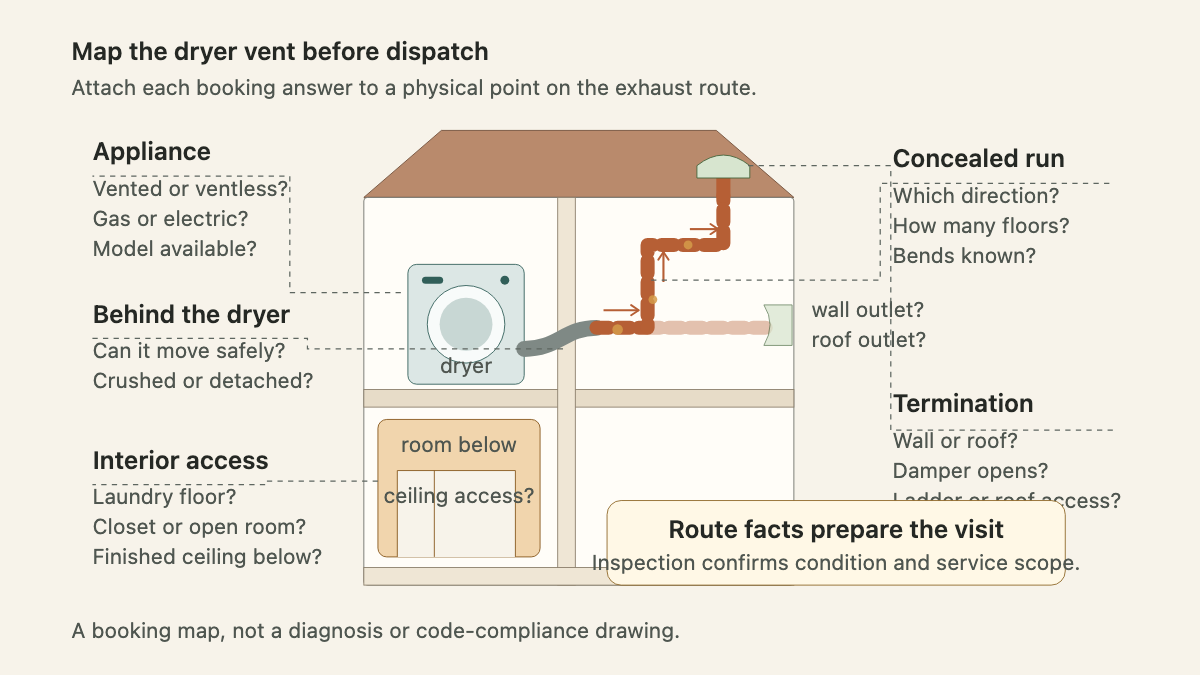
Ask about turns without pretending the caller can count concealed elbows. A customer may know that the duct rises from a first-floor closet and exits through the roof, or that a prior technician described several bends. Keep uncertain fields marked unknown. The Dryer Vent Safety Council’s homeowner guidance describes full-line inspection and cleaning that accounts for run length and bends, includes the exterior termination, and verifies the result. Those details help the office prepare equipment and time. They are still subject to inspection.
Apartment, condominium, and commercial laundry calls need a building question. Does the dryer have its own duct, or does the caller believe it connects to a shared exhaust system? Who controls the roof, exterior wall, mechanical room, and utility spaces? Get the property manager’s name, access rules, certificate-of-insurance requirements, loading instructions, parking limits, and approved work hours before dispatch.
For broader HVAC duct estimates, use the air-duct cleaning estimate intake guide. Keep the work orders separate. A clothes-dryer exhaust line and a home’s heating and cooling duct system serve different equipment and may require different tools, scopes, and technicians.
Locate the termination and describe safe access
Ask where the exhaust appears to leave the building. Common caller descriptions include a flap on an exterior wall, a hood near the foundation, or a cap on the roof. Record the side of the building and approximate floor level. If the customer can observe it safely from the ground, ask whether the damper opens while the dryer runs and whether lint, nesting material, damage, paint, landscaping, or stored objects are visible around it.
The U.S. Fire Administration’s dryer safety flyer advises checking the vent behind the dryer for damage, crushing, or restriction and confirming that the outdoor covering opens during operation. Reception can capture those observations. It should not ask the caller to remove a cover, probe the duct, stand beneath falling debris, or use a ladder.
Access deserves its own work-order field. Note fences, locked gates, pets, steep grades, narrow side yards, balconies, roof height, fragile landscaping, snow, or a neighbor’s property between the service vehicle and the termination. For a roof outlet, state the company’s policy clearly. Some firms inspect roof terminations under defined conditions; others require a separate roofer or decline roof work. Weather can change that plan on the day of service.
Separate cleaning from repair or rerouting
A cleaning appointment should not quietly become a promise to repair the system. Read the company’s included scope in plain language. Does the visit include inspection, mechanical cleaning, before-and-after airflow measurement, appliance movement, transition replacement, exterior-cover cleaning, minor fastening, photographs, or a written condition report? Name exclusions too.
A crushed transition, disconnected joint, damaged outlet, inaccessible route, unsuitable material, or suspected installation problem may require a separate estimate or another trade. The office can record what the caller sees and route the note for review. It should avoid promising that a technician will reroute concealed ductwork, cut walls, repair a roof, move a gas connection, or certify code compliance during a standard cleaning visit.
USFA’s basement fire-safety guidance advises cleaning the lint filter every use and cleaning dryer vent ductwork every year. If your company gives maintenance reminders, attribute the public guidance and let a qualified technician adjust the recommendation for the actual route, usage, appliance, and observed condition. A busy shared laundry room and a short residential run do not present the same service history.
When the complaint centers on the appliance failing to heat, shutting off, or displaying a fault, the dryer-not-heating intake guide helps separate appliance-service details from exhaust-service observations. One visit may reveal a need for the other trade, but reception should not collapse them into one diagnosis.
Read back a field-ready booking note
Close with a short summary that preserves what is known and what remains uncertain:
“Electric vented dryer in a second-floor hallway closet. Customer reports towels began needing a second cycle about three weeks ago. No smoke, flame, sparking, burning odor, gas odor, or alarm reported. Dryer is stacked above the washer and sits behind folding closet doors. Customer believes the duct rises into the attic and exits through the rear roof, but the concealed route and bend count are unknown. Roof cap is visible from the yard; operation of its damper has not been confirmed. Property is a townhouse. The association controls roof access, and the customer will obtain authorization. Cleaning, repair needs, and final scope remain subject to inspection.”
That note gives dispatch an appliance, symptom, route, termination, access plan, and boundary. An AI receptionist can collect the same approved fields after hours. The useful handoff is concrete: where the dryer sits, where the exhaust may travel, who opens the roof, and which facts the field team still needs to verify.