A homeowner turns a casement handle and feels almost no resistance. The handle goes around, but the sash stays six inches open. “The crank is stripped” sounds specific. For a service office, it is still only the caller’s description.
Start with the window’s condition. Find out whether the sash is open, loose, hanging unevenly, exposed to rain, or unable to secure. Then follow the movement in order: handle, operator shaft, arms, and sash. Capture the brand or label, hinge side, visible arm shape, markings, affected-unit count, and safe photos. That record lets a technician identify the repair without the office promising an operator that may not fit.
Route the open sash before discussing the crank
Ask where the sash sits right now. Is it fully closed and locked, partly open, or extended far enough that wind can catch it? Does it stay supported when the caller releases the handle? Is any operator arm detached? Is the glass cracked? Can the caller close and secure the opening through ordinary operation, without extra force?
A closed window with a loose handle may fit a normal repair slot. A sash hanging on one arm, moving in wind, or refusing to secure needs the company’s urgent review. Record weather exposure, floor, room use, children or pets near the opening, and whether the window is part of a bedroom escape plan. Keep the caller indoors. Do not ask anyone to lean outside, hold a moving sash for a photograph, or improvise a tie around the hardware.
If normal movement produces grinding, a hard stop, or visible twisting, stop the test. One observed cycle is enough. Repeated cranking can change the scene the technician needs to inspect.
The service record should quote the behavior: “Handle rotates with little resistance; sash remains partly open.” Avoid turning that sentence into “stripped gears confirmed.” A loose handle connection, wear inside the operator, a disconnected arm, trouble in the track, hinge resistance, or sash and frame conditions can produce different versions of a call that sounds the same at first.
Follow movement from the handle to the sash
The fastest useful question is, “When you turn the handle slowly, what else moves?” The answer places the break in motion without naming the failed part.
First watch the handle. Does the grip turn around a stationary center, wobble, lift off, or stay firmly attached? Ask whether a screw is visible in the handle and whether the handle appears seated on the operator stem. A close photo of that area may show fit and condition. The caller should not remove it for the phone intake.
Next ask about the shaft and cover. Does the stem beneath the handle rotate? Does the operator cover lift, shift, or remain fixed? Then move the observation outward. Can the caller see an arm moving along the sill? Does a second link arm move too? Does the arm remain connected to the sash bracket or track?
Finally, ask what the sash does. It may stay still, start moving and slip, travel unevenly, or bind near the same point each time. A sash that moves when gently pushed by hand does not settle the operator question, and reception should not ask the caller to push it. The technician needs the mechanism in its current state.
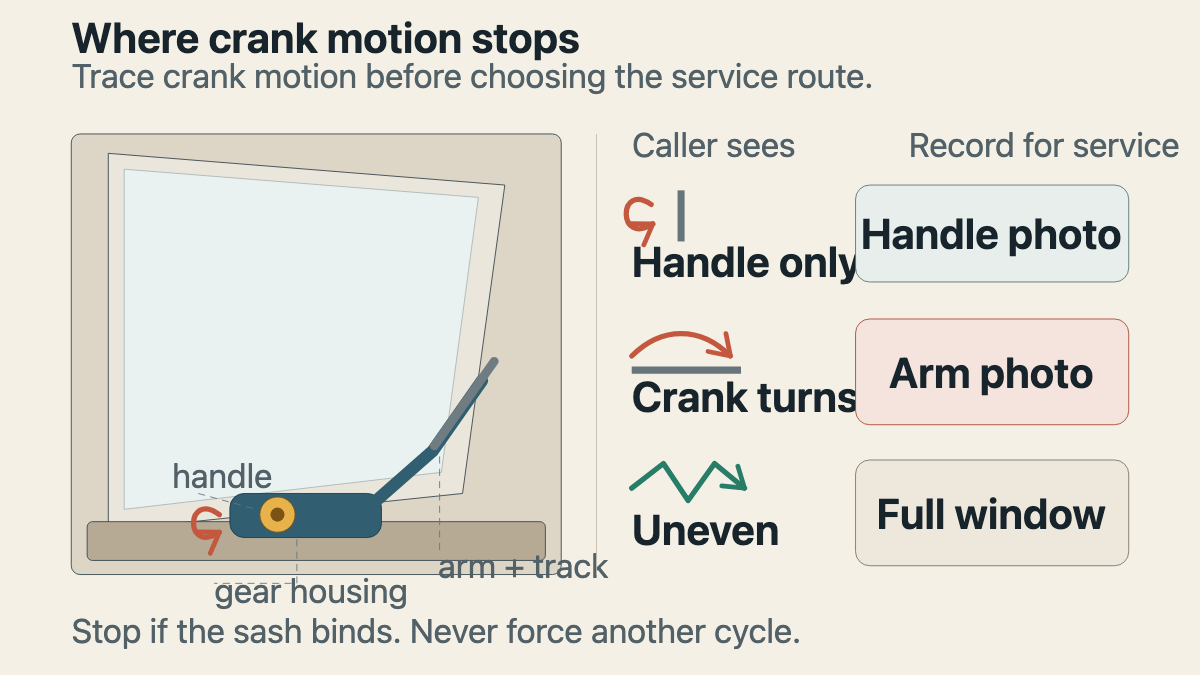
The motion map creates three practical routes. Handle-only movement calls for a clear view of the handle fastener and spline area. A turning crank with no sash travel calls for the complete operator arms, product identity, and markings. Uneven or resistant sash movement widens the appointment to hinges, track, frame, and sash condition. These are evidence routes, not diagnoses.
Collect the whole operator, not a lonely handle photo
A tight photo of a folding crank rarely gives a parts reviewer enough information. SWISCO’s casement and awning operator identification guide starts with an overhead view that shows as much of the operator and its arms as possible. It then calls for the dimensions appropriate to that arm style and any stamps or markings. The guide also makes an important limit clear: manufacturer information by itself may not identify the replacement.
Ask for the following photos only when they can be taken safely from inside:
- The entire window, square to the opening, with the current sash position visible
- The handle, its attachment point, and the operator cover
- A top-down view of every visible operator arm, link, bracket, and track
- Any etched logo, stamped number, product label, or code, photographed exactly as it appears
- The hinge side, sash corners, and any gap, rubbing mark, loose fastener, water stain, or damaged wood
- A matching window that still operates, if the property has one and it can be photographed without cycling the failed unit
Do not request disassembly as a condition of booking. Some identifying details may sit under a cover or on an arm that cannot be seen until the unit is opened farther. That is field work when the sash is unstable, the operator is jammed, or the caller lacks safe access.
Record hinge side by orientation and viewpoint: “hinges on the left when viewed from inside.” Words such as left-handed and right-handed are easy to reverse between manufacturers, parts catalogs, and people standing on opposite sides of the wall. A photo removes the argument.
Product identity prevents the wrong parts promise
Operator shape varies with manufacturer, series, vintage, size, and window configuration. Andersen’s operator identification guidance directs owners to identify the product before choosing the operator. Its guidance for A-Series and 400 Series casement operator types distinguishes straight-arm and split-arm configurations within named product families.
That is why “Andersen casement” is not a complete parts request. Neither is one number copied from the handle. Preserve every marking, but attach it to photographs of the whole mechanism and the window label. Add the approximate installation year, frame material, room, floor, and whether nearby windows match.
Count the affected units. One spinning crank among twelve matching windows suggests a focused repair review. Four same-age windows that grind at the same point may change the parts plan and appointment length. It still does not prove a shared failure. Give the technician the pattern and let the inspection explain it.
Ask who owns and authorizes the window in a rental, condominium, office, or managed property. Building management may control exterior appearance, access, approved hardware, work hours, or proof of insurance. The person on the phone may be able to report the symptom but unable to approve the visit.
Widen the visit when the sash tells a bigger story
A crank complaint can be the first visible sign of a broader window condition. Record whether the sash rubs the frame, sits low at one corner, moves freely until the final inches, or leaves a changing gap. Ask about recent impact, repainting, water entry, swollen wood, loose trim, storm damage, or work on the wall around the opening.
Those facts help dispatch choose between a narrow hardware visit and a wider assessment. They do not prove that the full window needs replacement. A repairable operator may sit in a damaged opening, and a sound opening may contain discontinued hardware. Parts availability and field condition decide the scope.
If the caller reports frame rot, recurring water stains, cracked sash material, or an opening that has moved, link the intake to the broader full-frame versus insert window consultation. Keep the intent separate when the main complaint is security hardware. The window will not lock guide covers latch travel, keeper alignment, and whether a closed sash can secure. A vertically sliding sash that falls belongs in the sash support intake guide, not this crank workflow.
Painted wood adds a building-age question. EPA says its Renovation, Repair and Painting Rule covers paid work that disturbs painted surfaces in covered homes and child-occupied facilities built before 1978. EPA also notes that authorized state and Tribal programs may administer their own requirements. Reception should flag construction age and deteriorated paint, then let the contractor determine what applies to the planned work.
Give the technician a motion record
Read the ticket back before ending the call. A useful note might say: “Second-floor bedroom casement, hinges on left when viewed indoors. Sash is open about six inches and remains supported. Glass intact. Folding handle stays attached and turns with little resistance. Operator stem appears to turn, but visible dual arms do not move. No grinding heard during one gentle observation. White vinyl frame, estimated 2008 installation. Label and overhead arm photos attached. One of six matching units affected. Clear interior access. Owner available Tuesday morning.”
That note gives the field team a product lead, a motion boundary, safe access details, and an honest account of what remains unknown. The best closing line is equally concrete: “We have the label and arm photos, and the appointment is for assessment and repair options. The technician will identify the operator before confirming the part.”
The wider window and door installer resource library can help an office keep adjacent repair calls in separate lanes. For this call, the lane is simple: secure the scene, follow the motion, photograph the full mechanism, and leave the parts decision with the person who can inspect it.
Sources
- How to Identify Casement and Awning Operators, SWISCO
- Identify Casement or Awning Window Operator, Andersen Windows & Doors
- Operator Types Used on A-Series and 400 Series Casement Windows, Andersen Windows & Doors
- Lead Renovation, Repair and Painting Program, U.S. Environmental Protection Agency