A homeowner calls during a hard rain and says, “Water is coming in under the front door.” The towel is wet near the latch-side corner, but the rest of the threshold looks dry. They want to know whether they need a new sweep, more caulk, or a whole door.
The office should resist naming the repair. A useful exterior door threshold leak intake captures the first wet point, the way rain reached the opening, how the door closes, the exterior landing, recent work, visible damage, safe photos, and who can authorize an inspection. Water at the floor can pass through the door assembly, around the opening, or along an adjacent surface before it becomes visible indoors.
Pin the first wet point to the door
Start with location. Ask the caller to stand inside, face the closed door, and describe where water first appeared. Use “hinge side” and “latch side” instead of left and right. Those terms survive the handoff when the technician views the door from outside.
Get specific. Did the first bead show at a bottom corner, along the center of the threshold, beneath a sidelight, at the base of a jamb, or from under the interior trim? Did the floor become wet before the caller noticed the threshold? Is the stain on the finished floor, baseboard, wall, or ceiling below?
Then record spread. A note such as “first wet at latch-side bottom corner, then a narrow line moved six inches onto the entry floor” gives the inspector a starting point. “Door leaks” does not.
Avoid turning the wet point into a diagnosis. The U.S. Department of Energy’s sill-pan guidance treats the door as an opening in the wall’s water-control layer. The product, perimeter joints, flashing, and nearby wall all remain in scope until someone inspects them.
Record the rain event that produced it
Threshold leaks can depend on storm direction, wind, duration, and the surface outside the door. Ask whether rain was blowing toward the entry, falling nearly straight down, or flowing across a porch or landing. Find out whether the door sits under a deep porch, a small overhang, or open sky.
Timing helps too. Did water appear as soon as rain began, after a long steady period, during one wind gust, or after the storm eased? Has the same door stayed dry during lighter rain? Has the leak happened in more than one storm?
Capture the exterior approach without asking the caller to step into unsafe weather. From a sheltered position or after the storm, they may be able to report a concrete stoop, wood deck, pavers, porch floor, or accessible threshold. Ask whether water ponds near the door, runs toward it, splashes from a roof edge, or arrives from one side. Record what the caller sees. Do not tell them that the landing slope caused the leak.
FEMA’s guidance on water intrusion through windows and doors focuses on wind-driven rain during extreme wind events. Its useful intake lesson is narrower: water can move through a door product or around its installation, and wind changes the demand on the opening. An ordinary rain call still needs field diagnosis.
Check how the door closes
The position of the slab matters. Ask the caller to close the door normally and describe whether it latches without lifting, pushing, pulling, or leaning on the handle. Ask whether the deadbolt aligns. Find out if the lower corner rubs, if daylight is visible, or if the bottom contact looks uneven.
Do not coach the caller through threshold adjustment while water is entering. Adjustable caps, sweeps, hinges, latches, and weatherstripping interact. Raising one section can make the slab bind or change contact elsewhere. The office needs the operating symptoms, not a phone repair attempt.
Also ask whether the door is single or double, inswing or outswing, and whether it has sidelights. Note the material if known, such as fiberglass, steel, or wood. For double doors, identify the active leaf and say whether water appears at an outside corner or where the two doors meet.
FEMA advises that doors should close tightly and firmly latch because cracks and gaps can admit wind-driven rain. That supports recording closure and latch behavior. It does not prove that adjustment will solve the caller’s leak.
Keep concealed drainage in the inspection scope
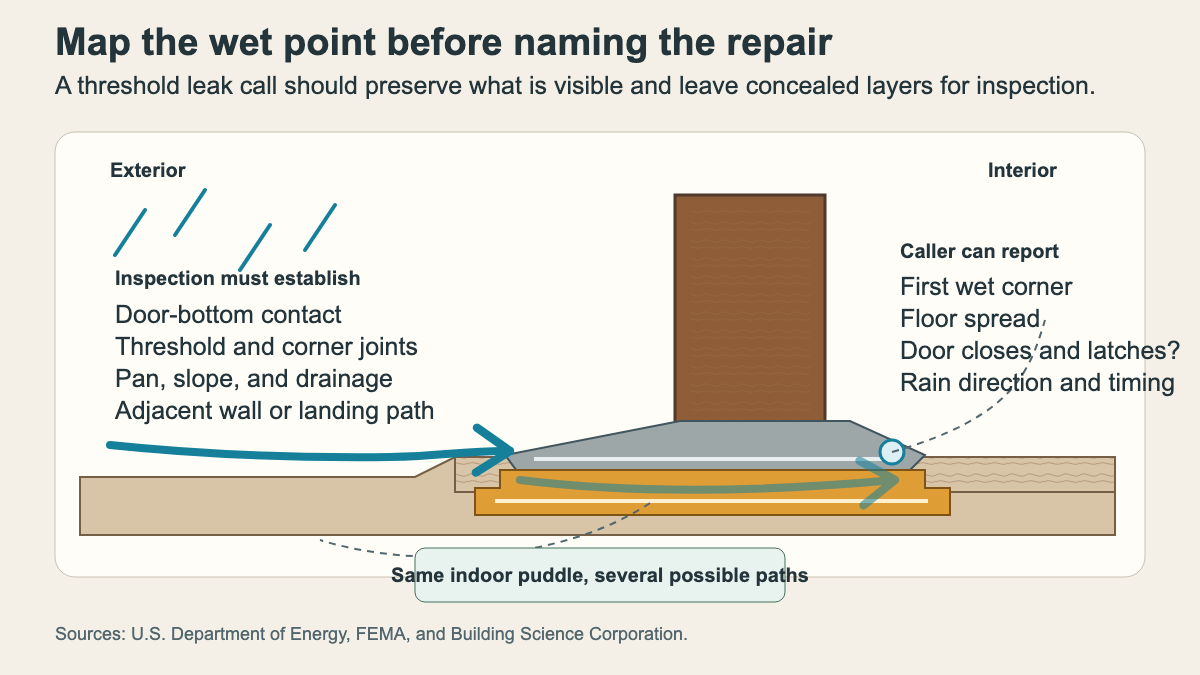
The caller can see the slab, bottom seal, exposed threshold, floor, and parts of the jamb. They usually cannot see the rough sill, pan flashing, corner seals, substrate, or how the opening connects to the wall drainage plane.
Building Science Corporation’s pan-flashing guide describes a drained opening with a waterproof pan surface, a back dam or positive exterior slope, end dams, and a path that laps over the drainage plane below. Existing doors may use different approved details. The principle is what matters at intake: water management can continue beneath and beside the visible threshold.
That is why “just needs caulk” is a poor ticket. Sealant might be present, missing, separated, or unrelated to the entry path. Adding material in the wrong place can also obscure evidence or interfere with drainage. Reception should describe visible joints and prior repairs without prescribing another bead.
Ask whether anyone has recently replaced the door, threshold, flooring, siding, porch, flashing, or exterior sealant. Get the approximate date and contractor if known. A leak that began after a new porch surface was installed carries a useful change history. It still does not establish fault.
Screen damage and immediate hazards
Ask whether water is active now and how much has reached the interior. A few drops at one corner belong in a different routing category than water spreading across a foyer or reaching the room below.
Check for wet outlets, extension cords, floor lamps, or other powered equipment near the water. Do not ask the caller to touch a wet device, remove an outlet cover, or cross standing water to unplug something. Follow the company’s escalation policy for electrical danger.
Also ask about a soft floor, swollen trim, loose tile, lifted planks, sagging material, or a door frame that moves. Keep people away from visibly unstable finishes. If water has spread beyond the opening, the job may require coordination with flooring, siding, electrical, or water-damage professionals after inspection.
Simple property protection can be reasonable when it is safe: move a rug or furniture away, place a towel or shallow container at the indoor wet point, and photograph the condition before drying the surface. Do not advise the caller to pry up the threshold, pull trim, drill a drain hole, climb during a storm, or run a hose test.
Ask for a short, useful photo set
Request orientation before detail. One wide interior photo should show the whole closed door and nearby floor. Add a medium photo of the lower opening, then close views of the first wet point and both bottom corners. An exterior photo taken safely after the weather passes should show the whole doorway, overhang, landing, and approach.
If the door has sidelights or a double-door meeting line, include them in the wide view. If a manufacturer label is already visible on the hinge edge or frame, a clear photo can help identify the product. Never ask the caller to remove a cap, sweep, trim piece, or fastener to find one.
Name each file by viewpoint when it enters the work order. “Interior-wide,” “latch-corner,” and “exterior-landing” are more useful than a string of phone-generated image numbers.
For calls centered on air, daylight, or worn seals without active water, the weatherstripping and draft-repair intake guide keeps that scope separate. If the first wet point is at a nearby window, use the window rain-leak inspection guide. The window and door resource hub covers other opening-specific calls.
Book the inspection the evidence supports
Confirm the address, floor level, door location, property type, parking, gates, pets, and access to both sides of the opening. Ask who owns the property and who can authorize inspection, testing, and later repair. A tenant’s report can be detailed and accurate, but the company may still need landlord approval before opening trim or quoting corrective work.
Set the appointment expectation plainly. The first visit may be a visual inspection, a diagnostic appointment, warranty assessment, or repair estimate under company policy. State the diagnostic fee and what it covers. Avoid promising a same-day fix because drying, controlled testing, material removal, product identification, or another trade may be needed.
Read the ticket back before ending the call:
“Fiberglass front entry door under a shallow porch. Water first appeared at the latch-side bottom corner during wind-driven rain from the east, about thirty minutes after the storm began. A narrow wet line reached the wood floor but stayed away from outlets. Door latches only when pulled toward the frame; no rubbing reported. Caller sees water collecting on the concrete landing near the same corner. Exterior caulk was replaced last spring; installer unknown. No soft floor or loose trim reported. Interior-wide, bottom-corner, threshold, and exterior-landing photos attached. Homeowner will be present for a diagnostic inspection.”
That note gives the technician a reproducible event, a starting location, operating symptoms, exterior context, change history, safety screen, and access plan. An AI receptionist can collect the same fields after hours when the company supplies its service area, fees, escalation rules, and appointment types. The field inspection still owns the diagnosis.