“The right door closes, but only if I pull the left one toward me.”
That sentence contains the start of a useful French door repair intake. It identifies two leaves, an interaction between them, and a closure problem that may involve more than one hinge. The office still needs to learn which leaf is active, where contact begins, whether the inactive leaf is secured, and how the gaps look around the full opening.
When French doors rub or fail to latch, ask the caller to operate each leaf separately, locate the first point of contact, compare the visible gaps, and describe the center hardware. Then collect wide photos with both doors closed and open. Book an assessment around those observations. Do not promise a hinge adjustment before a technician sees the frame, sill, panels, and hardware together.
Name the active and inactive leaves first
Paired doors are easy to describe badly. A caller may say “the left door” while standing outside, then send a photo taken from inside. That reverses the reference. Use fixed descriptions such as “the leaf with the everyday handle” and “the leaf with bolts at the top and bottom.” Record the view used in every left or right reference.
The active leaf is usually the one opened for daily passage. The inactive leaf may stay secured by flush bolts that engage at the head and sill. Some products use different hardware arrangements, so the office should record what the caller can see without assuming a standard configuration.
Ask the caller to try one slow open-close cycle of the active leaf while the inactive leaf remains secured. Then, if the inactive leaf can be released and moved normally, ask what happens when that leaf closes on its own. Stop the observation if a panel is loose, glass is damaged, hardware is pulling away, or the door needs force.
This short sequence separates three complaints that callers often blend together: one leaf rubbing the frame, the two leaves touching each other, and hardware failing to engage after the panels reach the closed position.
Locate the first contact, not the loudest scrape
A door can scrape along several inches after the first contact begins. The first contact tells the technician more than the longest scuff.
Ask the caller to watch the perimeter during a slow closing cycle and report where resistance starts. Useful descriptions include the upper center corner, lower center corner, threshold, hinge-side edge, meeting stile, latch receiver, or top and bottom flush-bolt area. If the caller hears a scrape but cannot see it, ask where the sound begins and whether the panel must be lifted, pushed, pulled, or slammed to close.
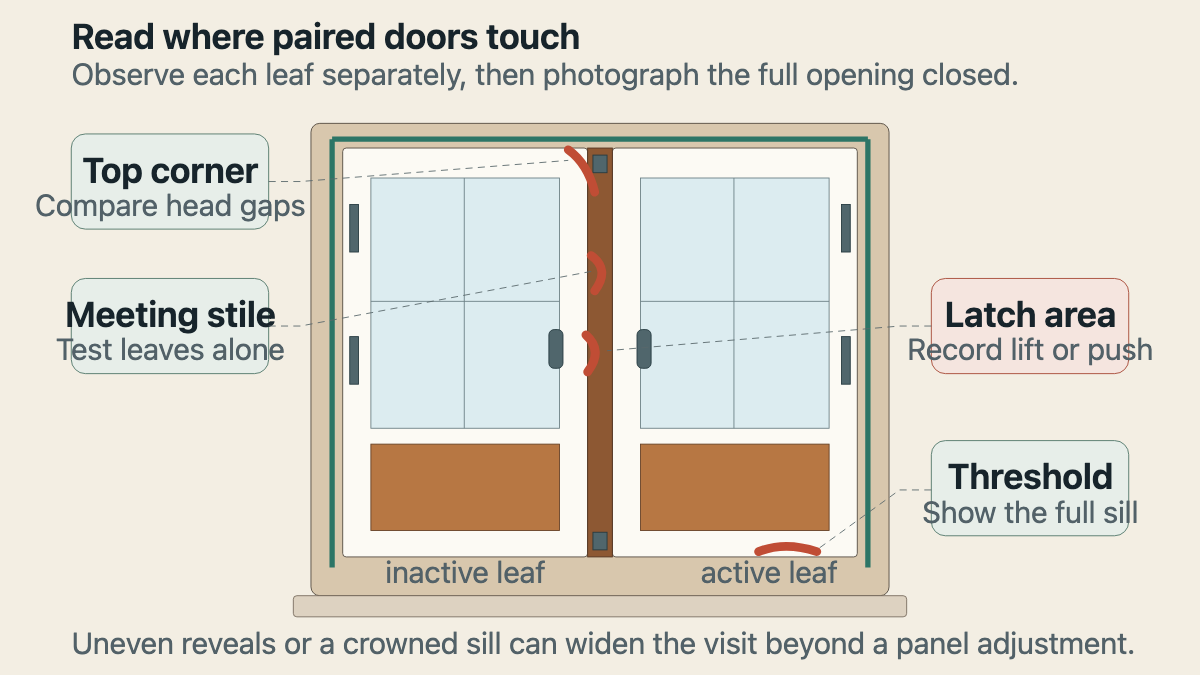
A pencil mark, worn finish, compressed weatherstrip, chipped paint, polished metal edge, or dark rub line can help locate repeated contact. Ask for one close photo of that evidence and one wider photo that keeps the contact point in context. A close-up of a scuff with no view of the paired panels tells the technician very little.
Do not coach the caller to plane an edge, add a shim, bend a receiver, or drive a longer screw. Those actions can hide the original condition, damage a product-specific hinge, or change how the two leaves meet.
Read the gaps before calling it a hinge problem
The visible space around a door panel is often called the reveal. Ask the caller whether the reveal looks even along the top, both outer jambs, the threshold, and the center where the doors meet. Photos should be taken straight on with both leaves fully closed. An angled image can make a consistent gap look tapered.
Manufacturer guidance draws a firm boundary here. Marvin’s swinging French door instructions tell installers to verify that the frame and sill are square, plumb, level, and true before adjusting panels. The guide says adjustable hinges can correct minor misalignment, but they cannot correct a humped sill, sagging head jamb, or frame that is not true.
Andersen’s hinged patio door service guide also separates side-to-side panel position from vertical position and tells the technician to check gaps at the sides, top, and bottom. It warns that hinge replacement does not correct every condition caused by an opening that is out of plumb, level, or square.
That is why “the top hinge is bad” is too narrow for an intake note. A caller can report that the top center gap closes to nothing while the bottom center gap grows wider. The technician decides whether that pattern comes from panel position, hinge condition, frame geometry, sill shape, installation, or another cause.
The broader exterior door repair intake guide covers water, weather seals, frame deterioration, and security across single exterior doors. Keep this French door record focused on how two leaves share one opening.
Treat the center as its own assembly
The center meeting line may include an astragal, weather seals, latch receivers, hook-bolt receivers, and flush-bolt hardware. Andersen’s service guide identifies several of these components at the astragal or jamb. Their presence matters because a caller who says “the doors hit in the middle” may be describing panel-to-panel contact, a latch meeting its receiver, a bolt that misses its opening, or weatherstrip compression.
Ask which leaf carries the center strip or astragal. Then capture what happens in order. Do the panels reach the closed position? Does the latch enter its receiver? Does the handle need upward pressure? Do the top and bottom bolts on the inactive leaf engage? Does locking become easier when someone pushes the panels together?
Record the answer without naming the failed part. The phrase “active leaf reaches the astragal, but the latch sits below the receiver unless the handle is lifted” is useful. “Needs a new latch” is a diagnosis made from a phone call.
Also ask whether the inactive leaf was recently opened for moving furniture, appliance delivery, or construction access. A flush bolt left partly engaged, debris in a receiver, or a changed panel position may appear after that event, but reception should preserve it as history rather than cause.
Add timing, weather, and movement history
Find out when the behavior started and whether it changes. Ask about recent storms, impact, flooring or threshold work, painting, hardware replacement, foundation work, and long periods when one leaf stayed unused. Note whether rubbing occurs every day or mainly during humid, rainy, hot, or cold conditions.
Wood products can change with moisture, while metal, fiberglass, finish layers, seals, fasteners, and the surrounding opening introduce other variables. The office should not reduce a seasonal pattern to “swollen wood” unless a technician has confirmed the door material and condition.
Look beyond the rub mark for visible movement. Ask about cracks near upper corners, separated trim, a threshold that bows upward, loose hinge leaves, pulled screws, water staining, soft wood, or a panel that appears twisted. If the opening includes old painted surfaces and the work may disturb them, flag the property age for the contractor’s lead-safe process. The EPA explains the federal boundary in its Renovation, Repair and Painting Program; state, Tribal, and local rules may add requirements.
Request a photo set that shows the relationship
The technician needs the doors as a system. Request these images when the customer can take them safely:
- one straight-on photo from inside with both leaves closed
- one straight-on photo from outside with both leaves closed
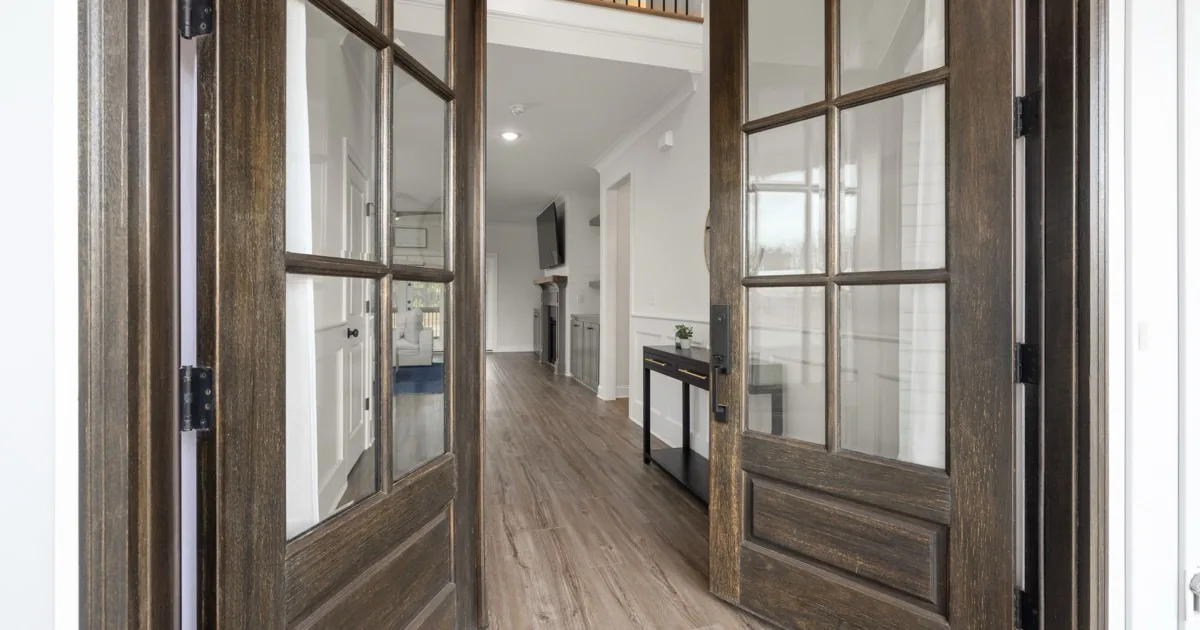
- one wide photo with both leaves open enough to show hinges, center hardware, and threshold
- close views of each contact mark, hinge set, latch and receiver, astragal, flush bolts, and sill receivers
- a short video of one slow active-leaf cycle, followed by the inactive leaf if it operates safely
- product labels, etched glass marks, hinge stamps, or serial information without removing trim or hardware
Product identity matters. Andersen publishes Frenchwood hinge guidance by manufacturing date and product family. A generic adjustment promise can be wrong even when the visible symptom looks familiar.
Write the dispatch note around observations
A finished note should let a technician picture the opening before arrival:
“Rear inswing paired patio doors viewed from inside. The right active leaf is used daily; the left inactive leaf has top and bottom flush bolts. With the inactive leaf secured, the active leaf first touches at the upper center corner and the latch sits below its receiver unless the handle is lifted. The active leaf closes without scraping when the inactive leaf is open. The head gap appears narrower at the center than at the outer jamb. The problem began after a furniture delivery on Thursday. Both leaves lock with effort. Full-opening, hinge, astragal, latch, flush-bolt, threshold, and contact-mark photos are attached.”
That note supports a real assessment. It does not commit the company to a hinge adjustment, latch repair, panel replacement, or frame correction before inspection.
If an AI receptionist handles after-hours calls, it can follow the same sequence and label the two leaves consistently. The useful handoff is still simple: where contact begins, how each leaf behaves alone, what the center hardware does, and what the full opening looks like when closed.
A French door pair should arrive on the schedule as one opening with two interacting panels. Capture that relationship, and the technician starts with evidence instead of “door rubs.”