A homeowner calls at 7:15 on a rainy morning and says, “My front door will not shut right.” That could mean the slab rubs the jamb, the latch misses the strike, the sweep drags across the threshold, or swollen wood has changed the fit. Then the caller adds one more fact: water appeared on the floor overnight.
Do not book that as “adjust front door” yet.
A useful exterior door repair intake captures the observed symptom, where it appears on the assembly, whether the door closes and locks, when the problem started, what the weather was doing, and what the customer can safely photograph. Those details let the office choose among routine hardware work, a frame or threshold assessment, urgent securing, and a broader door-opening evaluation. The technician still determines the cause on site.
Start with what the door does
Ask the caller to describe the behavior before naming a part. “What happens when you open, close, latch, and lock it?” gets better information than “Do you think the hinges are bad?”
Record the customer’s words. Useful descriptions include:
- the top corner rubs before the door closes
- the bottom drags across the threshold
- the knob turns but the latch does not enter the strike
- the deadbolt works only when someone lifts or pushes the door
- daylight shows at one edge when the door is closed
- cold air enters near the bottom corner
- rainwater appears at the sill or on the nearby floor
- the frame feels soft, looks split, or has peeling paint
Then ask when the symptom began. A door that changed after new flooring, a storm, impact, lock replacement, or months of seasonal movement needs a different first look. Note whether the problem is constant or changes with rain, heat, humidity, or temperature. That timing is evidence. It is not a diagnosis.
Security comes first. Ask, “Can the door close and lock right now?” If the answer is no, record whether this is an occupied home, rental, vacant property, or business entrance. Follow the company’s urgent-securing policy. Never tell a caller that a misaligned lock is safe enough for the night.
Put the symptom on the door assembly
Callers use “door frame” to mean almost anything around the slab. The intake record should be more precise without forcing the homeowner to know trade vocabulary.
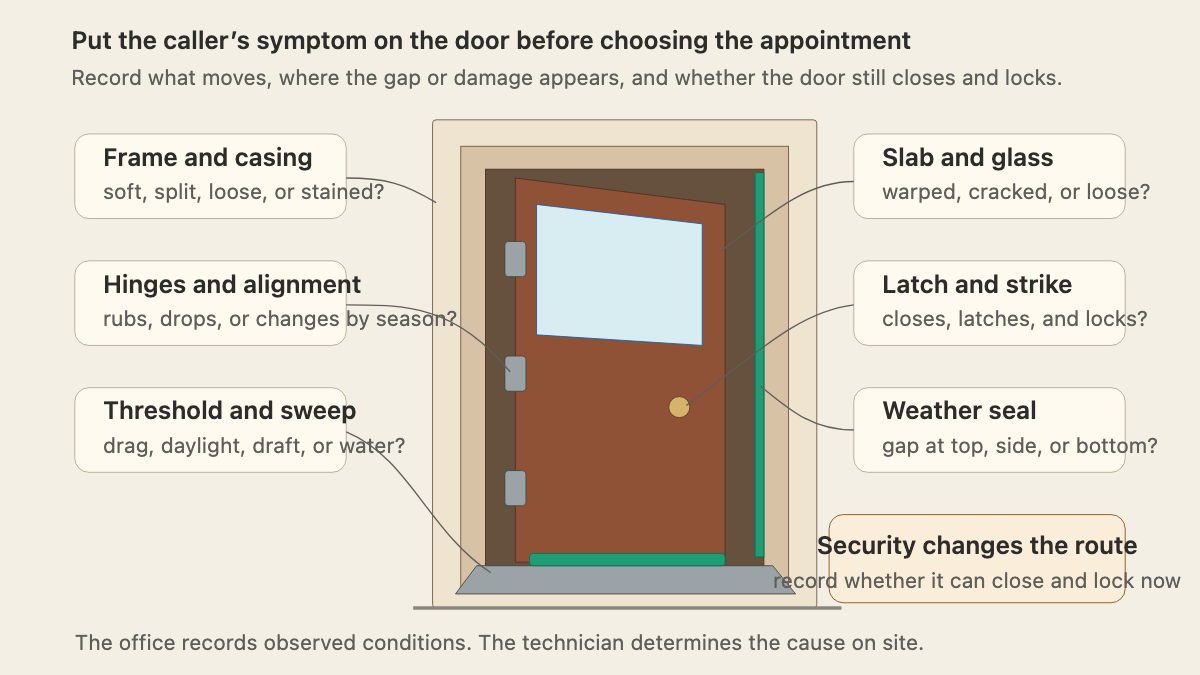
Walk around the assembly in a fixed order. Start with the moving slab. Ask whether it is wood, steel, or fiberglass if the caller knows. Note any glass, sidelights, storm door, pet door, dents, cracks, loose panels, or visible warping.
Move to the hinge side. Ask whether the hinges look loose, bent, rusty, painted over, or pulled away. Record where rubbing occurs, but do not promise that tightening a screw will solve it. Alignment can reflect conditions at the hinge, jamb, threshold, frame, or opening.
At the latch edge, separate the latch from the deadbolt. Does each enter its strike? Does the key turn normally? Does the customer have to lift, lean on, or slam the door? If a smart lock was recently installed, capture the brand and model from a photo when possible. Keep access codes out of ordinary job notes.
Finish with the perimeter. Ask about gaps along the top, sides, and bottom. A torn strip at the latch side, a flattened corner pad, a loose sweep, and daylight under the slab are different observations. The weatherstripping and draft repair call guide covers draft-specific intake across doors and windows.
Treat water as a scope question
A caller may ask for “new weatherstripping” because the floor is wet. That requested fix should be recorded, but the appointment must reflect the evidence.
Pacific Northwest National Laboratory guidance separates the moving seals around a door from air sealing and flashing around the rough opening. Its retrofit guidance also calls for inspection of water damage and dry rot. Building Science Corporation explains that sill-pan drainage is intended to collect water that reaches an opening and direct it outside. Those layers can sit behind the threshold and trim.
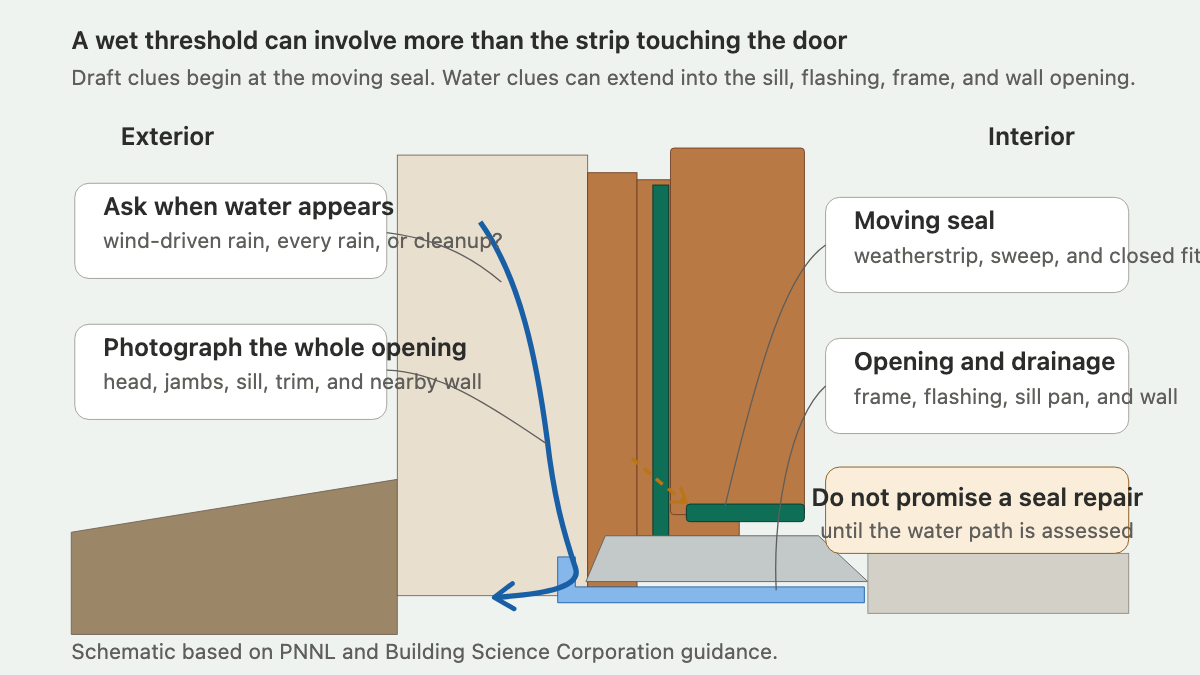
Ask exactly where the customer first sees water: on top of the threshold, beneath it, at a lower jamb corner, under interior trim, or farther into the floor. Record whether it happens during every rain, only wind-driven rain, after snowmelt, or during cleaning. Ask whether the overhang, gutter, downspout, porch, siding, or exterior caulk near the opening has changed.
Photos should include the entire door from inside and outside, the head, both jambs, threshold, lower corners, adjacent wall, and floor. Add close-ups of stains, peeling finish, soft material, gaps, or damaged seal. A tight close-up with no context can hide the path a technician needs to inspect.
Do not tell the caller that caulk, a sweep, or weatherstrip will stop the leak. Water may be entering at more than one point, and the office cannot trace that path through a phone call. If material is soft, crumbling, swollen, or repeatedly wet, route the job under the company’s moisture and deterioration policy.
Separate a repair visit from a replacement consultation
A limited complaint can fit a repair appointment. Examples include an identified loose hinge, worn sweep, damaged weatherstrip, misaligned strike, or minor trim issue within the company’s service list. Mr. Handyman’s published door-service guidance similarly distinguishes hinge, hardware, alignment, weatherstripping, and minor frame conditions from badly warped, cracked, deteriorated, or poorly fitting assemblies that may need replacement assessment.
That distinction should guide routing, not become a promise. A dispatcher can say, “I’ll book an assessment for the sticking and latch problem. The technician will check whether the repair stays within our door-service scope.”
Use a broader consultation when the caller reports severe deterioration, a damaged slab, recurring water entry, movement around the opening, failed glass, multiple prior repairs, or a desire to change the door itself. The exterior door replacement quote guide covers size, swing, unit configuration, material, glass, jamb depth, and finish choices for planned replacement.
Never quote a replacement from “standard 36-inch front door” alone. The rough opening, jamb, threshold, trim, sidelights, wall material, hand and swing, exposure, and local requirements can alter the scope.
Build a photo set a technician can use
Before sending an upload request, tell the customer what to capture. Ask for one wide photo of the full opening from inside and one from outside. Then request the symptom areas: each hinge, latch and strike, deadbolt, top and lower corners, threshold, sweep, weatherstrip, and any water or rot evidence.
For a rubbing door, a short video of one slow open-close cycle can show where resistance begins. The customer should stop if the slab, glass, frame, or hardware appears loose or unsafe. Do not coach someone to remove hinge pins, pry trim, probe hidden damage, or dismantle a lock for the intake.
Confirm that the image set belongs to the correct opening. A side garage door and the front entry may look similar in close-up. Label the location in ordinary terms such as “front entry,” “kitchen to deck,” or “house to attached garage.”
Close with a dispatchable record
Read back the job in one compact paragraph:
“Front entry door at 42 Cedar Lane began rubbing at the upper latch corner after this week’s rain. The latch misses unless the customer pushes the slab, but the deadbolt currently locks. Water was found at the interior lower hinge corner. Photos are attached for the whole opening, threshold, hinges, latch, and stained trim. The customer is available Tuesday morning, and the office will review the moisture evidence before confirming the appointment type.”
That record gives the technician a location, symptom, timing, security status, moisture clue, evidence set, and next action. If an AI receptionist handles the call after hours, it can collect the same fields and route the record under the company’s rules. It should not diagnose the door or promise a repair.
The best intake leaves one thing for the site visit: the cause. Everything the office can observe and organize should already be waiting with the job.