A homeowner calls about one loose cabinet hinge. “That should take five minutes,” she says, then asks why the visit has a minimum charge. The office has two bad options if the policy is vague: defend a random-looking fee or promise that the repair will fit inside it.
Use a simpler explanation. State the minimum amount early. Name the event that triggers it, define the labor or service it includes, and explain which materials or added tasks require approval. Then collect the scope and record the caller's agreement. A minimum service charge is easiest to explain when it reads like a service policy, not a surprise line on the invoice.
Name the policy before you defend it
Handyman companies use several pricing structures. A small task may have a flat price, an hourly rate with a minimum labor period, or a minimum visit charge. Those terms describe different promises. If the website says “minimum service charge,” the scheduler says “trip fee,” and the estimate says “labor minimum,” the caller has every reason to wonder whether three charges are coming.
Choose one approved name for each policy and use it on the phone, in booking confirmations, on estimates, and on invoices. The name should match the mechanics. A minimum visit charge may reserve a technician and include a defined amount of labor. A trip charge may cover dispatch or travel and leave labor separate. A flat small-job price may cover one tightly described task. The office should never improvise among those models during the call.
Housecall Pro's handyman pricing guide describes hourly, flat-rate, and minimum-fee approaches. Jobber's pricing guide also starts with the company's costs and chosen pricing model. Neither source supplies a universal fee. Your amount and inclusions have to come from your own costs, service area, schedule, and work policy.
Write the approved policy in one sentence before training anyone to explain it. For example: “Our minimum visit charge applies when we reserve and send a technician, and it includes up to one hour of approved labor. Materials and added work are separate.” That sentence is only useful if it matches the estimate and the actual booking rules.
Explain the reserved visit
The caller sees the loose hinge. The schedule sees a route stop.
A technician must reach the address, park, bring in the relevant tools, confirm the scope, protect the work area, complete and test the repair, clean up, document the result, collect approval or payment, pack the vehicle, and reach the next stop. Some steps are short. They still occupy the service window.
Angi's consumer cost guide notes that minimum call-out charges are common for small handyman jobs and may cover the first labor period. Housecall Pro includes travel, setup, administrative time, tools, and labor in its discussion of minimum pricing. These sources support the structure, not a price benchmark for your market.
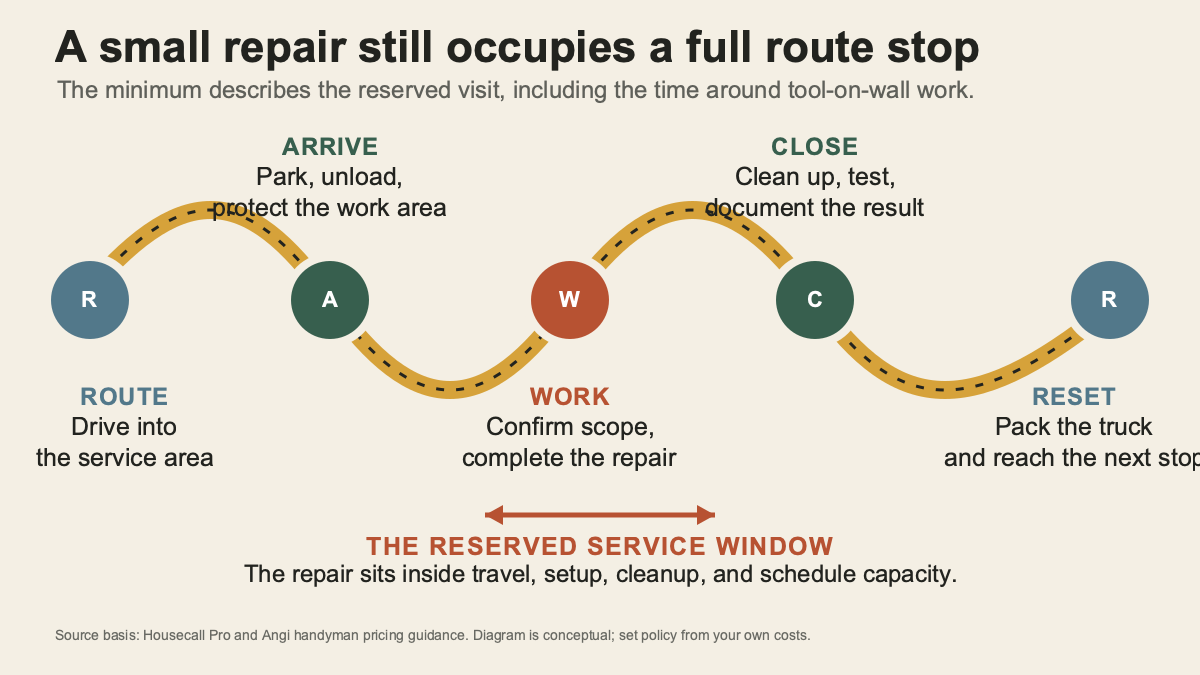
Keep the explanation concrete and brief. “The minimum reserves the service visit and includes the first hour of approved labor” tells the caller what she receives. A speech about insurance, fuel, software, tool replacement, payroll burden, and office rent sounds defensive. Those costs may inform the company's calculation, but the caller needs the policy she is agreeing to.
Do not claim that a five-minute repair always takes an hour. The field condition can change once the hinge, cabinet material, stripped screw holes, door alignment, and nearby damage are visible. Tell the truth: the company reserves a minimum service window, and the technician confirms the repair after arrival.
Qualify the work before quoting the visit
A clear fee explanation cannot rescue a thin work order. The office should find out what the caller expects inside the minimum before offering a slot.
Start with the task count. “One hinge” may mean one loose screw, a concealed hinge pulled out of particleboard, two doors that rub, and three spare hinges the homeowner wants installed if time allows. Record every requested item as a separate line. The multi-task handyman visit guide explains how to keep a mixed punch list usable for the field worker.
For each item, ask for the room, the affected object, the observed problem, previous repairs, and a wide and close photo. Ask whether the caller already has parts. Do not confirm that a customer-supplied hinge, anchor, faucet, lockset, or bracket will fit from a package photo alone. Record the brand and model when visible and leave compatibility subject to field confirmation.
Access changes the visit too. A second-floor curtain rod over a stair landing needs a different access plan than a rod above a ground-floor window. A wall-mounted television may involve unknown wall construction, concealed wiring, building rules, and a customer-supplied mount. A tenant may need owner approval. These facts affect routing and scope even when the office does not change the minimum charge.
Capture:
- every requested task as its own line item;
- room, surface, fixture, and observed condition;
- wide and close photos tied to the correct item;
- customer-supplied parts, packaging, and model information;
- ladder, parking, gate, elevator, pet, and occupancy constraints;
- the company's included labor or service under the minimum;
- materials, disposal, specialty access, or added work that may be separate;
- the caller's requested date and any real deadline.
Avoid saying, “That should all fit.” The office can confirm what the minimum includes as a policy. Only the field worker can see whether this particular list fits the approved scope and time.
Use a four-part phone explanation
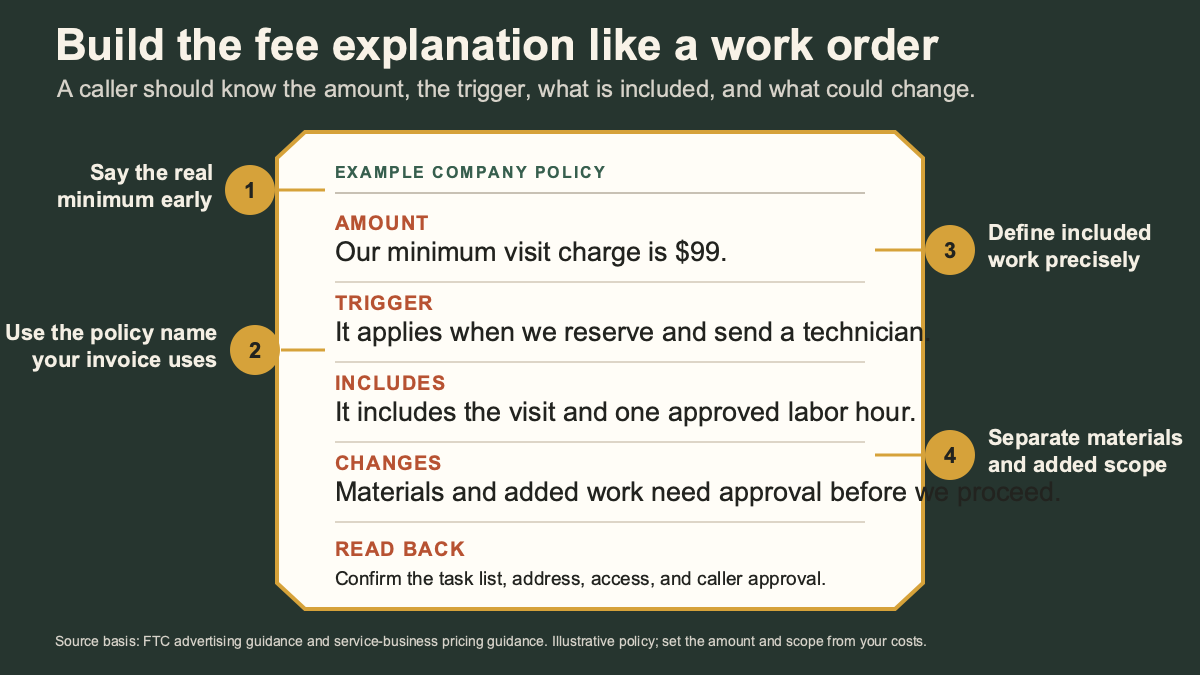
A good explanation has four load-bearing parts: amount, trigger, inclusion, and change conditions. Put them in that order.
The amount comes first because that is what the caller asked. If the company minimum is $99, say $99. Do not hide it behind “our rates start at” or “there is a small service fee.” The $99 figure here is a fictional example for wording, not a recommended price or an Answara charge.
The trigger tells the caller when the charge applies. “It applies when we reserve and send a technician to the property” is clearer than “it covers overhead.” The inclusion defines what the customer receives. Use the real policy, such as a site visit and up to one hour of approved labor, if that is truly what the company sells.
The change conditions protect the boundary. State whether materials are separate. Explain that work outside the recorded list or included labor needs approval before it proceeds. If a diagnostic visit, written estimate, specialty ladder, disposal fee, permit, or return trip follows another policy, say so when it becomes relevant. Local consumer rules and contract requirements vary, so the company should have its wording reviewed for the places it serves.
The Federal Trade Commission's advertising guidance for small businesses says price claims should disclose the actual consumer cost clearly and conspicuously. The current FTC unfair-fees rule has narrower sector coverage and should not be described as a handyman rule. The useful operating principle is still plain: if you state a price, do not bury a mandatory condition until later.
Here is the fictional policy as a natural phone response:
“Our minimum visit charge is $99. It applies when we reserve and send a technician, and it includes the visit plus the first hour of approved labor. Materials and work beyond that included hour are separate. The technician will confirm the scope with you before added work begins. I have one loose kitchen cabinet hinge on the list. Are there any other items you want us to photograph and review while we are there?”
The last question helps the caller use the visit well, but it does not promise that an unlimited punch list fits inside the minimum.
Handle the common objections without arguing
When a caller says, “It is only a five-minute job,” agree with the observable part. “The visible repair may be quick. The minimum applies to the reserved visit and includes the service described in our policy.” Then return to scope: ask what is loose, what material is damaged, and whether there are other items.
When the caller asks whether the charge disappears if the repair proceeds, answer from the actual policy. Some businesses credit a diagnostic or visit fee toward approved work. Others sell a minimum that already includes labor. Never promise a credit because it sounds reassuring.
When the caller asks for an exact total, separate the known amount from the unknown work. The office can confirm the minimum, included service, and listed exclusions. Materials, concealed damage, incompatible parts, added tasks, and work outside company scope may require field review. If the company offers flat prices for well-defined tasks, route the request through that price book instead of forcing every call into the minimum policy.
A caller who declines after hearing the real terms is not a failed call. She made an informed choice before the truck moved. Pressure and vague phrasing only move the disagreement to the doorway.
Put the agreement in the work order
Read back the policy and task list before booking. Then send the same information in the confirmation.
A useful note might say: “Caller approved the $99 fictional-example minimum policy used in training: visit plus first hour of approved labor; materials and added labor separate. Actual company amount must replace the training example. Requested task C1 is one loose lower-cabinet concealed hinge in the kitchen. Wide and close photos attached. Caller has no replacement part. Technician to confirm repair method and any material before work.”
Public-facing confirmations should contain only the company's real amount and terms, never training language. The example above shows the fields the work order needs: policy version, task, evidence, exclusions, and approval.
An AI receptionist can deliver an approved minimum-charge explanation and capture the same intake fields after hours. The policy still has to be written by the business and kept current. Start with the sentence your invoice can honor, then make every call record point back to it.