A caller says she has “a dresser and a few shelves” to assemble on Saturday. The dresser is already out of its boxes, one shelf is a wall-mounted unit, the apartment is up three flights, and the building allows contractor access through a service entrance that closes early. Those details turn a simple furniture assembly booking into a different visit.
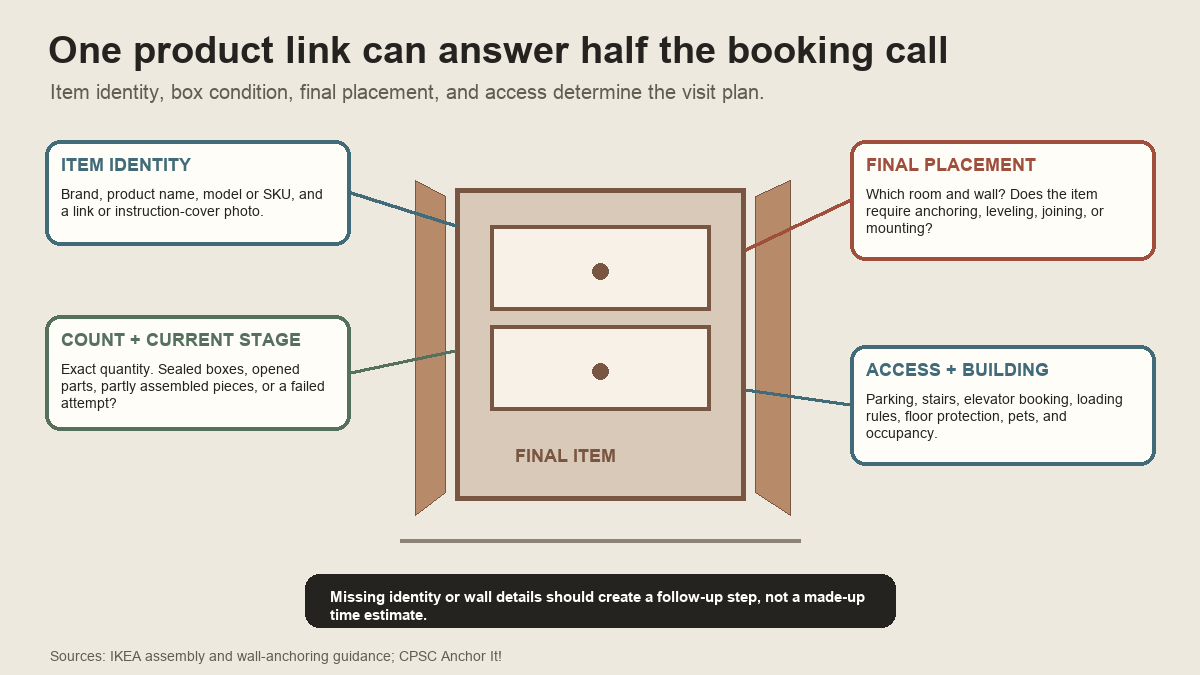
Start with the exact products. Ask for the quantity, brand, product name or model, and a retailer link or photo of the instruction booklet. Then document whether each item is sealed, opened, partly assembled, or taken apart after a failed attempt. Confirm the final room, stairs or elevator, wall-anchoring scope, workspace, building rules, and packaging removal before discussing appointment length.
The office is defining the job, not assembling it by phone. A clean intake gives the technician a product list and a route through the property. It also identifies the unknowns that need a photo, a follow-up call, or field review.
Identify every item before discussing time
“Bookcase” is a category, not a scope. It could mean a short freestanding shelf with a few panels or a tall modular run with doors, lighting, joining hardware, and wall attachment. Ask the caller to name each product separately.
The best identifier is a retailer or manufacturer product link. A model number, SKU, photo of the instruction-cover page, or clear label photo can work too. Capture the quantity beside every item. “Two identical nightstands and one six-drawer chest” is useful. “Bedroom set” leaves the estimator to guess what arrived.
IKEA's assembly service page structures assembly around the quantity and types of items. A handyman business may price work differently, but the intake lesson holds: the item list must be reviewable. Do not use a retailer's category name as a substitute for the actual product.
Ask whether the caller has all packages shown on the delivery receipt. Do not promise that the boxes contain every part. The office cannot see damaged panels, missing hardware bags, duplicate pieces, or a carton delivered for another product. Record what the caller can observe: package count, visible damage, wet cartons, crushed corners, or a label mismatch.
Ask what happened after the boxes were opened
A sealed product is easier to describe than a pile of boards with no packaging. Ask for the current stage of every item:
- sealed and unopened; opened with parts still sorted; partly assembled; fully assembled but needing adjustment; or disassembled after a problem;
- original instructions and hardware present, instructions available online, or documentation missing;
- visible damage, stripped fasteners, broken dowels, enlarged holes, missing panels, or parts installed backward.
Use observational language in the record. “Caller says the left side panel has two enlarged screw holes” is better than “side panel ruined.” The technician or estimator can decide whether the item can be completed, needs a replacement part, or falls outside the company's repair policy.
Ask who started the assembly and why it stopped. The answer may reveal a missing page, a panel that would not line up, a concern about stability, or a realization that the finished item will not fit the planned room. Avoid coaching the caller to remove hardware, force a joint, drill a new hole, or continue until the visit. More work by phone can erase useful clues and cause fresh damage.
Pictures help when they show the whole item, the remaining parts, the hardware, the instructions, and the problem area. One tight photo of a cam lock rarely explains the state of the job. Request context first, then detail.
Separate assembly from anchoring and mounting
Furniture assembly can end with a freestanding item, a manufacturer-required wall restraint, a wall-mounted cabinet, joined modular units, or a piece that must be leveled and secured. Those are distinct scopes. Ask which one applies before the appointment is accepted.
Tall dressers, bookcases, wardrobes, and other furniture can present a tip-over hazard. The U.S. Consumer Product Safety Commission's Anchor It! guidance treats wall anchoring as a central prevention measure. IKEA's safer homes guidance also directs customers to secure furniture and use the instructions and hardware appropriate to the wall.
That does not give the call handler enough information to select a fastener. Ask whether the product instructions require attachment, whether the original restraint is present, which room and wall the customer selected, and what the caller knows about the wall surface. Record drywall, plaster, masonry, tile, paneling, or unknown without declaring what sits behind it.
The field technician should verify the substrate, product instructions, restraint, fastener, utilities, and final location. If the company does not perform wall anchoring or mounting, say so in the scope before scheduling. Never let “assembly included” quietly turn into drilling through tile, attaching a cabinet system, or mounting a heavy shelf after arrival.
Keep the furniture out of use when required anchoring is incomplete. The office should follow the manufacturer's safety language and the company's policy, especially when children may be present. It should not improvise a temporary restraint.
Map the route to the final room
The product has to reach a usable work area before it can be assembled. Follow its physical route with the caller. Where are the boxes now: curb, garage, lobby, storage room, delivery area, or final room? Does the booked service include moving them?
Ask about parking, loading access, exterior steps, interior stairs, tight landings, elevator size, elevator reservations, and service-entrance hours. Some apartments, condominiums, offices, and managed properties require advance scheduling or a certificate of insurance. Record the building's stated requirement and route it through the company's normal process. Do not tell a caller that every building accepts the same document.
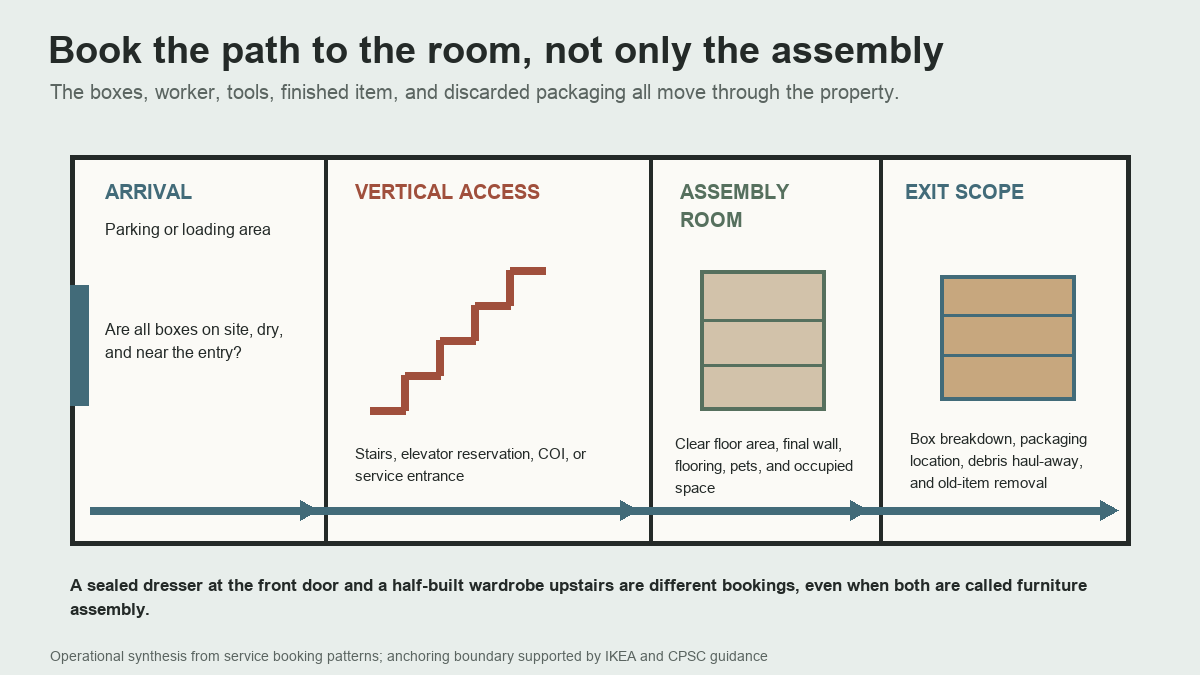
The final room needs attention too. Ask whether there is clear floor space for the panels and hardware, whether another item must be moved first, and whether the home will be occupied during the work. Note delicate flooring, narrow hallways, pets, small children, or business customers working nearby. These details help the dispatcher plan access and floor protection without pretending to calculate labor from a phone description.
Confirm the finished item's location. A wardrobe assembled flat may need room to be raised. A wide unit may fit through the entry as boxes but not through a doorway once complete. The technician needs the product dimensions, room dimensions when fit is close, and a clear understanding of where assembly will happen.
Define what leaves with the technician
Assembly creates cardboard, plastic film, foam, ties, small bags, and sometimes a pallet. Ask what the company does with packaging and explain it plainly. Breaking down boxes, placing packaging in the customer's recycling area, and hauling debris away are different services.
Also ask whether an old item must be disassembled or moved. A caller who says “replace my dresser” may assume removal is included. Put old-item work on its own line. The same applies to carrying boxes upstairs, moving the completed piece, installing shelves, attaching knobs the customer bought separately, and returning defective materials.
The Kentucky Attorney General's home repair guidance advises consumers to ask about methods and materials and insist on detailed written agreements. Rules differ by jurisdiction and job type, but a written itemized scope is good operating practice anywhere. The confirmation should name the products, quantity, current condition, included assembly, anchoring or mounting scope, access assumptions, customer-supplied materials, and cleanup.
For a visit that combines furniture with unrelated household repairs, use a broader multi-task handyman scheduling process. Keep the furniture products itemized inside that visit. The handyman resource hub can help the office separate other job types that need different intake.
Read back a technician-ready booking
Before ending the call, read the record back in one compact handoff. It should sound like this:
“Two identical boxed nightstands and one partly assembled dresser are in the second-floor bedroom. Product links and photos are attached. The dresser instructions and hardware bag are present, but the caller reports one drawer will not align. The building has stairs and street parking. Assembly space is cleared. The manufacturer instructions call for wall attachment, the wall surface is described as plaster, and anchoring is pending field verification. Box breakdown is included; haul-away and old-furniture removal are excluded.”
That note tells the technician what is known, what was observed, and what still needs verification. It also gives the customer a fair description of the booked visit before anyone carries a toolbox upstairs.