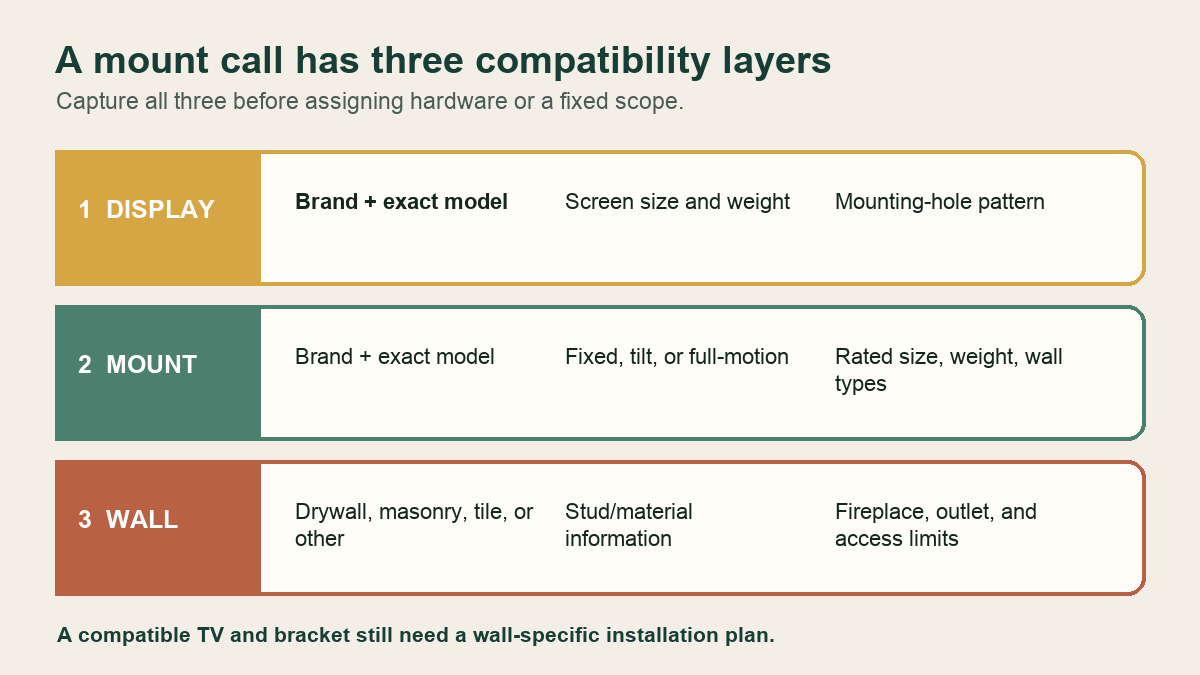
A caller says, “It is a 65-inch TV going over the fireplace. How much to hang it?” Screen size is useful, but it does not tell the installer which bracket fits, what the wall can support, whether the requested position is workable, or what “hide the wires” means in this house.
A useful TV mounting service call captures the exact TV model, the mount model if one has been purchased, the wall material, the requested position, the power and signal-cable plan, access conditions, and the building age. Ask for photos. Then book the visit type your company can support without choosing fasteners or declaring the wall suitable over the phone.
The office owns a clean description. The installer owns field verification.
Start with two model numbers
Ask for the TV brand and full model number. “Samsung 65-inch” can describe many displays with different weights, rear profiles, port locations, mounting-hole patterns, and hardware requirements. The model number is usually on a label at the back or in the television’s settings menu. A photo of that label reduces transcription mistakes.
Then identify the bracket. Did the customer already buy one? If so, collect its brand, model number, mounting style, and a photo of the box label or instruction cover. Record whether it is fixed, tilting, or full-motion. If the bracket came from a previous installation, ask whether all wall-plate hardware, TV-side brackets, screws, spacers, locking pieces, and instructions are present.
The VESA mounting standard defines the interface used by many flat displays and mounts. That hole pattern is one part of compatibility. The mount also needs to be rated for the exact television and intended use. SANUS explains the same practical check in its VESA compatibility guide: match the television’s size, weight, and mounting-hole pattern to a suitable mount.
Do not approve the caller’s bracket because the box mentions the same screen size. A model lookup and the manufacturer instructions should settle compatibility. If the customer has no mount, record the television model and the motion they want, then follow your company’s product-selection process.
Describe the wall before promising hardware
Ask the customer what is visible: painted drywall, plaster, brick, concrete, stone, tile, wood paneling, or another finish. Treat the answer as a description, not a structural finding. Drywall can cover wood studs, metal framing, masonry, furring strips, pipes, wiring, blocking, or a previous repair. A phone photo cannot confirm what sits behind it.
Request one wide photo showing the entire wall and nearby floor, ceiling, windows, doors, outlets, fireplace, furniture, and adjoining surfaces. Ask for a second straight-on photo of the intended TV area. If the customer has used a stud finder, note what they report, but do not turn that report into a promise about anchor points.
Placement needs its own questions. Ask where the customer wants the center of the screen, whether a console or soundbar sits below it, and whether the mount must swing toward another seating area. A full-motion arm creates a different clearance and movement question than a fixed bracket. Nearby cabinet doors, shelves, trim, a mantel, sloped ceilings, and side walls can limit travel.
Fireplace requests deserve a careful handoff. Record whether the fireplace burns wood, gas, or electricity, whether it is used, the mantel depth, the facing material, and any manufacturer information the customer has. Heat, clearances, wall construction, viewing height, and cable access need field review. The office should not promise that a television can go over every fireplace.
The Consumer Product Safety Commission advises securing flat-screen televisions and following manufacturer instructions. That supports a simple policy: the exact display, mount, wall, and instructions all matter. Screen size by itself does not establish a safe installation.
Turn “hide the wires” into a defined scope
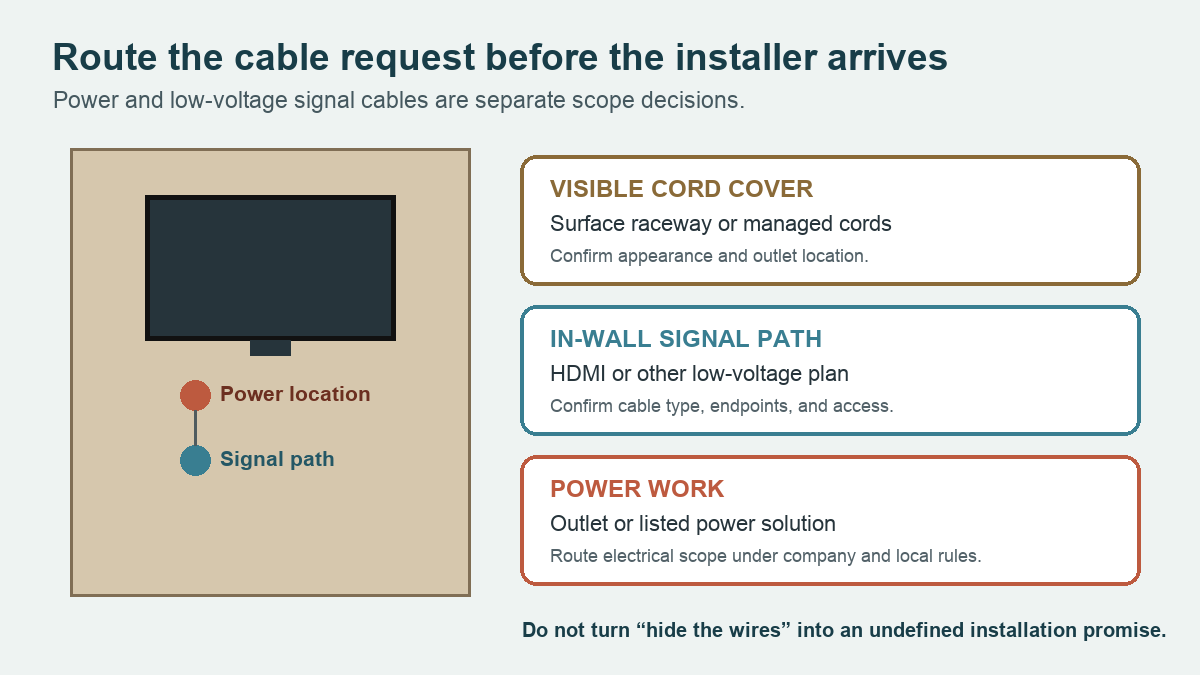
Ask the customer what equipment will connect to the television. A streaming device behind the screen is different from a game console, cable box, receiver, soundbar, antenna feed, or network connection across the room. List each device and where it will sit. Capture the cable types when the customer knows them, plus any existing wall plates or conduit.
Now ask what result they expect. Some callers want cords gathered neatly below the screen. Others want a paintable surface raceway. Some expect signal cables to pass through the wall. Another caller may expect a new receptacle behind the television. Those are separate scopes.
Power work must be routed under the company’s licensing policy and local requirements. Do not suggest placing an ordinary flexible power cord or extension cord inside a wall. Do not quote a new outlet as a minor add-on unless the qualified electrical scope, site conditions, and local rules have been reviewed. NFPA 70 is the national electrical-code source, but local adoption and amendments govern the actual job.
Signal cables also need specifics. Ask how many paths are needed, where both ends should emerge, whether the wall has insulation or fire blocking, and whether the customer expects a future cable to be replaceable. The installer can verify the route and choose an approved method after seeing the wall.
Flag access, surfaces, and older buildings
Ask who will provide the TV and mount, where the boxes are now, and whether the television is already assembled. Record whether a previous TV or bracket must be removed. Old holes, damaged drywall, missing paint, abandoned anchors, or a bracket left by the last resident can add repair work that belongs in the scope.
Access changes the appointment too. A clear living-room wall is different from a stair landing or a tall masonry fireplace surrounded by built-ins. Ask about ceiling height, stairs, furniture that must be moved, pets, parking, loading access, elevator rules, building work hours, and certificate-of-insurance requirements. If a condominium or rental requires written approval, identify the person responsible for obtaining it before the visit.
Building age matters when drilling or cutting may disturb painted surfaces. Ask whether the home or child-occupied property was built before 1978. The answer does not identify lead-based paint. It triggers the company’s compliance review. The EPA’s Lead Renovation, Repair and Painting guidance covers paid work that disturbs painted surfaces in many pre-1978 homes and child-occupied facilities, subject to scope, exceptions, and authorized state or tribal programs.
Tile, stone veneer, plaster, brick, and concrete also deserve explicit notes. Ask whether the customer has spare matching tile or finish material. Do not promise invisible patching if exploratory work, an old bracket, or a failed anchor has already damaged the surface.
Send the installer a record that answers the first ten minutes
The final handoff should include:
- Customer, service address, parking or building rules, and decision-maker contact
- TV brand, exact model, screen size, current location, and label photo
- Mount brand, exact model, style, condition, instructions, and hardware status
- Wide wall photo, close placement photo, reported wall finish, and any known framing or blocking information
- Desired screen position, furniture, mantel, soundbar, shelves, and movement or clearance request
- Connected devices, their locations, power source, signal cables, and requested concealment result
- Removal, drywall repair, painting, old-anchor, or packaging-disposal scope
- Building age, access limits, stairs, height, pets, occupancy, and approval requirements
- The booked next step, plus every assumption that still needs field verification
Read the key facts back. “Sony model X, customer-supplied tilting bracket model Y, painted drywall above a 60-inch console, outlet below and left, soundbar below the TV, surface cord cover requested, no fireplace, home built in 2006, wall and labels photographed.” That note gives the installer a real starting point.
For customers bundling TV mounting with shelves, pictures, curtain rods, or small repairs, keep every item separate. The multi-task handyman scheduling guide explains how to turn a household list into a workable visit without letting one line swallow the rest of the day.
An AI receptionist can capture these fields after hours when the technician cannot answer. The rules still come from the company. Compatibility, wall structure, electrical scope, and final placement stay with the qualified person who reviews the instructions and sees the site.
A good booking note does not say “mount big TV and hide wires.” It names the display, bracket, wall, placement, connected equipment, cable result, access, and open questions. The installer can arrive ready to verify the facts that matter.