A caller says, “Two deck boards are soft and the railing wiggles a little. Can you replace them this week?” The board count sounds like a scope. The loose railing changes the call.
Start with people and current use. Ask whether anyone fell or was hurt, whether part of the deck moved or collapsed, and whether someone is in immediate danger. An injury or active danger belongs with emergency services. For other reports of movement, failed boards, or loose guards, keep people off the affected area and arrange the company’s field-review route. Do not ask the caller to test the railing, walk across a soft board, crawl under the deck, or pull at a connection.
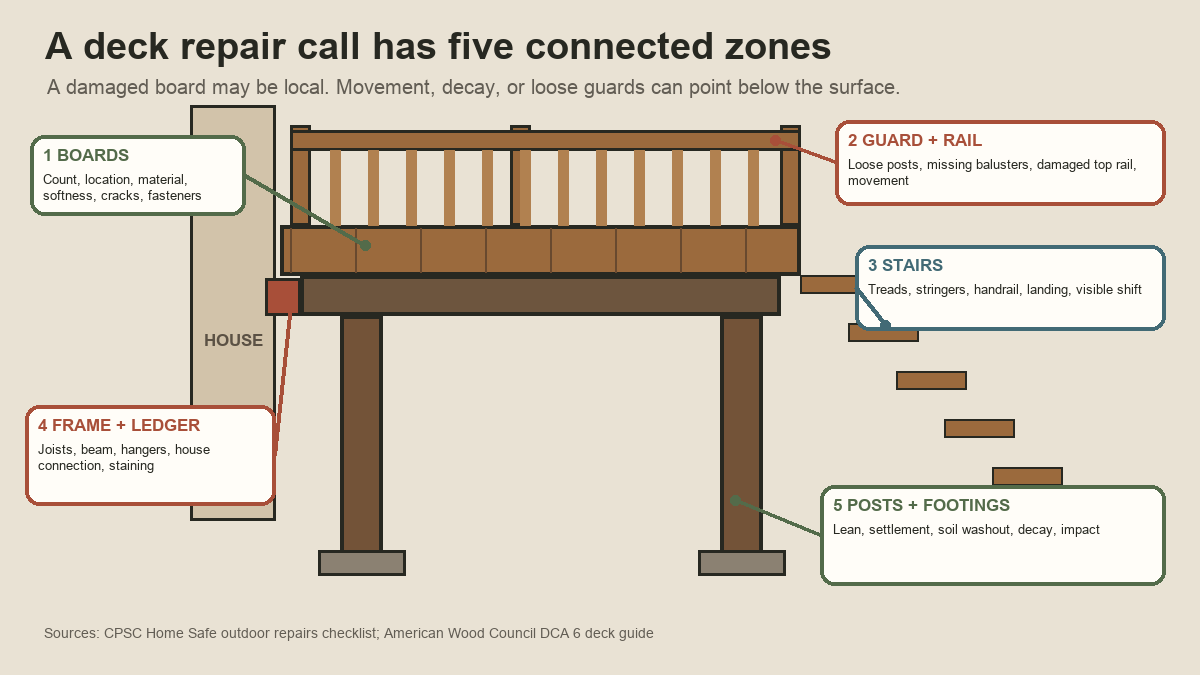
Then document the full deck as a connected assembly: surface boards, guard and railing, stairs, framing, the house connection, posts, footings, and access. A photo estimate may fit a clearly local cosmetic repair under company policy. It should not be used to declare a moving or decayed structure safe.
Separate the symptom from the repair scope
“Bad board” is an observation, not a complete diagnosis. Ask what the caller can see from a safe location. Is the board cracked, split, cupped, loose, soft, discolored, burned, or broken through? Where is it relative to the house, stairs, guard posts, grill, downspout, or planter? How many areas are affected?
The location matters because deck parts share loads and connections. A soft board in an open field of decking may lead to one kind of visit. Damage around a guard post, stair opening, beam, or house connection deserves wider review. The office does not need to decide which fastener or member failed. It needs to preserve the relationship between the reported damage and the rest of the deck.
Ask when the caller first noticed it and what happened beforehand. Useful events include a vehicle or tree impact, heavy objects moved onto the deck, standing water, a plumbing or drainage leak, recent construction, pest activity, or a sudden shift. Record the caller’s words. “North corner dropped after the tree limb hit the rail” is much better than “deck settling.”
The U.S. Consumer Product Safety Commission outdoor repair checklist advises professional inspection when a deck shows signs of distress and tells homeowners to stay off a deck that appears unsafe. That is a sound boundary for call handling. The office routes the risk. The person on site evaluates the structure.
Capture the guard and stair report precisely
A caller may use “railing” for the top rail, the vertical balusters, a guard post, or the handrail beside the stairs. Ask which part moves and where. Do not have the caller push it again. If the movement already happened during ordinary use, document that report and move on.
For the guard, ask whether a post leans, the top rail is detached, balusters are missing, a section has pulled away, or visible fasteners are corroded or absent. Note whether the problem is beside a stair, at a corner, or along an elevated edge. Ask for a wide photo from solid ground or another safe position, followed by a closer photo only if it can be taken without approaching the damaged area.
Stairs need their own record. Which flight is affected? Is the concern at a tread, riser, stringer, handrail, landing, or connection to the deck? Did a tread crack, did the stair shift, or did the handrail become loose? Can the customer avoid that route until the visit? If the stairs are the only exit or someone cannot leave safely, the call needs the company’s urgent safety process and may require emergency help.
The American Wood Council’s Prescriptive Residential Wood Deck Construction Guide treats guards, stairs, framing, ledger connections, posts, and footings as parts of one deck system. Its details are design guidance, not a remote troubleshooting script. For the office, the useful lesson is simpler: do not reduce a guard or stair complaint to a replacement board count.
Ask for photos that show relationships
One close-up can hide the condition that changes the job. Ask for a small photo set, taken only from places the caller can reach safely:
- one wide image showing the deck, house, stairs, and affected side;
- one image that locates each reported board or rail problem within that wider view;
- close images of visible damage, without touching, loading, or moving the part;
- ground-level images of accessible posts, footings, beams, or the underside, with no crawling or climbing;
- an image of any manufacturer label or material marking the customer can reach safely.
Video can help when the caller already recorded the event, but do not request a new “movement test.” A clip of someone shaking a loose guard creates risk and adds little. A still photo plus a plain description is enough to route the visit.
Ask what the decking and railing appear to be made from. Wood species may be unknown. Record “painted wood,” “capped composite,” “vinyl guard,” or “metal railing” as the caller’s description. If the customer has an invoice, product label, leftover board, or installation record, request a copy. Material identity can affect matching, lead time, fastening systems, and whether a partial repair will look consistent.
Document the frame without asking the caller to inspect it
The office should ask what is visible, not send the homeowner under the deck. Is the underside open and visible from the yard? Does the caller report sagging, leaning posts, separated connections, rust stains, dark staining, crumbling wood, soil washout, or standing water? Is the deck attached to the house or freestanding? Has anyone already inspected it?
The house connection deserves a specific question because callers often focus on the walking surface. Ask whether there is a visible gap between the deck and the building, recent movement near the wall, water staining, or work on the siding or door above. Do not label the connection sound based on a photo.
The American Wood Council’s guidance on deck connections to a house explains why connection details warrant professional attention. The office can use that source to recognize a wider inspection need. It should never turn the guide into a promise that one visible bolt, screw, or bracket makes the deck safe.
Access changes the appointment too. Record whether the technician can reach the yard through a gate, whether the property is occupied, whether pets must be secured, and whether the deck sits above a slope, patio, walkout basement, or enclosed room. Note stored furniture, grills, planters, hot tubs, and other loads without asking the caller to move heavy items near a weak area.
Check permit responsibility at the address
Permit rules vary sharply by jurisdiction and by the part being repaired. Some local departments distinguish nonstructural board replacement from work on guards, joists, beams, posts, or other structural members. Others require permits for a broader range of deck repairs.
Currituck County, North Carolina, gives one clear local example in its deck safety inspection guide: it treats repairs involving structural members differently from certain surface-component replacements. That page is evidence of local variation, not a national rule.
Ask for the project address and whether the customer, property manager, or another contractor has contacted the building department. Record any permit number, inspection notice, violation, engineering letter, or prior repair plan. Then follow the company’s process for checking the authority that serves that address. Do not promise that a permit is unnecessary because the caller says only two boards are involved. The railing or hidden condition may change the work.
Choose the appointment type after the safety route
A useful intake ends with a named next step. It does not end with “someone will call you.”
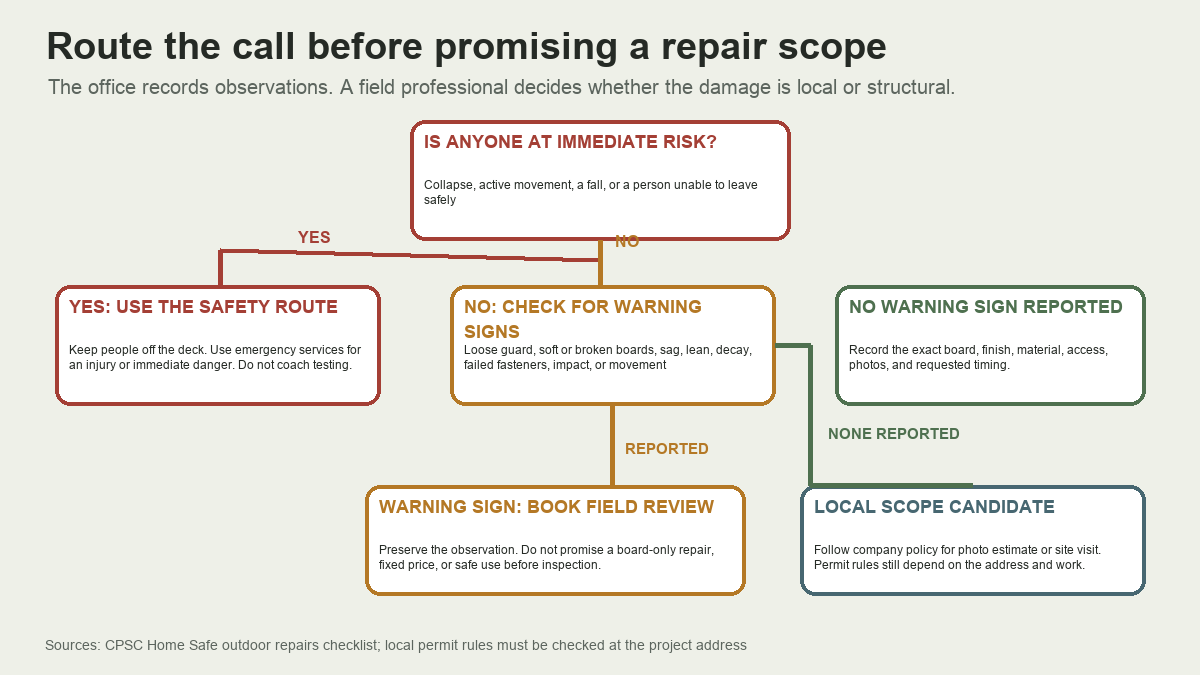
Use the urgent safety route when there is an injury, collapse, active movement, entrapment, or immediate danger. A report of loose guards, soft or broken boards, sag, lean, decay, failed connections, or impact should move to a field review before the office promises a local repair. An apparently isolated board or finish problem may qualify for the company’s photo-estimate process, but only if the submitted evidence fits its rules and no warning sign appears.
Read back the record before booking: exact affected area, observed condition, date noticed, prior event, current-use restriction, photo status, material description, access, address, and permit follow-up. If the caller begins with a longer household list, keep the deck concern on its own safety route and organize the remaining items with the multi-task handyman visit intake. Drywall, door adjustments, and shelf mounting can wait in a normal punch list. A moving guard should not disappear inside it.
An office team can use a written script, field-service form, or AI receptionist to capture the same facts after hours. The tool matters less than the handoff. The technician should receive the caller’s observations, the images, the access notes, and a clear statement of what nobody has promised yet.