A homeowner says cold air is coming through the front door. Ten seconds later, the story changes: the door rubs the frame, the deadbolt works only when someone pulls hard on the handle, and daylight shows at the bottom corner. Booking that as “replace weatherstripping” gives the technician an incomplete job.
Start by locating the opening and the reported air path. Ask whether the air is felt along a door edge, under the door, where a window sash closes, beside the interior trim, or across several openings. Then confirm that the door or window opens, closes, latches, and locks normally. Water, soft material, visible decay, broken glass, a loose frame, or an opening that cannot secure needs a different inspection path.
The office should record what the caller sees and feels. The field technician decides whether the remedy involves weatherstripping, a sweep, adjustment, hardware, stationary-joint sealant, material repair, or broader air-leak testing.
Locate the draft before naming the repair
“Drafty window” does not identify a joint. A window has moving contacts around the sash, stationary joints around the frame and trim, glass edges, locks, tracks, and nearby wall penetrations. A door adds jamb contacts, a head, a threshold, a bottom seal, hinges, a latch, and sometimes a mail slot or pet door.
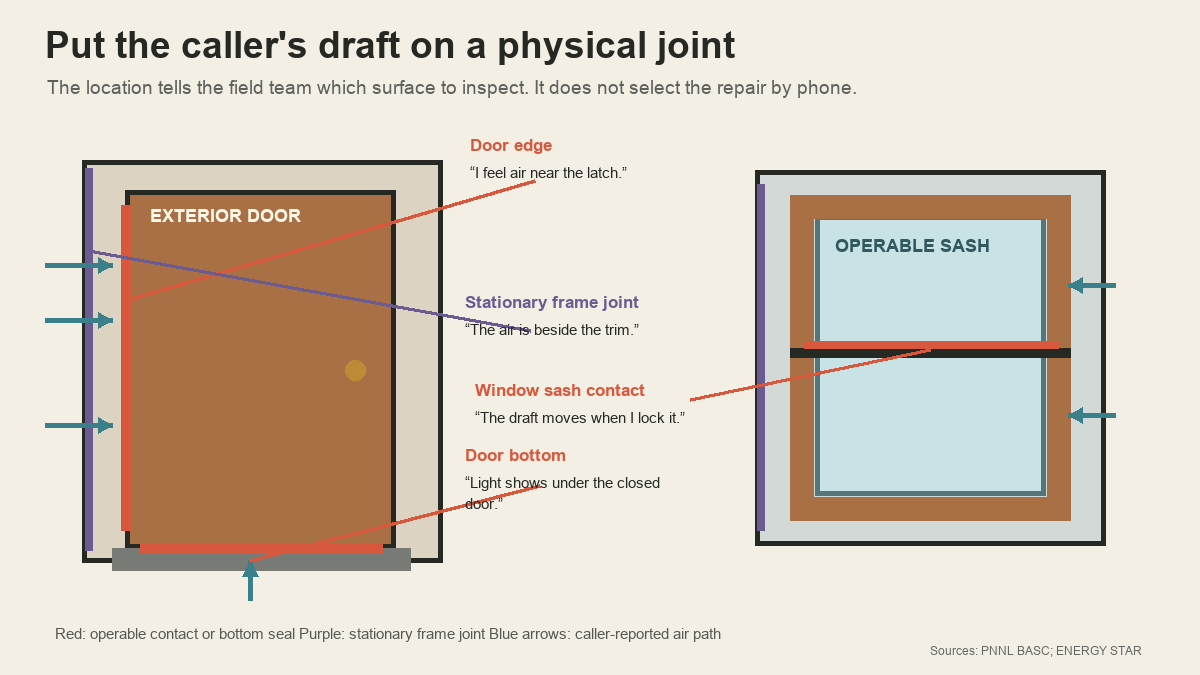
Ask the caller to stand at the opening and describe the exact location without taking anything apart. Useful answers sound like “air at the lower latch-side corner,” “a gap under the sweep near the hinge,” or “cold air beside the casing, not where the sash closes.” Record the room and whether the opening faces outdoors, a garage, an attic, a basement, or another unconditioned space.
The U.S. Department of Energy's Building America Solution Center guide starts with inspection of windows and doors for worn or missing weatherstripping and air leaks. That sequence matters to a booking office. Find the location first. Leave material selection until someone can inspect the surface, gap, motion, and existing seal.
Ask when the caller notices the problem. Wind from one direction, a recent storm, a cold night, or operation of an exhaust fan may make a leak easier to notice. Treat that as context. It does not prove where the opening leaks or why.
Separate moving contacts from stationary joints
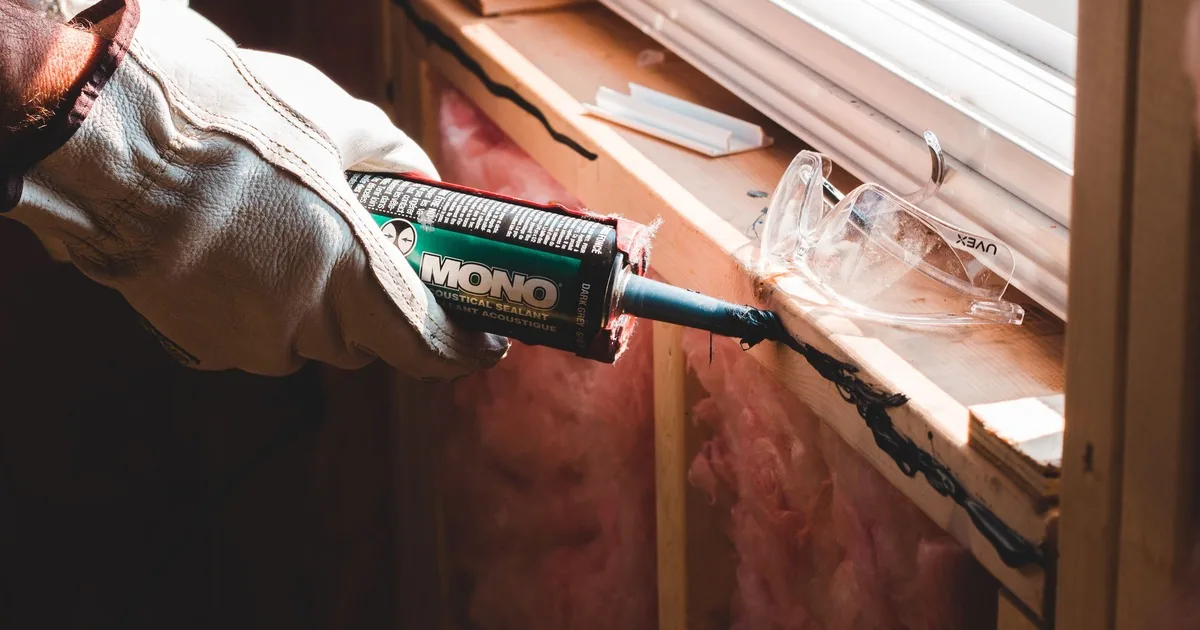
Weatherstripping belongs where a door or window moves against another surface. Caulk and similar sealants are generally used at stationary gaps. ENERGY STAR's seal and insulate guidance gives the plain examples of weather stripping on doors and caulking around windows. Florida's state caulking and weatherstripping guide makes the same movable-versus-stationary distinction.
That boundary keeps the call handler from offering the wrong fix. If air is reported at the contact between a closed sash and its frame, weatherstripping may be part of the inspection. If it is beside fixed trim, the technician may need to inspect a stationary joint and the materials around it. If the caller feels air near an outlet or baseboard, the opening may be a poor match for a door-and-window appointment.
Ask what material is already present. The caller might describe foam tape, fuzzy pile, a rubber bulb, a metal strip, a door sweep, or nothing visible. Photos are better than a confident guess. Request one image of the full opening, one of the reported leak area, and one of the existing material or damage. A tight photo with no frame context can make the location harder to understand.
Do not ask the caller to peel off the old strip or scrape sealant before the visit. Existing fasteners, compression marks, paint, residue, gaps, and failed material can help the technician understand what happened.
Check whether the opening operates normally
A seal works only as part of an opening that reaches its intended closed position. A door that has dropped on its hinges may leave one corner open while crushing the weatherstrip elsewhere. A sash may bind, a latch may fail to draw it closed, or a threshold may sit unevenly. Adding thicker material can make a difficult opening worse.
Run a short operation check on the call:
- Does the door or window open and close without lifting, pushing hard, or slamming? Does it latch and lock without pulling the handle or pressing the sash?
- Is the gap even around the opening? Does anything rub, drag, rattle, feel loose, or change when the lock is engaged?
- Did the problem begin after painting, flooring work, hardware replacement, impact, settlement, or another repair?
- Can the opening secure now? If it cannot, follow the company's urgent-security policy instead of leaving it in a routine weatherstrip queue.
Use the caller's words in the booking record. “Caller must lift handle for deadbolt to align” is useful. “Door is out of square” is a field conclusion the office has not earned.
This distinction also protects the estimate. Seal replacement, hinge adjustment, latch work, threshold repair, sash hardware, and frame repair may overlap at one opening, but they are separate tasks. The dispatcher should know which possibilities need inspection before assigning time, tools, or staff.
Route water and visible damage out of a simple seal booking
Air and water can appear near the same window or door without sharing the same path. Water may involve a sill, frame, flashing, drainage opening, cladding joint, roof condition, or deteriorated material. A phone agent cannot sort those systems from one stain.
Ask whether the caller reports active water, staining, peeling paint, swollen trim, soft wood, decay, mold-like growth, damaged drywall, or a musty odor. Record when it appears and whether it follows rain, wind, washing, or condensation. Do not label the source, promise that caulk will stop it, or describe indoor growth as harmless.
Broken glass, a loose frame, and material that moves when touched also need inspection before a simple seal scope is offered. If there is an immediate electrical, structural, security, or significant active-water concern, use the company's escalation policy. The call handler can tell the customer what appointment or referral comes next without coaching a risky repair.
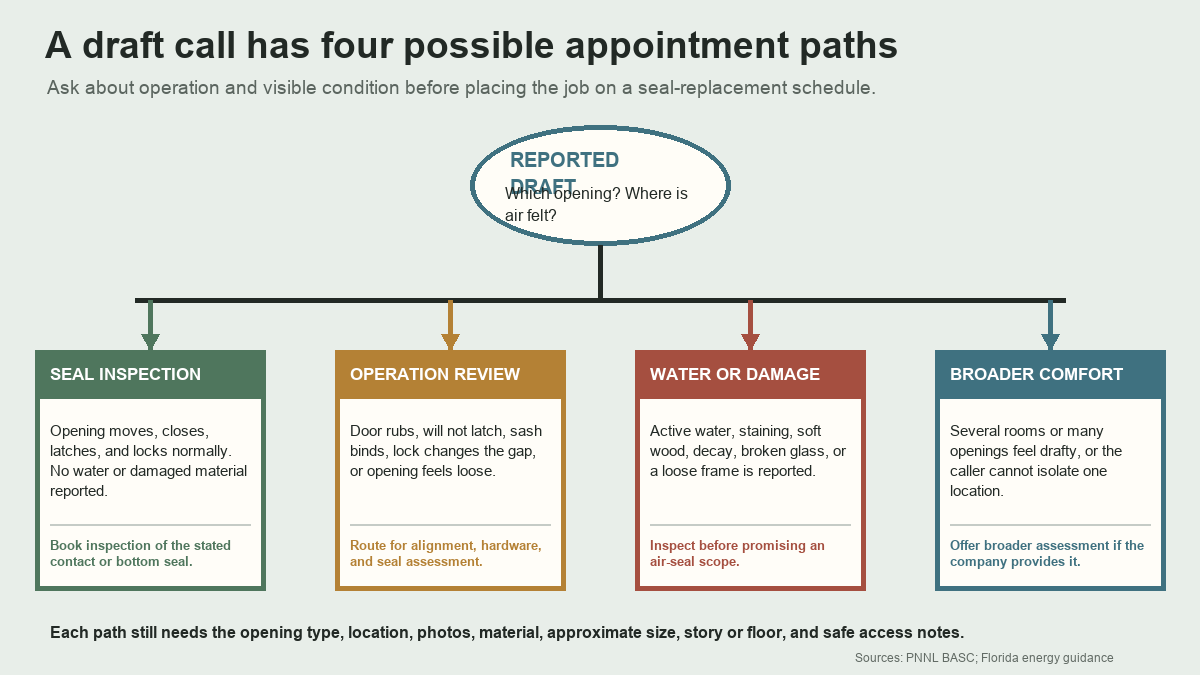
A complaint across many rooms may also exceed a small opening repair. Ask whether the caller can isolate one door or window. If drafts are widespread, a broader home-comfort or air-sealing assessment may fit better when the company offers that service. Do not promise that replacing seals on a few openings will resolve a whole-home comfort problem.
Collect dimensions, materials, and access details
The field team still needs practical preparation details after the call is routed. Capture the opening type and material: wood, vinyl, aluminum, steel, fiberglass, or unknown. Ask for approximate width and height, the number of similar openings, and whether each one has the same symptom. A photo of a label can help identify a window or door system, but the office should not promise parts availability from a label alone.
Location changes the visit. A ground-floor front door with clear interior access differs from an upper-story window above a porch roof. Ask which floor, whether the work area is reachable from inside, and whether exterior access may involve a slope, landscaping, locked gate, balcony, furniture, curtains, blinds, security sensors, or pets. The technician decides what access equipment and work method are appropriate.
For rentals and managed properties, identify the person authorizing work and the person providing entry. Record building hours, parking or loading rules, elevator requirements, and any request for insurance documentation. Never promise landlord approval, tenant responsibility, or compliance with a building rule that the company has not reviewed.
If the caller has several unrelated household repairs, put them through a multi-task handyman visit intake. Keep each drafty opening as its own line item. The handyman resource hub covers other job types that need a separate call path.
Read back a bounded appointment
End with a handoff that separates observations from pending field decisions:
“Front entry door, lower latch-side corner. Caller reports daylight under that corner and air along the latch jamb. Door rubs near the top and the deadbolt aligns only when the handle is pulled. No active water or soft material reported. Full-opening and close-up photos are attached. Door is on the ground floor with clear interior access. Appointment is for door operation, hardware, threshold, and seal assessment. Materials and final repair scope are pending inspection.”
That record gives the technician a location, operating symptom, condition boundary, and access plan. It also gives the customer an honest description of the visit before old weatherstripping is pulled away.