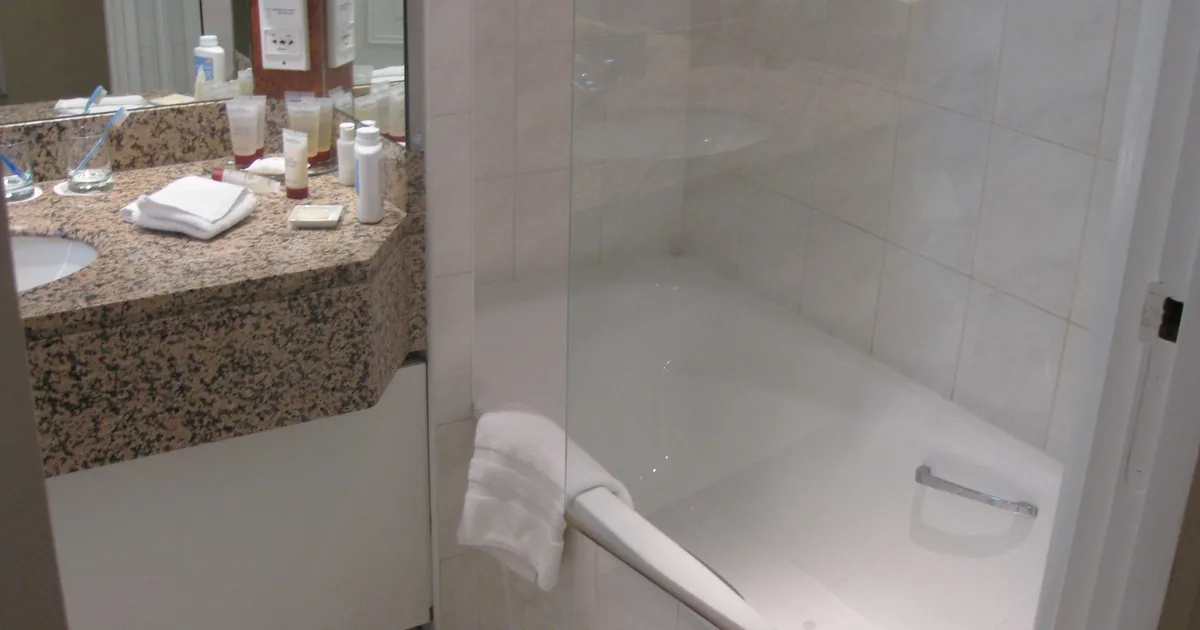
A daughter calls to arrange two grab bars for her father's bathroom. She says one should go “by the shower” and the other “next to the toilet.” The shower has a fiberglass surround, the toilet sits between a vanity and a wall, and the bars are still in an online shopping cart. That request is not ready for a simple two-item booking.
Start by asking where the person needs support during the movement. Then identify the exact fixture, wall, visible surface, requested position, bar, and surrounding access. Record what the caller knows. Leave hidden framing, suitable hardware, final placement, and code review for the installer.
The office should define the visit without prescribing a safety solution by phone. That boundary matters more here than a fast estimate.
Start with the movement that needs support
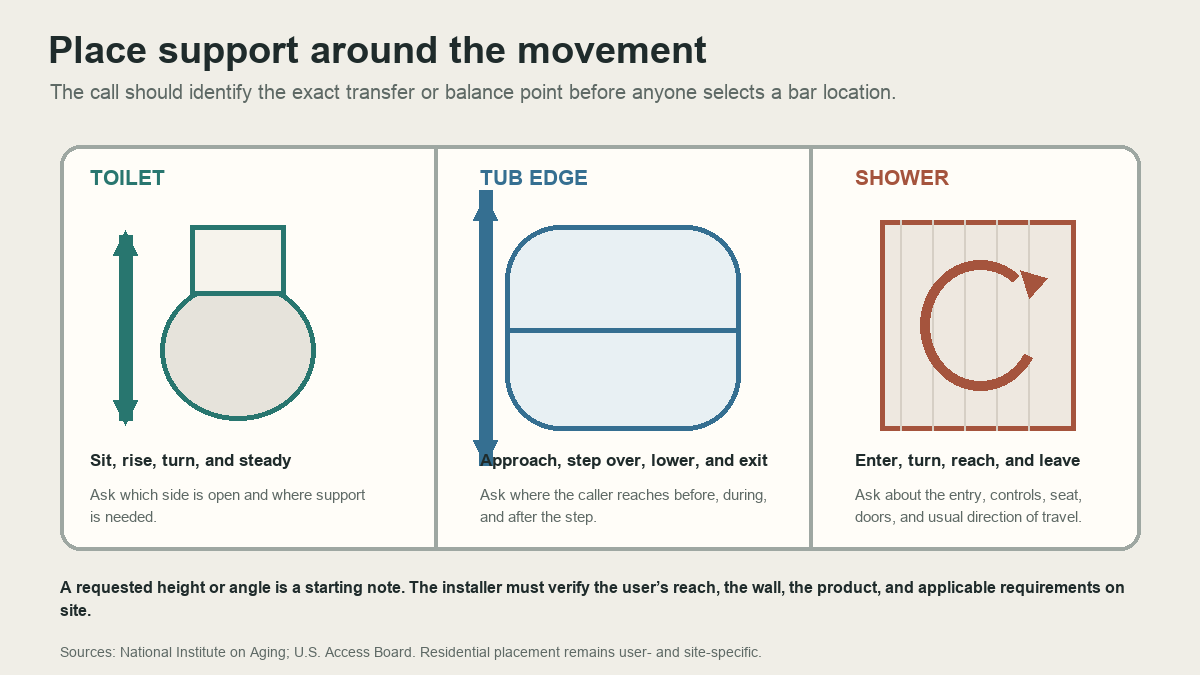
“By the shower” describes an area, not the moment when support is needed. Ask the caller to walk through the ordinary movement in plain language. Does the person reach for support before stepping over a tub edge? While turning inside a shower? When lowering onto the toilet? When rising and getting a walker back into position?
The National Institute on Aging recommends grab bars near toilets and inside and outside tubs and showers in its room-by-room fall-prevention guidance. Those are useful intake categories. They do not tell the office the right position for one person in one bathroom.
Record the direction of travel and which hand the person expects to use. Ask whether a cane, walker, wheelchair, shower chair, transfer bench, or fixed seat is part of the routine. Note doors, shower controls, towel bars, toilet-paper holders, vanities, glass panels, and shelves that compete for the same reach zone.
If an occupational therapist or another qualified professional has marked a location, capture the written recommendation or a wide photo of the marks. Do not reinterpret it. If the caller has only a verbal memory of “put it about here,” the visit still needs on-site confirmation.
Name the fixture and the exact wall
Grab bar calls get vague when the office records only a room and quantity. Turn each requested bar into its own line item. “Hall bathroom, two bars” should become “one requested on the shower control wall near the entry” and “one requested on the open side of the toilet,” with both locations pending field verification.
Ask for wide photos that show the whole fixture and nearby walls. Follow with close photos of the requested mounting area. The wide view catches a sliding shower door, a narrow return wall, a window, a medicine cabinet, or a toilet squeezed against a vanity. The close view helps identify grout lines, panel seams, cracks, previous holes, trim, and accessories.
For a tub or shower, record whether the wall is described as tile, a one-piece fiberglass unit, a multi-panel surround, solid-surface material, stone, or another finish. Ask whether there is an access panel or an unfinished wall on the other side. For a toilet location, identify the rear wall, side wall, and open transfer side. The installer still has to confirm what those walls can support.
The U.S. Access Board publishes separate guidance for bathing rooms and toilet rooms in facilities covered by federal accessibility standards. Its diagrams are useful because they tie bars to specific fixtures, clearances, and mounting conditions. Do not copy a commercial accessibility dimension into every residential booking. Private-home needs, local requirements, and the user's actual reach may differ.
Treat the visible surface as one layer
Tile is a finish. So are fiberglass, drywall, plaster, paneling, and stone. None of those words proves that a stud, blocking, masonry base, or compatible anchoring condition exists at the requested location.
This is where phone intake often drifts into an unsafe promise. A caller says, “It is tile, so it should be solid,” and the office replies, “That should be fine.” The ticket now sounds approved even though nobody has checked behind the tile, reviewed the bar, or looked for plumbing and wiring.
Use a narrower response: “I will note tile at the requested location. The installer will verify the support, mounting method, and final position before drilling.”
The Access Board's structural guidance treats the bar, fastener, mounting device, and supporting structure as one assembly. Retail instructions such as The Home Depot's grab bar installation guide also distinguish fastening into framing from using an anchoring system designed for the condition. The call handler does not need to select between them. The ticket needs to preserve the question.
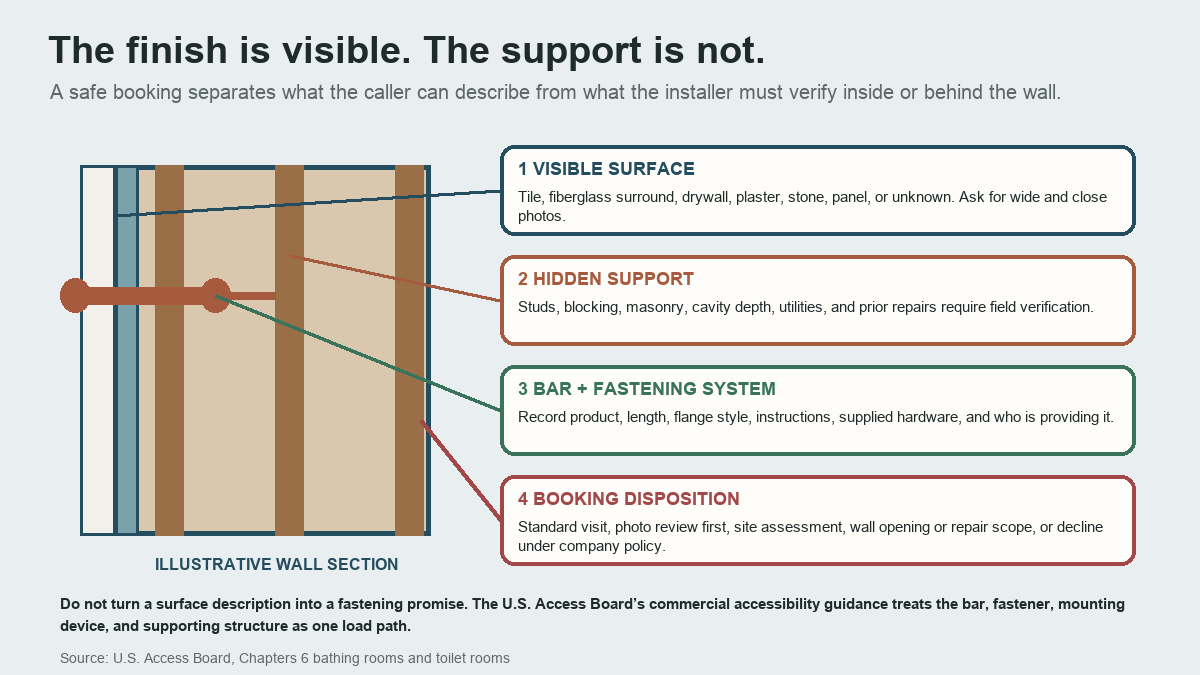
A company may handle that uncertainty with a standard installation visit, mandatory photo review, a site assessment, or a broader carpentry and wall-repair scope. Write the rule down. The office should never improvise it while a worried family member waits on the line.
Record the bar, materials, and surrounding work
Ask whether the customer already has the bar. If so, collect the manufacturer, model or product link, length, shape, finish, flange style, and installation instructions. Request a photo of the packaging and supplied hardware. Record those facts without saying the product is suitable.
If the company supplies bars, explain how selection works under company policy. A field assessment may need to happen first. Keep product selection separate from the caller's preference for polished chrome, matte black, a straight bar, or an angled configuration.
The visit may include more than mounting. Capture the related scope:
- removal of a towel bar, soap dish, shelf, or failed grab bar;
- drilling through tile or another brittle finish;
- opening and repairing a wall to add support;
- patching old holes, replacing damaged tile, or sealing penetrations;
- work in a second bathroom, hallway, garage entry, or other location;
- customer-supplied materials and any missing instructions;
- cleanup, debris removal, parking, pets, building access, and the person who will approve placement on site.
Do not promise that wall opening, tile repair, painting, or waterproofing is included unless the booked scope says so. A handyman may perform some of that work and refer out the rest. The important part is that the customer and technician see the same boundary before arrival.
A grab bar request bundled with several unrelated repairs belongs in a multi-task handyman scheduling process. Keep each bar as a separate line inside that work order. The handyman resource hub covers other job types that need their own intake.
Separate urgent safety concerns from routine scheduling
The office is not a medical triage line. Still, the call may contain a clear reason to slow down. The caller may report that an existing bar is loose, a fastener has pulled out, the wall is cracked, or someone fell while using the bathroom.
Do not tell anyone to test a loose bar or keep using it until the appointment. Record the observed condition and follow the company's escalation policy. If the caller reports an injury or immediate danger, direct them to appropriate emergency help under that policy. Avoid diagnosing why the failure happened.
A new installation request can carry the same time pressure after a hospital discharge. Capture the needed date and who is coordinating access, but do not promise a safe installation before the wall and placement are verified. A tight deadline changes scheduling priority. It does not remove the field checks.
Read back a field-safe handoff
Close the call with a compact readback. It might sound like this:
“Two residential grab bars are requested in the hall bathroom. The first is near the tub entry on a tiled wall; the caller says support is needed before stepping over the tub edge. The second is on the open side of the toilet for rising. Wide and close photos are attached. The bars have not been purchased. Final placement, wall support, product selection, fastening method, and any wall-opening or repair scope require field review. The daughter will meet the installer and approve the marked locations before work begins.”
That note gives the installer a bathroom, a movement, a wall, and a decision-maker. It also tells the family exactly what remains unresolved before the first hole is drilled.