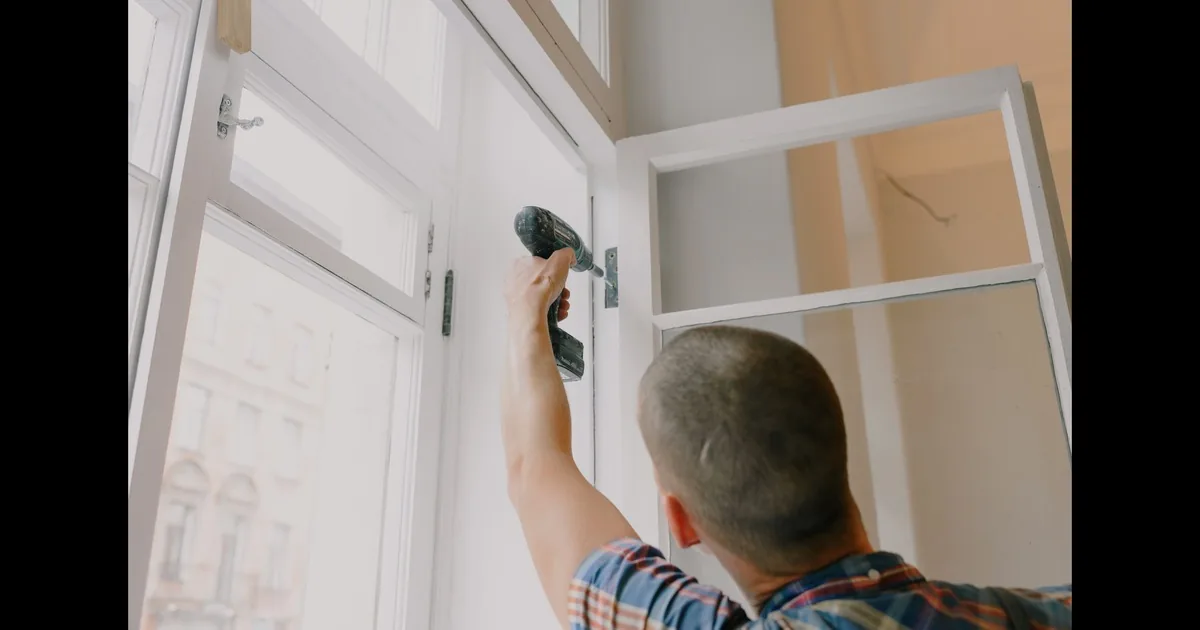
A homeowner lifts the lower sash six inches, lets go, and watches it slide shut. The office needs to treat that as a falling-sash safety issue before discussing parts. Ask the caller to leave the window closed and latched if that can be done without forcing it. Then collect the facts a technician can use: which sash moves, how it moves, the window brand or label, how many units are affected, and clear photos of the full window and each side jamb.
That sequence answers the immediate search intent behind “window sash will not stay open repair.” A balance or related connection often belongs in the repair conversation, but the call taker should record behavior rather than name a failed spring, cord, shoe, or pivot. Hung windows use several support systems, and similar symptoms can come from different hardware or from binding elsewhere in the opening.
Treat the falling sash as the first routing fact
Start with the condition right now. Is the sash closed? Can it drop without warning? Is there cracked glass, a loose sash corner, or a child’s bed beneath the opening? A sash that falls freely should move ahead of routine estimate questions because it can catch fingers or strike whatever is below it.
The safest office script is plain: “Please leave the sash closed and do not prop it open while we collect the service details.” Do not ask the caller to demonstrate the failure again for a video. A broom handle under a heavy glass sash is poor temporary hardware, and a phone call is the wrong place to coach someone through removing a tensioned component.
If the window cannot close, the sash looks partly detached, or glass is damaged, flag those facts for the dispatcher. The booking may need a different arrival priority, crew, or temporary-security plan. A caller who says “it slowly drifts down” presents a different field condition than someone holding a sash that slams shut.
Name the window and the moving sash
“Window” is too broad for parts research. Ask whether the unit slides vertically, slides sideways, swings out on hinges, or cranks open. A sash-support problem in this article means a single-hung or double-hung window that moves vertically.
Then identify the moving section. On a single-hung window, the lower sash usually moves while the upper section stays fixed. On a double-hung window, the upper and lower sashes can move. Record the caller’s wording if they are unsure: “the top glass panel slides down” gives the technician more than a guessed product name.
Ask whether the sash tilts inward for cleaning and whether it was tilted, cleaned, or reinstalled shortly before the problem began. Andersen’s instructions for certain A-Series and 400 Series Tilt-Wash windows describe a specific relationship between sash pivot pins and balance shoes. That guidance is useful because it proves the need for product identity. It does not make the same reset procedure suitable for another brand or series.
Approximate age helps, but a label is better. The brand, series, manufacturing code, or etched marking may be on the frame, sash edge, glass spacer, or product label. Do not direct a caller to remove the sash to find it. Ask for whatever can be photographed while the unit remains safely closed.
Capture one motion fingerprint
The office can sort the symptom into a useful field note without assigning a cause. Four descriptions cover much of what callers report:
- Drops quickly when released: leave it closed and flag the falling-sash condition. Record whether the whole sash stays square in the opening.
- Creeps down slowly: note where it was left and roughly how far it travels, using the caller’s observation rather than another test.
- One side sits lower: record which side, whether the sash looks twisted, and whether it was recently tilted inward.
- Feels stiff but stays in place: widen the record to paint, debris, swollen wood, weatherstripping, track damage, or an out-of-square opening.
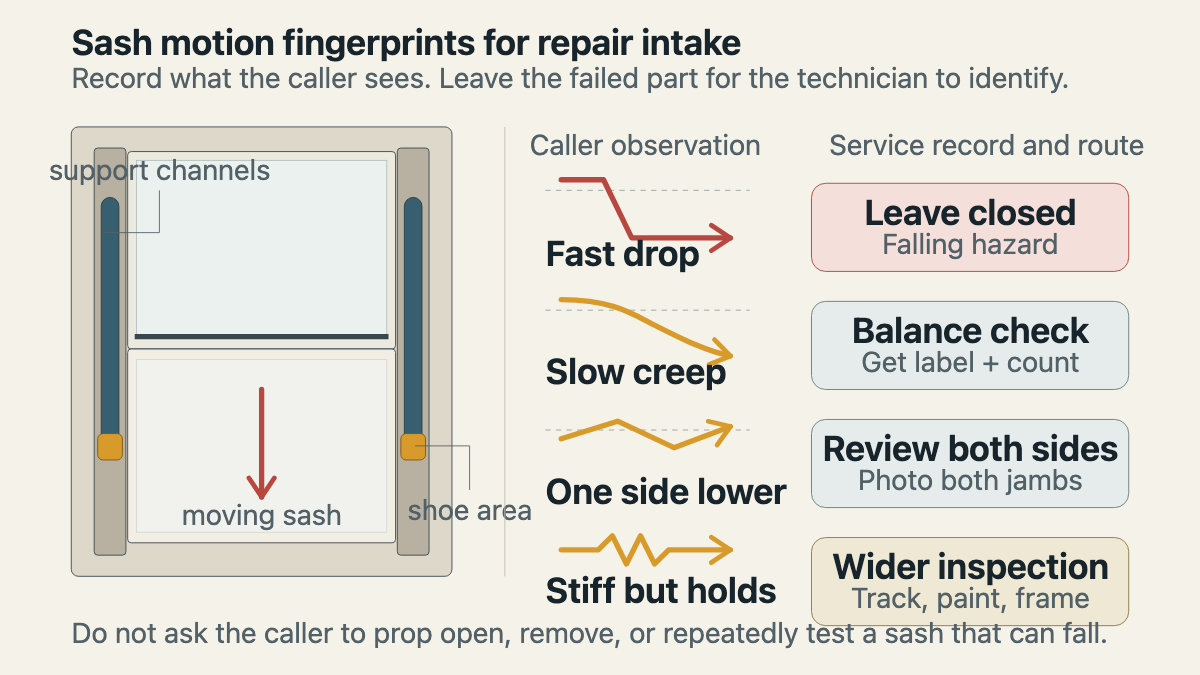
A scraping noise, visible cord, loose metal channel, exposed coil, or clicking inside the jamb belongs in the note too. Preserve the caller’s language. “A silver strip popped out on the left” is more useful than changing it to “broken balance,” which can send the technician toward the wrong part before anyone sees the window.
Collect photos that answer parts questions
A single close-up of white vinyl rarely identifies a window. Ask for a small, deliberate photo set:
- The entire window from inside, square to the opening, with the sash closed.
- The left and right jambs where the moving sash travels.
- Any readable brand label, code, or etching.
- The meeting rail and sash corners if one side sits lower.
- Any visible loose cord, channel, coil, shoe, pivot, cracked glass, water stain, or damaged frame.
Those images can help a technician recognize whether the window uses a channel, coil, spiral, overhead, or older weight-and-cord arrangement. SWISCO’s balance guide shows why a stamp alone may be insufficient: replacement research can depend on channel dimensions, end fittings, pivot shoes, coil housings, or other companion hardware. The office should promise assessment, not a stocked part, until the evidence has been reviewed.
Count matters as well. One failed sash among twelve matching windows may call for a focused repair visit. Several same-age units with the same behavior may justify a broader inspection and a different parts plan. Record the floor, room, accessibility, window size, and whether furniture blocks the interior work area. For an upper-floor exterior, note ladder or lift constraints without asking the caller to lean outside for a photo.
Separate repair evidence from broader window damage
A sound frame with identifiable, available hardware may support a balance-focused repair. The conversation changes when the caller reports rotten wood, recurring water stains, a cracked sash, fogged insulated glass, frame movement, or an opening that is visibly out of square.
Those details do not prove that the whole unit needs replacement. They tell the estimator that the scope may extend beyond support hardware. The full-frame versus insert window consultation guide explains the opening and frame questions that matter when replacement enters the discussion. For older character windows, the historic-home consultation guide adds preservation and matching questions.
Painted wood deserves one more intake question: was the home built before 1978? EPA says paid renovation, repair, or painting work that disturbs painted surfaces in covered pre-1978 housing and child-occupied facilities must follow lead-safe requirements. Authorized state and Tribal programs may administer their own rules. The office should flag the building age and painted-surface condition, then let the contractor determine what requirements apply to the planned work.
Build a service record the technician can trust
A clean dispatch note might read: “Bedroom double-hung window, lower sash drops immediately and is now closed and latched. Vinyl frame, installed around 2012. Caller reports left side lower than right after tilting for cleaning. One unit affected. Full-window, both-jamb, and label photos attached. No broken glass or water staining. Second-floor interior access is clear.”
That note does real work. It identifies the affected sash, preserves the observed sequence, keeps an unsupported diagnosis out of the record, and gives the technician a starting point for product and parts review.
Use a separate route when the caller’s main problem is that a closed sash will not secure. The window lock service call intake guide covers meeting-rail alignment, lock behavior, and security priority. The broader window and door installer resource library can help the office keep adjacent intents separate.
An AI receptionist can ask the same approved intake questions after hours and attach the caller’s answers to the service request. Keep the safety language and escalation rules written by the contractor. The best handoff still sounds like the homeowner’s window: lower sash, left jamb, fast drop, label photo attached.
Sources
- Everything You Need to Know: Window Balances, SWISCO
- Resetting Balancers on A-Series and 400 Series Tilt-Wash Double-Hung Windows, Andersen Windows & Doors
- Lead Renovation, Repair and Painting Program, U.S. Environmental Protection Agency
- Weatherstrip Double-Hung or Sash Windows, U.S. Department of Energy