A homeowner calls at 7:40 p.m. and says, “The bedroom window closes, but the lock will not catch.” That sentence could describe a loose latch, two sashes that do not meet, a casement that stops short, or a window that is open enough to create a security concern. The office cannot identify the failed part from that report.
A useful intake starts with safety and security. Then it records the window style, which part moves, what happens during one normal close-and-lock cycle, the product identity, and the number of affected units. The technician gets observations and photographs, not a diagnosis invented at the desk.
Screen security, glass, and escape use first
Before asking about brand or hardware color, establish what the open window means tonight. Is the glass broken? Is the opening reachable from the ground, a porch roof, a fire escape, or an adjacent balcony? Is the sash hanging, loose in the frame, or at risk of falling? Are young children in the home? Does the resident rely on this window as part of a bedroom escape plan?
Those answers change the route. An upper-floor window with an intact sash that will not draw tight may fit an ordinary repair appointment. An accessible ground-floor opening that cannot be secured may need the company’s urgent-security process. Broken glass belongs in the separate broken window glass intake.
The Consumer Product Safety Commission warns that screens keep insects out and should not be treated as protection against a child’s fall. Ask whether a child can reach the window and whether the caller already uses a guard or stop. Do not tell the caller to improvise a device or depend on the screen.
Escape use needs similar care. The National Fire Protection Association advises households to identify usable escape routes and make sure occupants can operate them. Reception should record that a bedroom window is part of the household’s plan, then flag it for qualified review. Avoid instructions to screw, nail, or paint a window shut. Local code and the property’s approved arrangement may also affect what is allowed.
Name the window before naming the fault
“The lock” means different hardware on different windows. Ask the caller to describe how the unit opens.
- A double-hung window has two sashes that move vertically. A single-hung unit usually has one moving lower sash.
- A sliding window moves sideways on a track. A casement swings outward with hinges and often uses a crank. An awning unit is hinged at the top.
- A fixed window does not open. If the caller expected it to move, verify the product before creating a repair ticket.
Plain descriptions work when the caller does not know the style. “The lower panel slides up” is enough. Follow with the room, floor, approximate installation age, frame material if known, and whether one unit or several units behave the same way.
Product identity matters because adjustment and hardware procedures vary. Andersen’s guidance for a casement lock and keeper directs attention to sash alignment and the reveal around that specific window type. That does not make the same adjustment appropriate for a hung or sliding window. Reception should capture the product, not translate one manufacturer’s instructions into a universal repair.
Ask for a photo of any label visible from a safe indoor position. Useful locations vary by product, so let the customer show what they can find without removing covers, leaning outside, or climbing. Record the manufacturer name, series, model, or code exactly as printed. A partial label photo still beats a guessed brand.
Record one normal close-and-lock cycle
Have the caller describe what happens during one normal attempt. Do not ask them to force the sash or repeat an action that strains the handle.
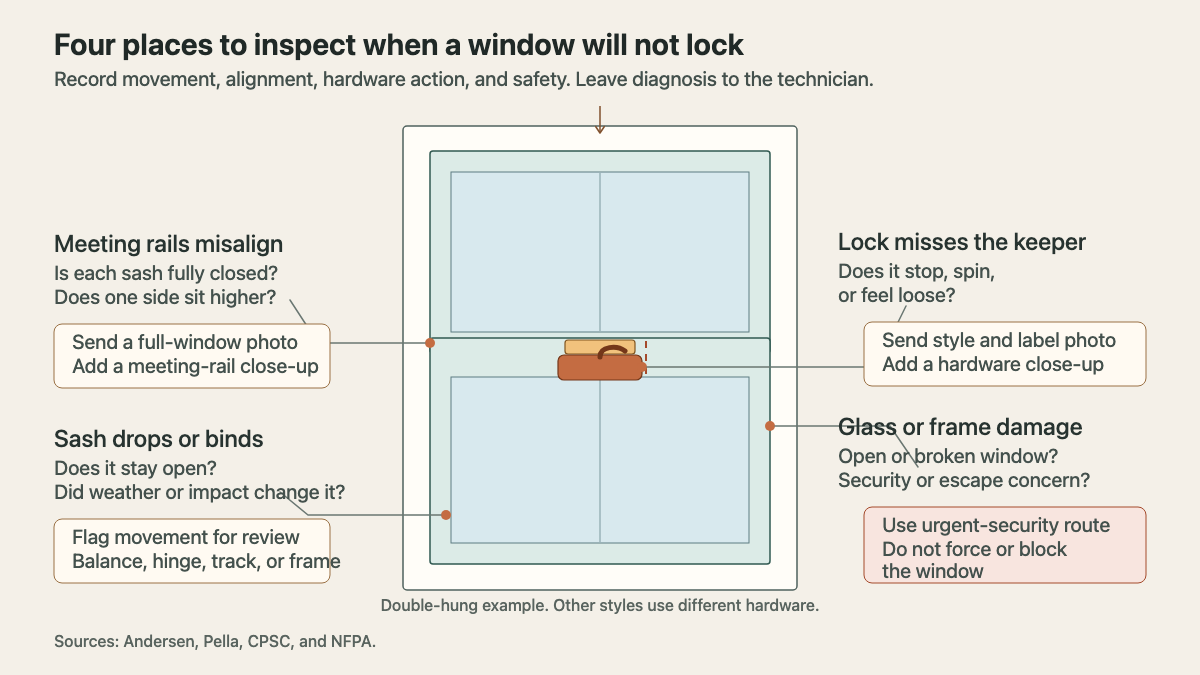
Start with movement. Does the window open and close through its usual travel? Does it stop before reaching the frame? Does one side of a hung sash sit higher than the other? Does the sash drift down after being raised, or does it feel loose? For a casement, does the crank bring the sash fully toward the frame before the lock is moved?
Then isolate the locking action. Does the handle travel normally but miss the keeper? Does it stop halfway? Does it spin, wobble, or feel detached? Is the keeper visibly loose? Did the problem appear suddenly after impact, cleaning, painting, or a storm, or did operation become harder over time?
Use the caller’s words. “Lower sash reaches the sill, but the left meeting rail sits higher and the lock stops halfway” is a strong dispatch note. “Broken lock” is a conclusion.
Pella’s window operation guidance recommends checking open, close, lock, and unlock operation and says persistent difficulty may require mechanism repair or replacement. It also ties proper locking to full closure. The office can use that sequence to organize observations while leaving the repair choice to the technician.
Ask for photos that show relationships
A tight photo of a latch can hide the reason it misses. Ask for a small, safe set that shows the hardware and the surrounding window:
- One full indoor view with the sash in its normal closed position
- One close view of the lock and keeper together
- One view across the meeting rails or the gap between sash and frame
- One label photo, plus a photo of visible damage or a loose part
Keep the caller on the room side. They should not lean outside, stand on furniture, reach over a stair opening, or hold a loose sash in place for the camera. If safe photographs are not possible, mark them unavailable and book from the verbal record.
Ask whether the window was recently painted, whether debris is visible in a track, and whether weatherstripping appears folded or displaced. Record those details without prescribing solvents, lubricants, shims, or adjustments. A product label or warranty may limit what should be applied or altered.
The office should also separate intact glass from glazing trouble. Condensation trapped between panes is a different service question, covered in the foggy double-pane window guide. Cracked glass, a loose pane, or a sash that appears to be separating should be routed by the company’s glass and safety protocol.
Capture access and the repair boundary
A technician needs to know whether the problem can be reached. Record the floor, room, interior ceiling height, furniture or built-ins below the window, exterior grade, landscaping, locked gates, pets, parking restrictions, and building rules. A third-floor casement over an awning is a different visit from a first-floor double-hung window beside a clear driveway.
For apartments, condominiums, offices, and managed homes, identify who owns the window, who can authorize work, and whether building management controls exterior access or product standards. Ask whether a certificate of insurance, scheduled loading area, elevator reservation, or resident notice is required.
Do not promise that a new latch will solve the problem. If several windows on the same wall changed at once, or the caller reports visible frame movement, widening gaps, water damage, or a hard-to-square opening, preserve those facts for assessment. The technician may find hardware wear, sash or hinge trouble, track obstruction, installation movement, frame damage, or another condition. The call record should keep those possibilities open.
The same boundary applies to repair versus replacement. A lock complaint does not automatically justify a full new unit. It also does not guarantee that a small part is available. If the eventual assessment points toward replacement, the full-frame versus insert consultation guide explains the broader opening and frame questions.
Read back a ticket the technician can use
Finish with a concise read-back. Confirm the address, contact, room, floor, window style, affected unit count, security priority, glass condition, sash movement, lock behavior, label details, safe photos received, access, authorization, and preferred appointment window.
A useful ticket might read: second-floor primary bedroom; one vinyl double-hung window; glass intact; lower sash opens and stays raised; both sashes appear closed, but left meeting rail sits higher; lock handle begins to move and stops halfway; no loose parts seen; Pella label photographed; opening not reachable from grade; two adults in home, no children; window is part of bedroom escape plan; clear interior access; owner authorizes assessment; four photos attached.
That record gives the technician a starting point while protecting the office from a premature parts promise. It also tells dispatch why a seemingly small latch call may need faster attention: the opening, the people around it, and the room’s use can matter as much as the hardware.