A homeowner calls after wiping the same living-room window twice. The haze stays put, and she can see clear glass on either side of it. Her first question is simple: “Do I need new glass, or does the whole window have to come out?”
The office should resist giving a final answer from that description alone. Start with the moisture location. Then record the glass, sash, frame, operation, opening, product labels, and warranty clues. If the haze appears sealed between the panes while the surrounding window seems sound, route an insulated glass unit assessment. If the caller also reports rot, deformation, failed hardware, difficult operation, staining around the opening, or broader upgrade goals, route a complete window evaluation.
Qualified field staff still decide the scope. A clean intake gets them to that decision faster and keeps the office from promising the wrong repair.
Start by locating the fog
“Foggy window” can describe three different observations. Moisture may sit on the room-side surface, on the outdoor surface, or inside the sealed space between the panes. Those locations do not belong in one dispatch note.
Ask the caller to wipe the accessible room-side glass with a dry cloth. If safe access is available, have the caller look at the exterior surface without climbing, leaning from an opening, or removing a screen that is difficult to handle. A second viewing angle often helps. Do not ask anyone to dismantle glazing or probe an edge seal.
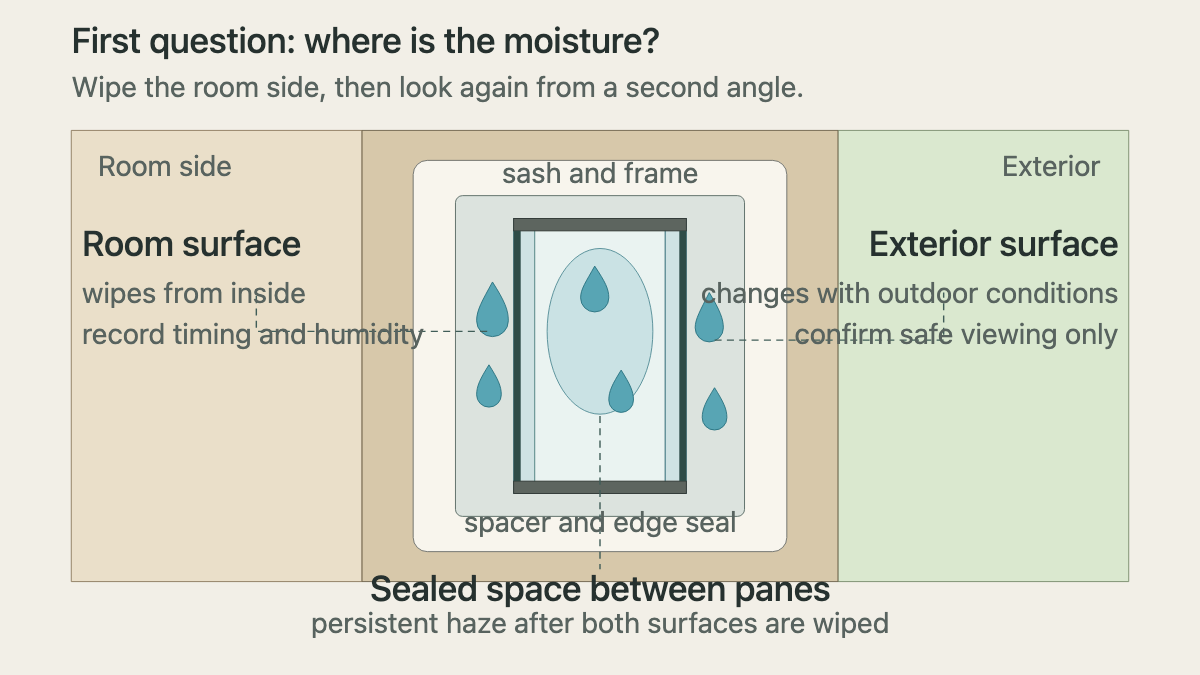
The NFRC Consumer Guide on window durability explains that failure of an insulating glass seal can release insulating gas and allow moisture between panes. Surface condensation has a different intake path because indoor humidity, glass temperature, weather, and room conditions can affect what the caller sees on an accessible face.
Use plain language in the record: “Haze remains after the room-side glass was wiped and appears between the panes.” That is useful. “Seal failed” goes too far unless qualified staff have confirmed it.
Timing helps too. Ask when the haze first appeared, whether it changes through the day, whether it clears in dry weather, and whether several windows show the same pattern. Request one photo taken straight on and another from an angle. The photos may support routing, but they do not settle the repair scope.
Name the glass unit, sash, and frame separately
A caller may use “window,” “pane,” and “glass” for the same object. The estimator cannot.
An insulated glass unit, often shortened to IGU, is the sealed glazing assembly. The Fenestration and Glazing Industry Alliance describes glass panels, an edge spacer, desiccants, sealants, gas fill, coatings, and optional internal grids as parts of an IG unit. The NFRC spacer guide explains that the spacer maintains the gap between panes and works with sealants to keep that space sealed.
That unit sits inside a sash. The sash may be fixed or operable, depending on the window. The sash fits within the frame, and the frame connects to the wall opening. Locks, balances, cranks, hinges, weatherstripping, sill details, exterior trim, and interior stops belong to the larger assembly.
This vocabulary makes the office’s first routing choice clearer. A glass-unit assessment focuses on the sealed glazing and whether the existing sash can receive the appropriate replacement. A complete-window evaluation adds the sash, frame, hardware, installation, and surrounding opening to the scope.
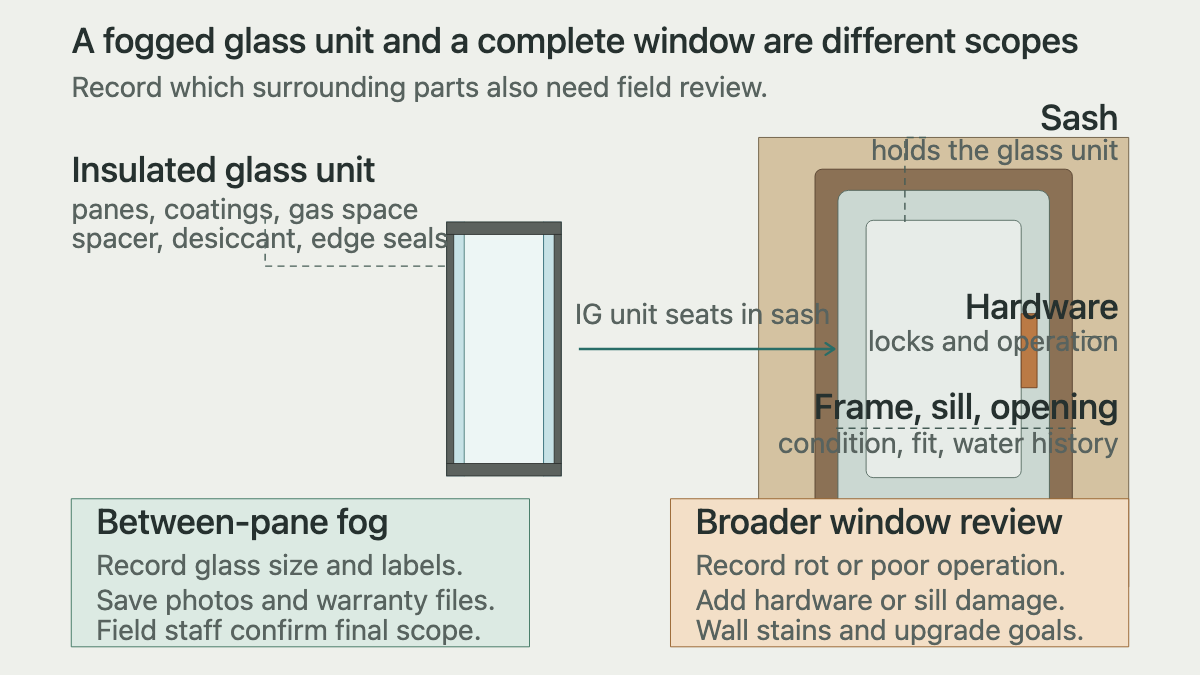
The office does not need to identify the glazing method by phone. It does need to avoid treating every fogged IG unit as proof that the surrounding window is sound.
Ask what else is wrong with the window
Once the moisture location is recorded, move around the assembly. The questions should follow the way a technician will inspect the opening:
- Does the sash open, close, lock, and stay in position normally?
- Is any frame or sash material soft, cracked, swollen, bowed, separated, or discolored?
- Are there stains, peeling finishes, damp trim, or damaged drywall below or beside the window?
- Does the caller feel a draft at the glass, at an operable joint, or around the frame and trim?
- Is the glass cracked, etched, scratched, tinted, coated, patterned, tempered, or fitted with grids?
- Is one opening affected, several matching windows affected, or a whole elevation affected?
- Has anyone repaired the glass, sash, flashing, siding, trim, or interior wall around this opening before?
A draft deserves its own location. Air at the sash joint can point toward weatherstripping or operation, while air around the trim may expand the inspection beyond the glass. Answara’s guide to weatherstripping and draft repair call intake gives office staff a separate set of questions for that complaint.
Water staining around the opening also needs care. Record the weather direction, first observed date, recent storms, and prior exterior work. If the caller describes wet wall finishes or staining that extends beyond the window, the intake may overlap with an exterior-envelope inspection. The siding leak and moisture call guide shows how to preserve that history without assigning blame or naming a leak source over the phone.
Collect the details needed to identify the unit
Window glass cannot be ordered from “double-pane living-room window.” Ask for information that helps the estimator identify the product and prepare the visit.
Start with the address and exact room. Record whether the opening is on the first floor, an upper story, above a porch roof, in a stairwell, or blocked by built-ins. Note whether the sash is fixed, single-hung, double-hung, casement, awning, sliding, or another style if the caller knows. Photos of the whole window, glass edge, lock or crank, and any etched corner markings can help.
Product labels may appear on the frame, sash edge, head jamb, or spacer between the panes. Ask the caller to photograph visible labels without removing stops, forcing the sash, or climbing. Capture the manufacturer name, product line, installer, approximate installation year, and any readable code exactly as shown. Do not “correct” a code that looks odd.
Warranty records belong in the same intake. NFRC notes that insulating-glass warranties vary by manufacturer and product. Ask whether the caller has an invoice, warranty certificate, builder packet, prior service record, or transfer paperwork. The office can say, “We’ll review the documents and product identification.” It should not say, “That will be covered.” Coverage, labor, shipping, transfer terms, and exclusions must be checked against the actual warranty.
Route the appointment without promising the outcome
The final call record should make uncertainty visible. A strong note might read:
“Living-room fixed window, first floor. Persistent cloudy band appears between two panes after inside surface was wiped. No cracked glass reported. Frame looks straight in photos. Caller reports no soft material, staining, or operating hardware because the unit is fixed. Three matching windows were installed at the same time; one is affected. Manufacturer label and installer invoice are attached. Schedule IG assessment and warranty-document review. Final glass specification and repair scope pending field confirmation.”
A broader record could say:
“Second-floor double-hung window. Haze appears between panes. Lower sash is difficult to raise, lock does not align, and the interior stool has an old water stain. Caller wants this opening assessed along with two drafty windows on the same wall. Exterior access requires company equipment. Schedule complete window and opening evaluation. Do not quote glass-only work from the call.”
These notes tell the field team why the appointment was routed. They also preserve facts that may change the plan once the product, sash, glazing, and opening are inspected.
Give the caller a precise next step
Close with what the company will do, not what the company has already decided. Confirm the appointment type, documents to send, access needs, affected openings, and who must approve the work. If the business charges an assessment or diagnostic fee, explain what the fee covers in plain terms and state when a repair quote can be issued.
An AI receptionist can capture these fields after hours and route the record by symptom. The same script works for a human receptionist. Either way, the useful result is a note that says where the moisture appears, which parts have other problems, and what evidence is ready for the estimator.
The homeowner who called about “foggy glass” should leave with one firm promise: the right person will inspect the right scope. The glass unit, sash, frame, and wall opening can then answer the rest.