A homeowner calls while rain is tapping the glass: “Water is coming through the window.” That description is urgent, but it leaves the office with almost nothing an inspector can use. The water may have appeared at the head, one jamb, the meeting rail, a sill corner, or the wall above the opening. It may show up in every shower or only when wind pushes rain against one side of the house.
A useful window leak intake captures the first visible wet point, weather direction, delay before the leak appeared, spread into nearby finishes, recent work, and safe photo evidence. Keep the cause open. The indoor drip can sit several inches or several feet from the exterior entry path, and a phone call cannot separate the window product, perimeter joint, flashing, or surrounding wall.
Start with the first wet point
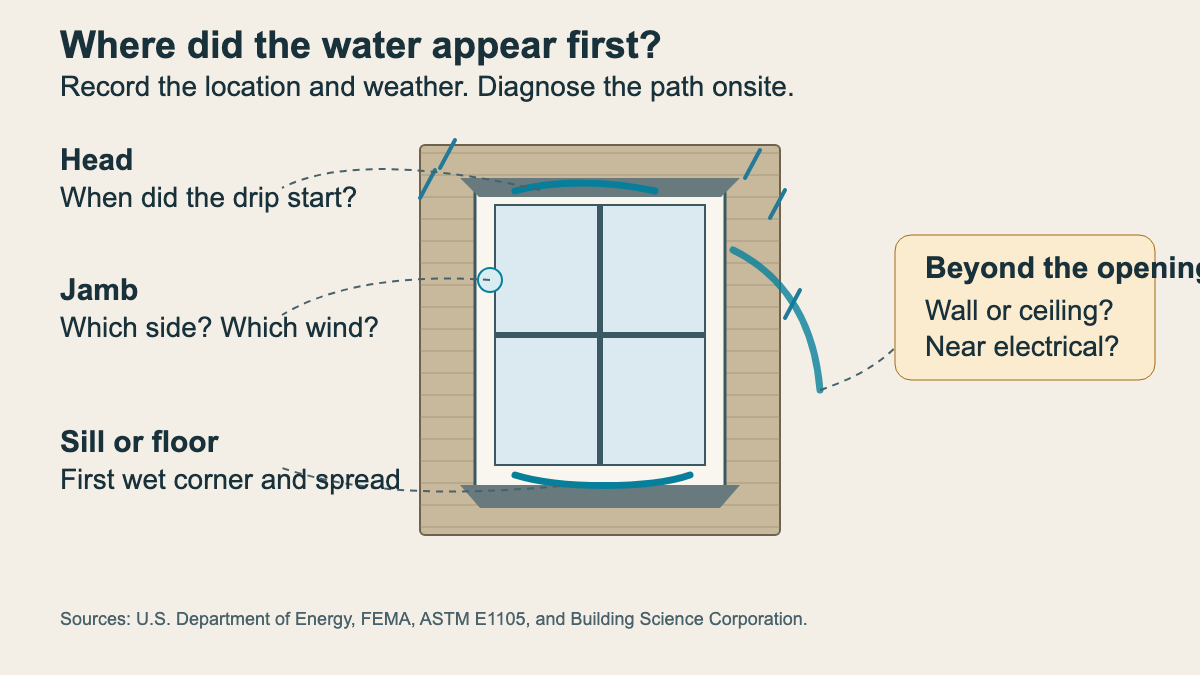
Ask the caller to describe where water first became visible, then pin that description to a fixed part of the opening. “Around the window” is too broad. “At the upper-left inside corner, where the painted trim meets the wall” gives the inspector a repeatable location.
Useful location choices include the top trim, left or right jamb, bottom corner, sill surface, lock or meeting rail, between panes, wall above the head, and floor below. Record left and right as viewed from inside the room. That small convention prevents a reversed note when the crew walks around the exterior.
Then ask how the water moved. Did one bead form and stay put? Did a line run down the jamb? Did the sill fill before water reached the floor? Is the drywall stained with no active drip? Mark the farthest visible edge against a landmark such as an outlet, trim joint, floorboard seam, or curtain bracket.
This sequence preserves evidence without turning reception into diagnosis. A wet lower corner may be where water exits indoors, not where it entered the wall.
Record the storm that reproduced it
Window leaks often depend on weather. “It rained all day” is a start, but the field team needs a better account of the event.
Ask which side of the house received the rain and whether the wind was pushing toward that wall. Find out whether water appeared as soon as rain began, after a long delay, during a heavy burst, or after the storm eased. Ask whether the same window stays dry during light rain and whether the problem has occurred in more than one storm.
FEMA’s guidance on water intrusion through windows and doors distinguishes water moving through a product from water moving around its installation. Its focus is extreme wind events, so it should not be stretched into a diagnosis for an ordinary shower. It does support one intake principle: wind and pressure can change how rain reaches an opening.
Capture the event in the caller’s own terms. A strong note might read, “Leak starts after roughly twenty minutes of wind from the east; no water during straight-down rain; upper-left corner becomes wet first.” If the caller does not know wind direction, ask which exterior wall faced the rain. Do not manufacture precision they cannot supply.
Keep the window and wall in the same inspection scope
A window sits inside a larger water-control system. The U.S. Department of Energy’s window flashing guidance describes the opening as an interruption in the wall drainage plane. Properly integrated flashing should direct incidental water outward. Its related fully flashed opening guide shows how sill, side, and head flashing connect with the wall’s water-control layer.
That means intake should cover the opening and nearby construction. Ask what sits above and beside the window: another window, a roof edge, balcony, gutter, siding joint, masonry ledge, hose bib, exterior light, or wall penetration. Record visible gaps, loose cladding, cracked trim, or staining, but do not tell the caller which one caused the leak.
Recent work matters. Ask whether the window, siding, roof, gutters, exterior paint, or sealant changed before the first incident. Get the date and contractor if known. A replacement window installed last month and a twenty-year-old unit that began leaking after roof work belong to different inspection histories.
Building Science Corporation’s window-leak investigation found several paths in one project, including a mulled joint, sash gasket, and sill flashing that did not drain incidental water outward. The case does not establish what failed at another house. It shows why “needs caulk” is a poor phone diagnosis.
Separate active damage from a routine inspection
Most recurring leak calls can be booked for inspection. Some need faster routing because water is spreading or reaching an electrical hazard.
Ask whether water is active now. If it is, find out whether it is near an outlet, switch, light fixture, appliance cord, or electrical panel. Do not direct a caller to touch wet electrical equipment, cross standing water, or remove a cover. Follow the company’s emergency policy and refer electrical danger through the proper local emergency route.
Also ask about a bulging ceiling, sagging drywall, falling material, a soft floor, or water entering the room below. Keep people and pets away from a visibly unstable area. The window company may need to coordinate with a roofer, siding contractor, electrician, or water-mitigation company once a qualified person reviews the scene.
For ordinary dripping, the office can offer simple property-protection guidance that does not disturb the assembly: move furniture if it can be done safely, place a container or towel at the interior drip, and photograph the water before drying the surface. Do not advise drilling a ceiling, pulling trim, climbing a wet ladder, or applying exterior sealant in the rain.
Request photos that preserve the scene
Four photographs usually tell a better story than twenty close-ups with no orientation. Ask for one wide interior view showing the whole wall, one medium view showing the entire window, one close view of the first wet point, and one exterior view taken safely from ground level. Add a photo of any model label or manufacturer marking if it is already accessible.
Have the caller name the room and mark which way the window faces. If several openings leak, number them on a simple room list and request the same views for each. “Bedroom two, east wall, window one” survives a handoff better than “the bad upstairs window.”
A caller may offer to spray the exterior with a hose. Decline casual testing before the inspection unless the company has a controlled procedure and has asked for it. ASTM E1105 evaluates installed windows and perimeter joints with controlled water application and specified pressure conditions. A broad hose spray can wet areas that natural rain did not reach and muddy the evidence.
Photos should document conditions, not create them. Never ask a caller to remove siding, trim, glazing stops, screens that require tools, or interior finishes.
Book enough time and the right person
The appointment type should match the evidence. Record the number of affected windows, floor level, window style, approximate age, material if known, operable or fixed status, and whether the sash closes and locks. Note storm windows, shutters, security bars, deep landscaping, steep grade, a balcony, or restricted exterior access.
Ask who owns the property and who can authorize inspection or testing. For a tenant call, get the landlord or property manager contact before promising a repair slot. For a condominium, note whether the window is owner responsibility or part of the exterior envelope under the association. Reception should record that question, not interpret governing documents.
Clarify what the visit includes. Is it visual inspection, diagnostic testing, a repair estimate, warranty service, or an evaluation before replacement? State the diagnostic fee and whether testing is separately priced according to company policy. Avoid promising that the technician will complete a same-day repair. The opening may need drying, material removal, specialty testing, or coordination with another trade.
If inspection suggests full-frame work, the office can use the full-frame versus insert consultation guide for the next conversation. Broader wall and cladding concerns may also need the siding moisture call-intake guide. The window and door resource hub keeps those scopes separate.
Read back a field-ready ticket
Before ending the call, read the note back. A useful ticket sounds like this:
“Second-floor east bedroom, double-hung vinyl window, age unknown. During two wind-driven storms, water first appeared at the upper-left interior trim corner about twenty minutes after rain began. It ran down the left jamb and wet the sill, but did not reach the outlet three feet away. Light rain without east wind has not reproduced it. Exterior siding was replaced six weeks ago. The sash closes and locks. No bulging drywall, ceiling leak, or electrical contact reported. Wide interior, close wet-point, and ground-level exterior photos attached. Homeowner will be present and can authorize diagnostic testing.”
That note gives the inspector a location, trigger, sequence, change history, safety screen, access status, and evidence set. It leaves room for the fieldwork to find the actual path.
A trained receptionist or AI call handler can collect the same fields after hours, especially while the storm is still producing evidence. The script should stay disciplined: locate the first water, describe the weather, screen immediate hazards, document the surrounding wall, and book an inspection without naming the repair in advance.