“The dryer runs, but there’s no heat.”
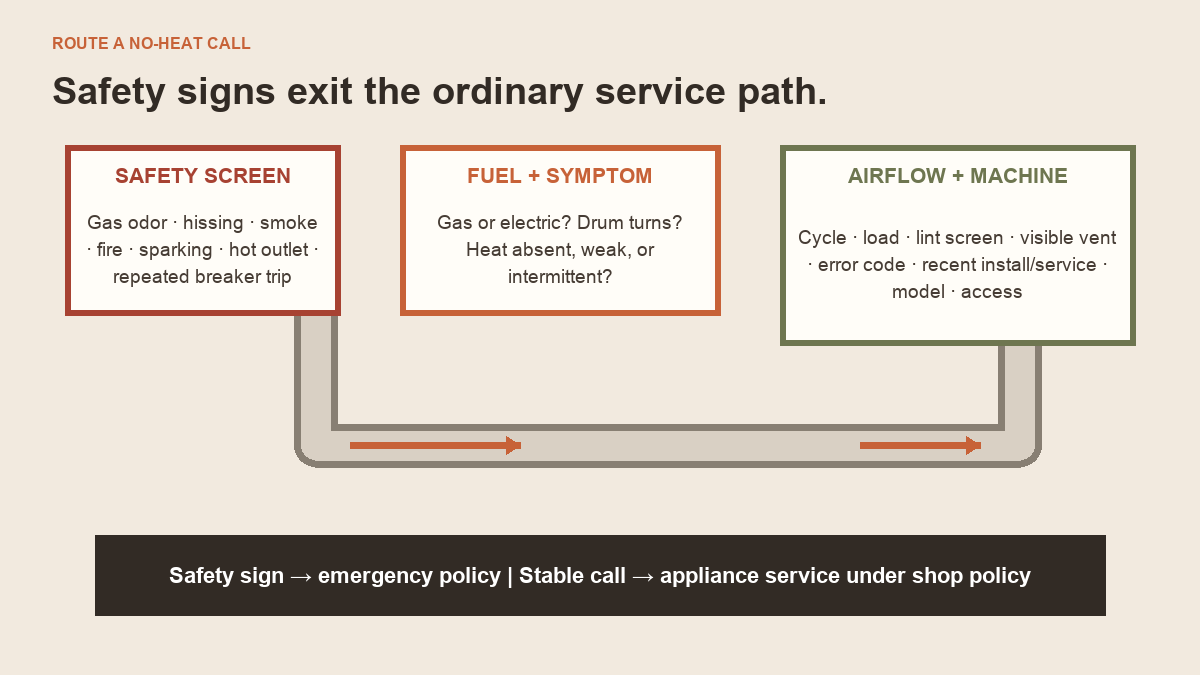
That complaint sounds complete. It is missing the detail that determines the rest of the call: gas or electric. Before you ask, check for an immediate hazard. Ask whether the caller smells gas, hears hissing, sees smoke or sparking, notices a hot outlet or damaged cord, or has a breaker that keeps tripping.
A yes stops ordinary booking. The U.S. Consumer Product Safety Commission says anyone who smells gas or hears gas leaking should leave the home immediately and contact local gas authorities from outside. The person should avoid operating lights, phones, or other electronics before leaving. Your office needs an approved emergency script that states this plainly. Do not keep a caller standing in the laundry room while you collect a model number.
For a stable scene, identify the dryer type and define what “no heat” means. Then collect the cycle, load, airflow, machine, installation, and access details a technician can use. The receptionist should preserve observations. Voltage tests, gas-flow checks, and component diagnosis belong with qualified service staff.
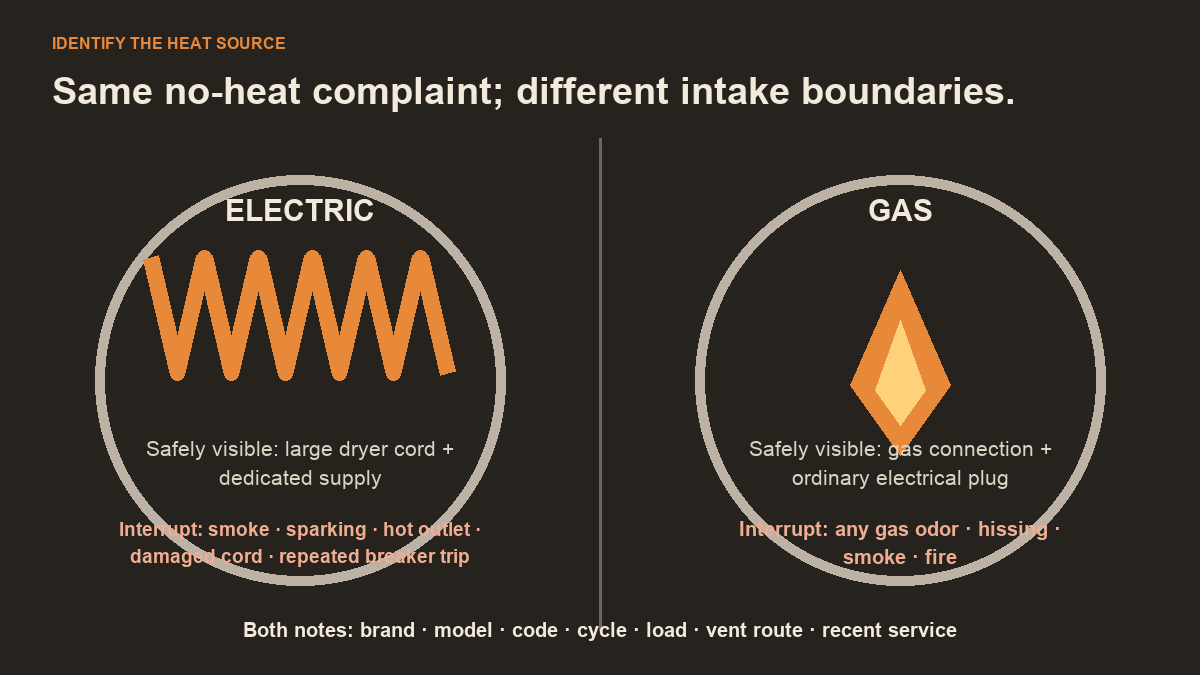
Confirm gas or electric without sending the caller behind the machine
Many callers do not know which type they own. Ask first. If they are unsure, use information they can reach safely: the purchase record, owner’s manual, model listing, utility account, or a clear photo already on their phone.
Do not ask someone to pull out a stacked unit, squeeze behind a dryer, touch a gas connector, inspect a receptacle, or open the electrical panel. A safely visible large dryer cord may suggest an electric model. A safely visible gas connection may suggest gas. Those clues still need confirmation from the model information or technician.
The distinction matters because a turning drum does not prove the heating side has what it needs. Whirlpool’s electric dryer no-heat guidance explains that one circuit can operate the motor while another operates the heating element. The drum may turn even when the electric heating supply is unavailable. That is useful context for intake, but it is not permission to coach electrical testing.
Whirlpool’s gas dryer guidance makes the parallel point for gas models: the drum can turn while the dryer does not heat when gas supply is unavailable. Record whether the caller reports recent gas service, an installation, or a closed valve they already observed. Never direct a caller to loosen a fitting, test for a leak, or recreate an ignition attempt.
Find out what “not heating” means in this house
A dryer that stays cold is a different report from one that gets warm but needs two cycles. So is a machine that heats for ten minutes and then cools. Ask the caller to describe what they observed without choosing a failed part for them.
Start with the drum. Does it turn? Does the cycle start and finish? Does the display show an error code? Write the code exactly, including letters, numbers, and punctuation. Do not translate it from memory. Codes vary by brand and model.
Then ask about heat in plain language. Are clothes room temperature at the end, slightly warm, unusually hot, or still damp despite feeling hot? Did the caller notice a change during one load or across several loads? Was the result the same on a timed cycle and a sensor cycle, if they already tried both? You are building a sequence, not asking the homeowner to perform a test plan.
Capture what was in the dryer. One heavy blanket can behave differently from a normal mixed load. Ask whether the load was unusually large, tightly packed, or made up of one bulky item. Record the caller’s answer. Avoid telling them that the load caused the problem.
If the caller mentions a burning odor, scorching, smoke, or a dryer that becomes excessively hot, return to the company’s safety lane. “Still damp” belongs in ordinary intake. “Smoke came from the back” does not.
Airflow belongs in the note, but the office should not diagnose the vent
A no-heat call often arrives as “the dryer takes forever.” The caller may be dealing with absent heat, weak heat, a sensor-cycle issue, restricted airflow, an overloaded drum, or another condition. The office can separate those observations without naming the cause.
Ask when the lint screen was last cleaned and whether it is cleaned between loads. Ask where the exhaust exits the building, whether the visible flap opens during operation, and whether the caller has noticed crushed ducting, lint around the outlet, or a recent vent change. Keep every question within safe, visible reach. No one should climb a ladder, disconnect ductwork, or run the machine for your benefit.
CPSC’s consumer safety alerts advise periodic cleaning of the dryer lint screen or filter, exhaust duct, and vent. Whirlpool also includes vent kinks and obstructions in its dryer not-heating guide. These sources support collecting airflow history. They do not prove that a particular vent is blocked.
The vent route affects the appointment. A short first-floor run that exits behind the laundry wall presents different access from a duct routed through a ceiling to a second-story roof. If your appliance technicians do not clean or repair building vents, tell the caller how your company handles that boundary. You can inspect the appliance first, schedule a separate vent assessment, or refer that scope under written policy.
Record recent changes before you offer an appointment
The week before the symptom often matters more than the caller’s guess about a part. Ask whether the dryer was installed, moved, stacked, converted, or reconnected recently. Ask about electrical work, gas service, remodeling, a new vent, or a utility interruption. Record who performed the work if the caller knows.
Get the brand, full model number, and serial number from a safe location. An emailed label photo is better than a partly heard string over a noisy phone line. Never ask someone to tilt or move the machine to find the label. Manufacturer support or the owner’s manual can show the label location for that model.
The installation changes access too. Capture whether the unit is freestanding, stacked, in a closet, under a counter, or inside a tight alcove. Note doors that may need removal, shelving above the appliance, stairs, elevator reservations, parking limits, pets, and the route from the entrance to the laundry area.
For rentals and managed properties, identify who can authorize diagnosis, repairs, and payment. Find out whether a tenant will provide access and whether the owner requires a written estimate before work begins. A technician should not discover at the door that the only person present cannot approve anything.
Build the dispatch note in a fixed order
A technician should be able to read the note once in the driveway. Use the same order for every dryer no-heat call:
- Safety status: No gas odor, hissing, smoke, sparking, hot outlet, damaged cord, or repeated breaker trip reported. Record any escalation separately.
- Dryer and symptom: Gas or electric, brand, model, serial, drum behavior, heat description, timing, cycle, error code, and load type.
- Airflow context: Lint-screen history, visible vent condition, exit location, duct route if known, and whether vent work is inside the company’s scope.
- Recent changes: Installation, move, stacking, electrical work, gas service, utility interruption, remodeling, or prior repair.
- Access and authority: Configuration, stairs, parking, doors, pets, tenant or owner contact, authorized adult, and payment or estimate rules.
- Expectation: Appointment window, diagnostic fee explanation, and the fact that repair scope and price follow inspection.
That note is more useful than “dryer not heating, customer thinks element.” The customer’s theory can be included as a quote, but it should not replace the observed facts.
For a related appliance example, the washer not-draining intake guide shows the same discipline applied to standing water, wet loads, and household-drain clues. The exact questions change. The office’s job does not: protect safety, preserve what happened, and hand the technician a clean starting point.
An AI receptionist can follow this approved sequence after hours and save each answer in the same fields. The appliance shop still controls its emergency language, service boundaries, escalation contacts, and appointment rules.
Pull the last five dryer no-heat calls from your system before the next shift. If the notes do not identify gas or electric, the safety status, what the drum did, what “no heat” meant, the vent context, and the model, fix the intake form before the next dryer starts tumbling cold.