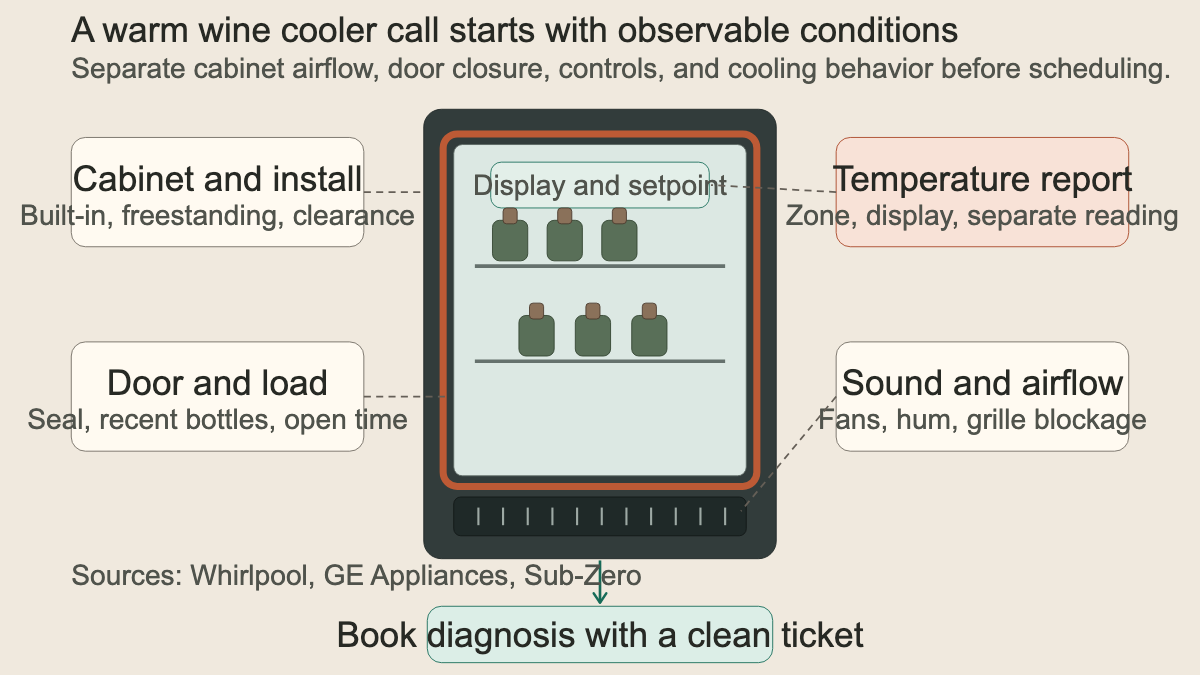
“My wine fridge says 55, but the bottles feel warm.” An appliance repair office could book that as a generic no-cool call. A better ticket separates the display from the caller’s observation, identifies the affected zone, records the installation and airflow, and captures what changed before the temperature drifted.
Start with six facts: the temperature shown, any separate thermometer reading, whether one or every zone is warm, the make and model, whether the cooler is built in or freestanding, and whether the door closes fully. Then ask about recent bottle loading, room heat, blocked ventilation, sounds, lights, alarms, and error codes. Leave compressor, fan, sensor, refrigerant, and control-board diagnosis to the technician.
Define what “not cooling” means
Ask the caller what prompted the call. The answer may be a warm bottle, a display reading above the setpoint, condensation, an alarm, or a cooler that has gone quiet. Those reports belong in separate fields.
Record the displayed temperature and setpoint for each zone exactly as shown. If the customer used a separate thermometer, note where it sat and when the reading was taken. Do not convert “the reds seem warm” into a precise temperature. The technician needs the original observation.
Ask whether the unit is cooling a little, cycling between warm and cool, or staying close to room temperature. When did the caller last know it was operating normally? Did the change appear in one zone or the whole cabinet? A dual-zone cooler with one warm compartment presents a different service history from a unit whose display, lights, and cooling all stopped together.
Keep this call distinct from a full-size refrigerator failure. The refrigerator not-cooling intake guide covers perishable food, freezer condition, and urgent household routing. A wine cooler ticket centers the collection, cabinet conditions, installation, and equipment behavior. If the customer asks how to protect valuable bottles, follow the shop’s approved guidance or refer them to the manufacturer. Reception should not invent a storage plan.
Identify the unit and its installation
Request the manufacturer, full model number, serial number, approximate age, number of zones, and installation type. A photograph of the rating plate is better than a model name read from memory. The appliance model and serial number guide explains how to keep those fields separate.
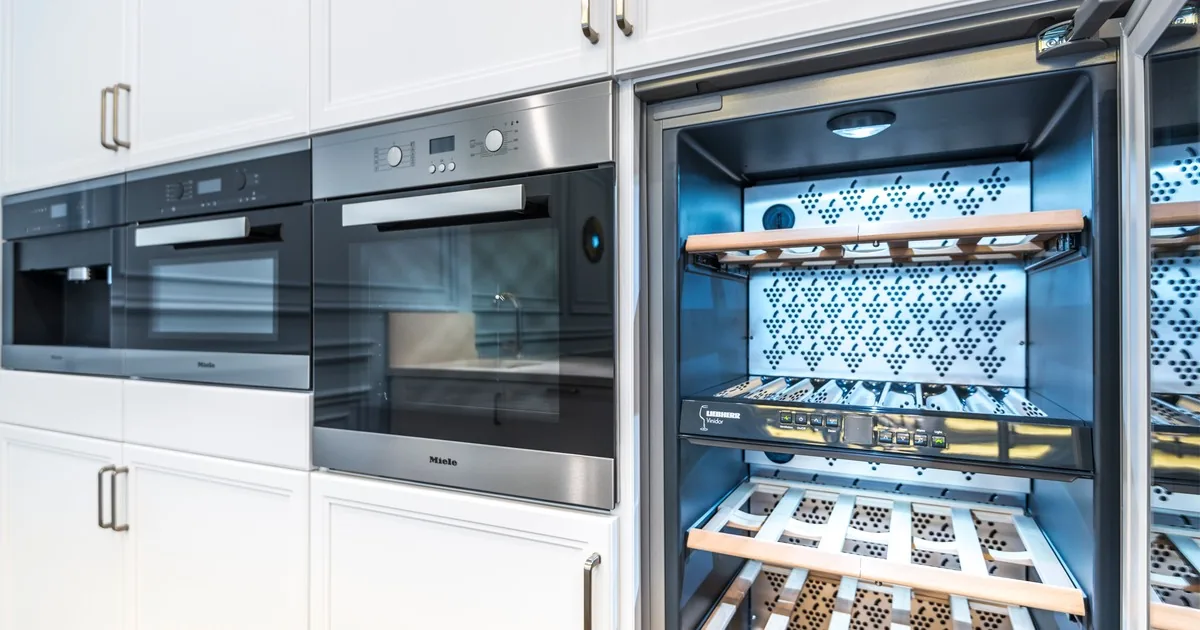
Ask where the cooler sits. Is it under a counter, inside a tall cabinet, beneath a bar, in a pantry, or freestanding with open space around it? Was it designed for that installation? Do not ask the caller to pull a built-in unit out. A wide photo of the cabinet and surrounding millwork is enough for intake.
Ventilation details matter. Whirlpool’s wine-cellar support page warns that a blocked base grille can interfere with airflow and cooling. GE’s refrigeration support also lists blocked airflow and inadequate clearance among the conditions to check. Record whether a rug, toe kick, cabinet door, dust buildup, pet hair, boxes, or stored bottles cover a visible intake or exhaust. Avoid telling the customer to remove a grille or open a panel.
Ask about the door and the recent load
A glass door can look closed while a bottle neck, shelf, label, or rack keeps the seal from meeting evenly. Ask whether the door sits flush along all four edges. Does it rebound after closing? Is there moisture at one corner? Has the gasket pulled loose, torn, folded, or collected debris? Ask for a straight-on photo if the gap is visible.
Then build a short timeline. Was a case of room-temperature wine loaded recently? Was the door held open while shelves were rearranged? Did the caller clean the cabinet, reverse the door, move the unit, replace cabinetry, or complete nearby construction? Did a power outage or breaker event occur? A crowded cabinet and a newly loaded cabinet are different observations, even when both callers say “It stopped getting cold.”
Whirlpool notes that frequent door opening and adding many warm items can raise cabinet temperature. Sub-Zero’s warm wine unit guidance also asks about recent loading and whether the door was left ajar. These are intake facts, not proof of a cause. Record them without promising that waiting, unloading, or closing the door will solve the complaint.
Room conditions belong in the ticket too. Ask whether the cooler sits beside an oven, near direct sun, in a garage, or in a room that recently became hotter than usual. Capture the room temperature if the caller has a reliable reading. Manufacturer operating limits vary, so staff should consult the manual for the exact model before giving a range.
Record controls, lights, sounds, and indicators
Ask the caller to describe the control panel without changing settings during the call. What setpoint and cabinet temperature appear? Is there an alarm, service icon, flashing light, or error code? Photograph the display if it can be done without exposing a private interior or moving the appliance.
Sound is useful when it stays descriptive. Ask whether the caller hears a steady hum, a fan, repeated clicks, a brief start followed by silence, rattling, or nothing. Record whether the sound comes from inside the cabinet, the base, or the rear as best the caller can tell. “Fan failure” and “bad compressor” are diagnoses. “Base area clicks every few minutes; interior light works; no airflow felt at the visible grille” is a ticket.
Note whether the interior light remains on after the door closes if the caller can observe that through the glass. Ask whether controls respond, whether another outlet was tested only if the shop permits that check, and whether the breaker has tripped. Do not direct the caller to use an extension cord, bypass a ground-fault device, remove a cover, or touch wiring.
Sub-Zero lists fans, sensors or thermostats, sealed-system components, and door seals among possible sources of warm temperatures. The same page says service is needed to determine and repair the exact cause when model-specific checks do not resolve it. That is the right boundary for the office. Several different conditions can produce the same warm-cabinet report.
Build the technician’s ticket
A useful wine cooler work order should contain:
- Customer name, service address, callback number, and access contact
- Manufacturer, model, serial number, approximate age, and warranty status if known
- Built-in or freestanding installation, number of zones, and cabinet location
- Displayed temperature, setpoint, separate reading, affected zone, and symptom timeline
- Door closure, gasket condition, recent loading, room heat, and visible ventilation blockage
- Lights, sounds, alarms, error codes, prior power events, and work already attempted
- Photos of the unit, installation, rating plate, display, door gap, and visible grille
Add site details that change the visit. Is the unit behind a finished toe kick? Are there stairs, tight halls, stone counters, fixed panels, or a business opening time? Who can approve access to cabinetry? If another company installed or serviced the cooler recently, request the invoice or service note.
Read the intake back in one compact paragraph: “Built-in two-zone wine cooler under the kitchen counter. Upper zone displays 64 with a 55 setpoint; lower zone displays 57 with a 55 setpoint. The customer first noticed warm bottles yesterday. Twelve room-temperature bottles were added two days ago. The door now sits slightly proud at the upper right, and the base grille is partly covered by a new cabinet trim piece. Lights and controls work. The customer hears a fan but reports no alarm or error code. Model and serial photos are attached.”
That ticket does not name the failed part. It gives the technician a model, an installation, a timeline, and four observable conditions to test.
Set the appointment around diagnosis
Explain the visit in bounded terms. The technician will confirm the unit identity, inspect the installation and door, compare controls with actual cabinet conditions, and test the cooling system as appropriate for that model. Parts, access work, additional labor, and a return visit may depend on what the inspection finds.
Do not promise a compressor, fan, gasket, control, or refrigerant repair from the phone description. Do not promise that every bottle can remain in place or that the unit will be restored during the first visit. If the shop services only certain brands or cooling systems, verify that before taking a deposit or giving an arrival window.
An AI receptionist can collect these same fields after hours and route the ticket under the company’s service-area, brand, and urgency rules. It should preserve the caller’s observations and stop before diagnosis.
The technician should arrive knowing which cabinet is warm, where it is installed, what the door and grille look like, and what the controls did. That is enough to begin real diagnosis at the appliance.