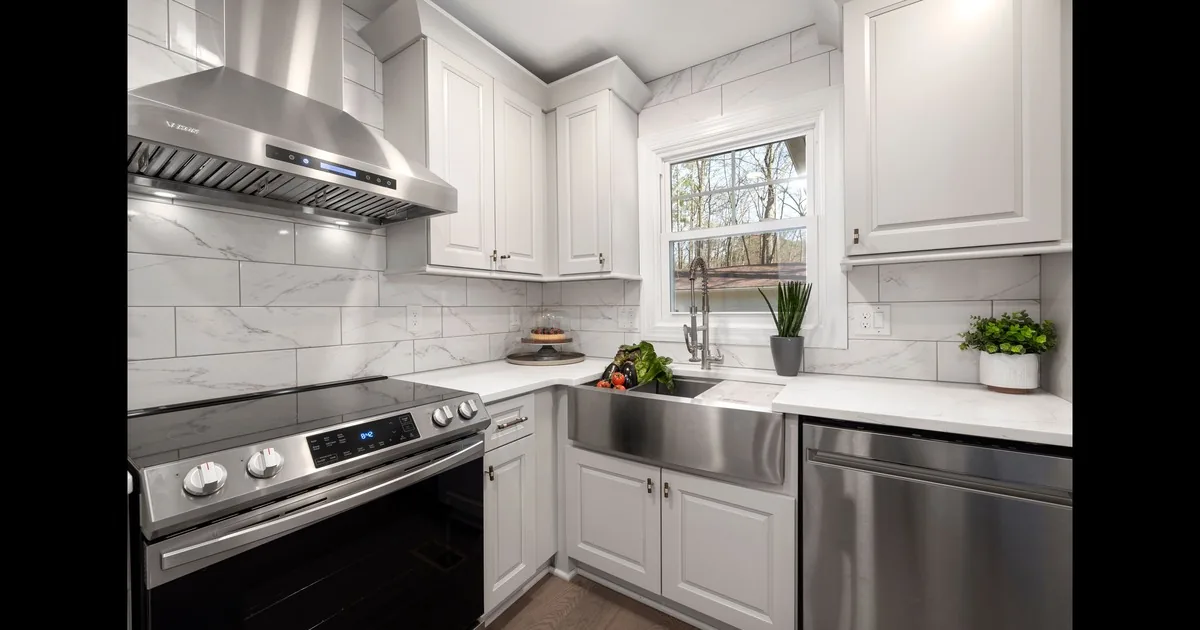
A homeowner calls because the range hood “stopped working.” That phrase could describe a dead blower with working lights, a fan that hums but does not turn, weak airflow through a grease-coated filter, or a hood that runs normally while smoke stays over the cooktop. Booking all four as the same repair leaves the technician to sort out the job at the door.
A useful range hood service intake captures the hood type, model information, exact fan behavior, light and control status, filter condition, venting setup, and any sign of heat or electrical trouble. The office should document symptoms, give only safe operating guidance, and leave diagnosis to the technician.
Start with what the caller means by “fan problem”
The first question should be plain: “What happens when you press the fan control?” Let the caller describe the result before offering choices. Then pin the description down.
A silent fan is different from a fan that hums. A rattling blower is different from a blower that sounds normal but moves little air. Some callers say the fan is broken when their real complaint is lingering odor or smoke. Others have a light failure and assume the whole hood has lost power.
Capture the caller’s words, then assign one observable symptom:
- The fan and lights are both dead.
- The lights work, but the fan is silent.
- The fan hums, rattles, scrapes, pulses, or runs at only one speed.
- The fan runs, but smoke, steam, or odors remain near the cooktop.
- The hood starts, stops, or changes speed without the caller selecting it.
That last symptom may be normal on some models. Broan-NuTone’s range hood FAQ explains that certain hoods have a heat-sensing feature that can raise the blower speed when high heat is detected. The office should record the behavior and model, not promise that the control is defective.
Separate a power symptom from a blower symptom
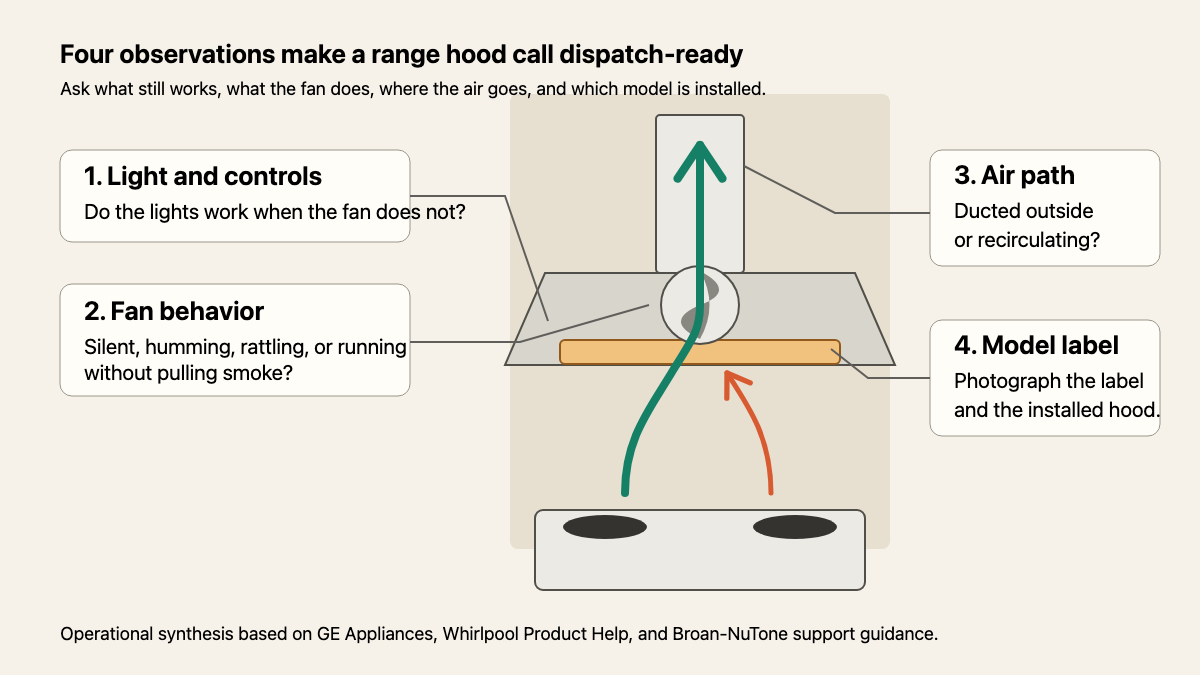
Ask whether the hood lights work. This quick split gives the technician better information without asking the homeowner to remove panels or touch wiring.
GE Appliances’ vent hood support guidance treats a completely dead hood differently from a hood whose lights work while the blower does not. GE tells owners to check the house breaker when neither function operates. It also notes that a blower connector may be loose when the lights work but the blower does not, with power disconnected before inspection.
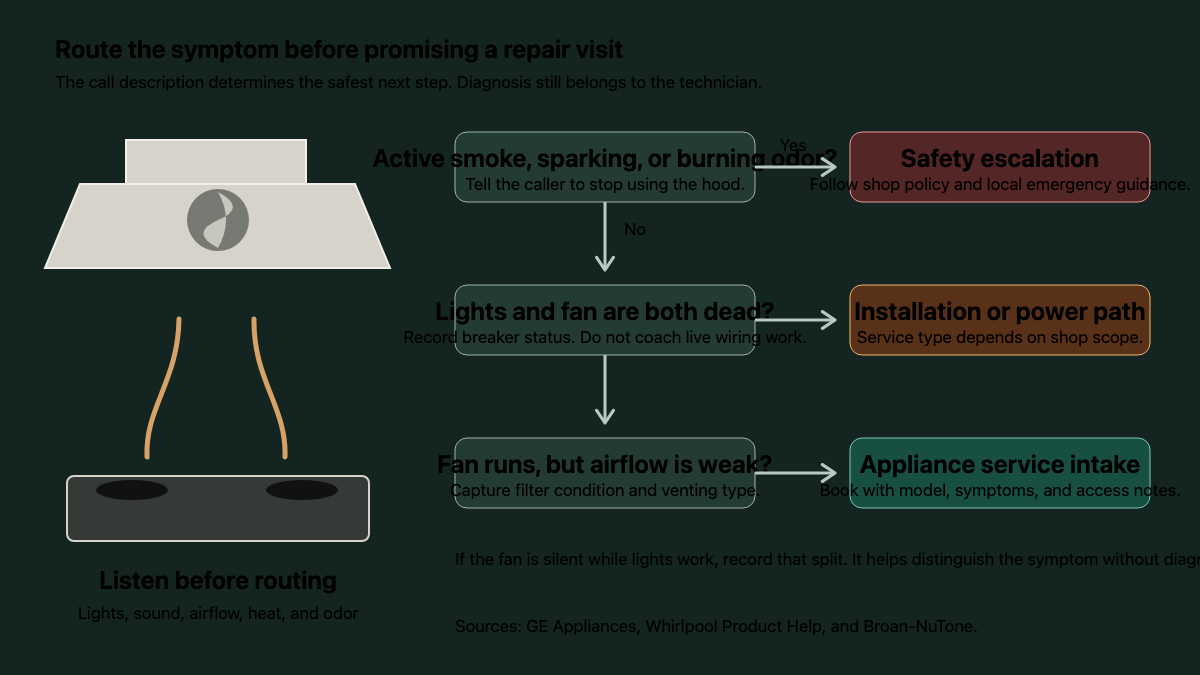
For call intake, stop short of walking a caller through an internal electrical check. Record whether the lights work, whether a breaker appears tripped, and whether the problem began after installation, remodeling, cleaning, or a power outage. If the breaker trips again, the hood smells hot, or the caller reports sparking, tell them to stop using the appliance and follow the company’s safety escalation policy.
The service ticket should distinguish “breaker status reported by caller” from “power supply verified.” The first is an intake note. The second requires qualified inspection.
Find out where the air is supposed to go
Ask whether the hood exhausts outdoors or recirculates air back into the kitchen. Many homeowners will not know. Useful follow-ups are: “Can you see a duct or vent above the cabinet?” and “Does the hood use a charcoal filter?” Record “unknown” when the answer remains unclear.
This distinction matters because filter types and airflow paths differ. Whirlpool’s vent hood guidance says a recirculating hood should have a charcoal filter, and that this filter is not washable. Whirlpool also directs owners to the model’s manual for the specified replacement and says outdoor-vented installations have their own venting requirements.
For a weak-airflow call, ask where the caller notices the failure. Does smoke drift into the room at every speed? Does the hood capture steam at the back burner but miss the front? Did performance change suddenly, or decline over time? Is the complaint about airflow, odor, noise, or all of them?
Avoid diagnosing a blocked duct, failed motor, poor installation, or dirty filter on the phone. Each remains a possible service finding. Intake should make the operating condition visible to the technician.
Ask about filters without turning intake into repair coaching
The caller can usually describe the visible filter safely. Ask when it was last cleaned or replaced, whether it looks heavily coated, and whether the symptom began after the filter was removed and reinstalled. Do not assume every metal filter belongs in a dishwasher.
Broan-NuTone’s filter cleaning instructions recommend warm water with mild detergent and say some filters may be dishwasher safe, subject to the owner’s manual. Its guidance also distinguishes the cleaning needs of metal grease filters from replacement-type charcoal filters.
The intake note can say, “Caller reports metal mesh filter is heavily coated,” or, “Caller replaced charcoal filter last week and weak airflow continued.” It should not say, “Filter caused fan failure.” That wording turns an observation into an unsupported diagnosis.
If a filter is missing, bent, loose, or will not stay seated, record that too. On certain designs, filter position can affect operation. The model-specific manual should control any next instruction.
Capture the model and installation before the appointment
Range hoods include under-cabinet units, wall-mounted chimney hoods, island hoods, inserts hidden inside custom enclosures, microwave hood combinations, and retractable downdraft systems. Access and service scope vary across those designs.
Ask the caller to send two photographs if the shop accepts images: one of the complete installed hood and one of the model and serial label. The label may be behind a filter or inside the hood, so tell the caller to consult the owner’s manual rather than reach into an unfamiliar assembly. A readable model number is more useful than “stainless 36-inch hood.”
Also collect:
- Brand, approximate age, and whether the caller is the owner, tenant, landlord, or property manager.
- Hood style, cooktop type, ceiling height for an island or chimney hood, and any custom cabinet enclosure.
- Whether another company recently installed, cleaned, or repaired the hood.
- Parking, gate, elevator, pet, and kitchen-access notes that affect the visit.
- Any warranty, builder, or manufacturer service arrangement the caller already knows about.
Model information also helps the office check whether the company services that brand and hood type. If the shop excludes ductwork, roof termination work, high-mounted island units, or microwave combinations, route the request before a truck is assigned.
Use safety language that does not pretend to diagnose
A range hood sits above heat, grease, and electrical components. Intake needs a firm safety boundary.
If the caller reports flames, active smoke from the appliance, sparking, a strong burning odor, a repeatedly tripping breaker, or a hood surface that appears damaged by heat, instruct them to stop using the hood and cooktop if they can do so safely. Apply the company’s emergency script. If there is an active fire or immediate danger, direct the caller to leave the area and contact emergency services.
Do not ask a caller to work on wiring, defeat a safety control, reach into a moving blower, or continue cycling a failing motor so the office can hear it. A short phone recording may help with an intermittent noise only when the appliance can be operated safely. Safety comes first.
Read back a ticket the technician can use
Before booking, summarize the job in one compact paragraph. A strong read-back might sound like this:
“Your wall-mounted Broan hood’s lights work, but the blower is silent at every speed. The breaker has not appeared tripped. The problem started after the filters were cleaned yesterday. There is no sparking, smoke, or burning odor. You will send a photo of the model label and make the kitchen accessible before Tuesday’s appointment.”
That summary gives the caller a chance to correct the record. It also separates reported facts from conclusions.
Do not quote a final repair from the symptom alone. Explain the shop’s diagnostic fee and approval process using its normal policy. If the office cannot confirm that the company services the hood brand or installation type, offer a callback after review instead of forcing the job into the calendar. The same discipline applies to other appliance calls, which is why a consistent model and serial number intake process is worth building.
A receptionist or AI call-handling system can capture these fields after hours, but the intake design matters more than the tool. The finished ticket should let the technician picture the installed hood, understand the exact symptom, and see every safety note before entering the kitchen.