A customer calls and says, “My ice maker quit.” The dispatcher opens the calendar. Five minutes later, the technician receives a note that says only ice maker not working.
That note hides four different jobs. The bin may be empty. Cubes may be small and slow. The machine may make ice that never comes through the door. Or water may be freezing into a sheet below the ice maker. One phrase does not tell the technician which scene is waiting in the kitchen.
A useful booking call defines the symptom, checks for a broader cooling or water problem, identifies the refrigerator, and records recent changes. The office should stop there. A phone description can prepare a visit; it cannot establish which valve, sensor, tube, switch, motor, or control has failed.
Define “not working” before opening the calendar
Ask the caller to describe what they see without offering a list of possible failed parts. A good first question is: “Is the ice bin empty, is it making less ice than usual, or is there ice in the bin that will not dispense?”
Then let the caller talk.
“No ice” means there are no new cubes in the bin. “Slow” may mean fewer batches, undersized cubes, hollow cubes, or a change noticed over several days. A dispenser complaint means ice exists, but pressing the paddle does not deliver it. Water, frost, or a solid block near the ice maker adds a different observation. Record the customer’s words first, then clarify.
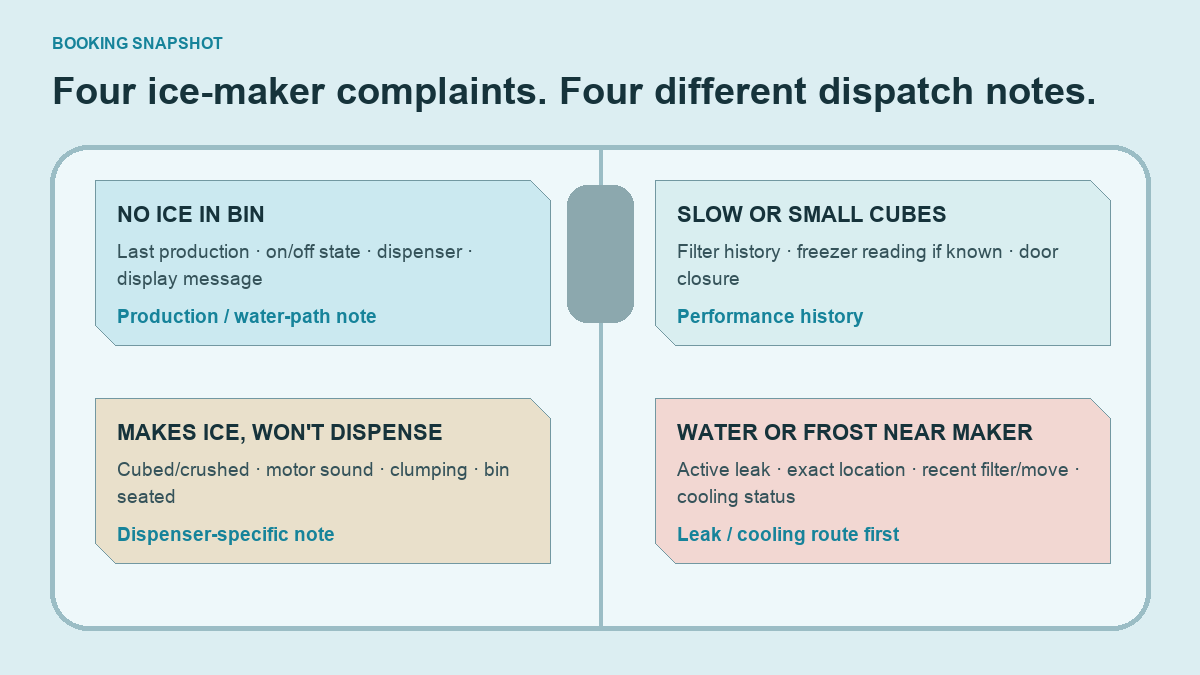
This distinction matters because manufacturer guidance treats water supply, freezer temperature, ice-maker power, filter condition, the ice bin, and the dispensing path as separate checks. Whirlpool Product Help organizes its guidance around those categories. GE Appliances also distinguishes an ice maker that does not fill from other ice-production and dispenser concerns.
The dispatcher does not need to resolve those branches. The dispatcher needs to label the branch accurately.
Cooling and active water change the route
Two questions come before routine ice-maker scheduling:
“Is water leaking now?”
“Are the refrigerator and freezer still cooling normally?”
An active puddle, water running inside the compartment, or water reaching flooring may belong in the company’s leak escalation lane. A refrigerator that has also gone warm belongs in the shop’s cooling-failure process. The customer may have called about ice because that was the first symptom they noticed, while the larger refrigeration complaint is already underway.
Follow the company’s approved safety language. Do not improvise electrical instructions, tell a caller to move a water-connected refrigerator, or ask them to remove the ice maker. If the shop has a policy for shutting off a known refrigerator water valve, use its exact wording and only within the conditions the company has approved.
A stable refrigerator with no active water can stay in ordinary intake. The next questions describe the appliance and its water path.
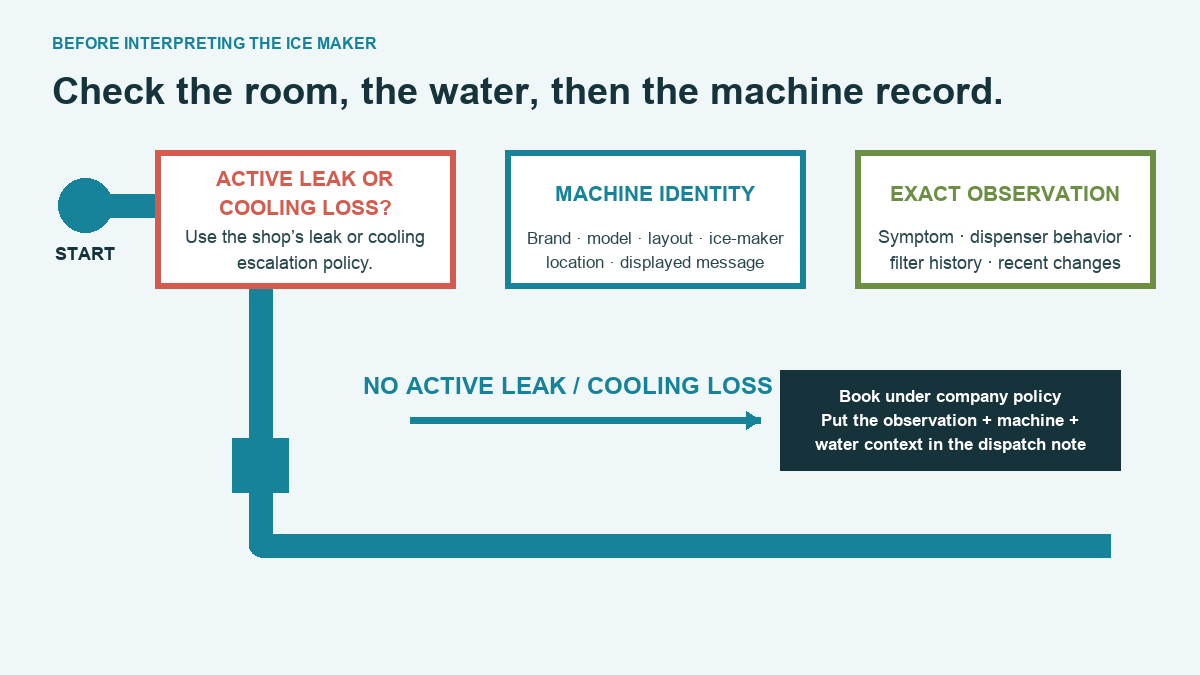
This routing boundary also prevents overlap with a refrigerator not-cooling emergency call. Ice production trouble by itself is a different service intent from a refrigerator that is warming food.
Identify the refrigerator before interpreting its controls
“Stainless French-door refrigerator” is a useful visual description, but it is not a model number. Controls, ice-maker location, filters, switches, service access, and diagnostic procedures vary across brands and models. Capture the identity before anyone interprets a button, light, or displayed code.
Ask for the brand, full model number, and serial number if the shop uses it at booking. Record the refrigerator layout: side-by-side, top freezer, bottom freezer, or French door. Then ask where the ice maker sits. It may be in the freezer compartment, inside a refrigerator door, or in another model-specific location.
If the caller cannot find the model tag while standing safely in front of the appliance, request a clear photo according to shop policy. Do not send them searching behind a refrigerator. A photo of the control display, ice bin, and visible frost or water can help too, but each image needs a label. “Photo 2 shows frost under the left-door ice bin” is useful. Three unlabeled kitchen photos are not.
Record codes and messages exactly as shown, including letters, numbers, spaces, and flashing indicators. Avoid translating a code from memory. The technician can check the correct service information against the model.
Water and filter questions need plain answers
Ice production depends on a water path, so ask whether the refrigerator has a working water dispenser. Capture the result in concrete terms: normal flow, slow flow, sputtering, no water, or no dispenser on this model.
That answer provides context, not a verdict. GE notes that an ice-maker fill-tube problem can exist while the water dispenser still works. Whirlpool explains that a restricted supply or an improperly installed filter can affect ice production and dispenser flow. The same caller observation can still have more than one cause.
Ask when the water filter was last replaced and whether the problem began immediately afterward. Manufacturer replacement guidance often names a six-month interval, including the Whirlpool and GE pages cited above, but the intake note should record the actual filter history. Do not promise that changing it will fix the call.
Recent changes deserve their own question. Was the refrigerator installed, moved, disconnected from water, or returned to service after being off? Was a filter replaced? Did anyone turn off the ice maker before a trip? Has plumbing work occurred in the home? GE’s no-fill guidance treats installation state, water connection, filter condition, and the ice-maker control as distinct checks.
A short timeline helps. “Moved Friday, reconnected Saturday, no new ice by Monday” carries more information than “recently moved.”
Capture what happened during the last cycle
Ask when the customer last saw fresh ice. If they emptied the bin, note whether any new cubes appeared afterward. For slow production, ask what changed: fewer cubes, smaller cubes, clumping, or long gaps between batches.
For a dispenser complaint, confirm that ice is visible in the bin. Ask whether the caller selected cubed or crushed ice, whether the dispenser makes a sound, and whether cubes appear fused together. Record observations only. A silent dispenser does not prove a bad motor, and a noisy one does not prove a jam.
For visible frost or water, note the exact location. “Frost on the back wall” is different from “frozen sheet under the ice bin.” Ask whether the condition returns after the customer clears loose ice, but do not ask them to chip ice with a tool or thaw internal parts. Manufacturer procedures differ, and hidden electrical or plastic parts can be damaged.
Add access and service-scope details
An ice-maker appointment still involves a large appliance in a real kitchen. Ask whether the refrigerator is built in, tightly boxed by cabinetry, located on an upper floor, or blocked by an island. Note delicate flooring, narrow entries, stairs, parking limits, gate codes, pets, and who can authorize work.
Clarify whether the shop services that brand and appliance type. A residential refrigerator ice maker is different from a freestanding countertop unit or commercial ice machine. Ask about warranty or factory-service coverage if that changes the company’s booking lane.
If the caller wants a repair price, explain the diagnostic visit and fee in the shop’s approved terms. The model, symptom, and inspection determine the repair recommendation. A broad symptom does not support a responsible parts quote.
Write a note the technician can scan in the driveway
The final note should fit on one screen. Use the same order every time:
- Route: routine ice-maker call, leak escalation, or cooling escalation
- Machine: brand, model, serial if required, layout, and ice-maker location
- Primary observation: no ice, slow or small ice, will not dispense, or visible water or frost
- Timing: last known production and when the change began
- Water context: dispenser behavior, supply changes, and filter history
- Controls: exact display message, indicator, or code
- Recent changes: installation, move, plumbing work, filter replacement, or power interruption
- Access: built-in condition, floor, stairs, parking, pets, and decision-maker
Here is a complete example:
Routine ice-maker booking. GE French-door refrigerator, model photo attached, ice maker in left refrigerator door. Bin has been empty since Saturday; refrigerator and freezer reported cooling normally. No active water. Door dispenser has normal water flow. Filter replaced about two months ago. Display shows no code. Unit was not moved and no plumbing work reported. Built into cabinet opening on first floor; homeowner will be present.
That note does not diagnose the refrigerator. It removes the avoidable mystery.
An AI receptionist can follow the same approved sequence after hours and save each answer in the correct field. The shop still decides escalation rules, supported brands, scheduling lanes, safety language, and what the technician sees before arrival.
The best ice-maker call note starts with one honest sentence: what the customer can see. Everything after that should help the technician arrive with the right model context and a clear picture of the kitchen waiting behind the door.