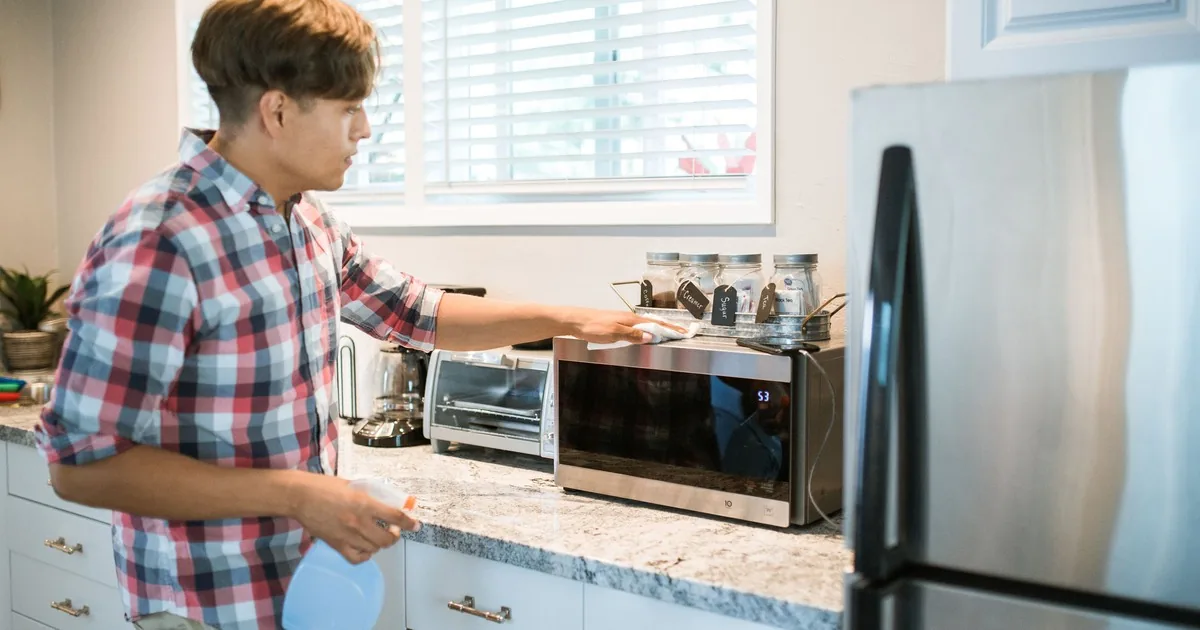
The microwave light comes on. The fan hums, the turntable moves, and thirty seconds later the coffee is still cold. A caller may describe that as “running fine except for the heat,” then ask whether the shop can bring a magnetron on the first visit.
The office should resist that diagnosis. A good microwave not-heating service call starts with visible safety conditions, confirms the exact behavior, identifies the unit, and records how it is installed. Internal parts stay out of the phone conversation. The resulting note should tell the technician what the customer observed without pretending the symptom proves which component failed.
Start with the conditions that stop use
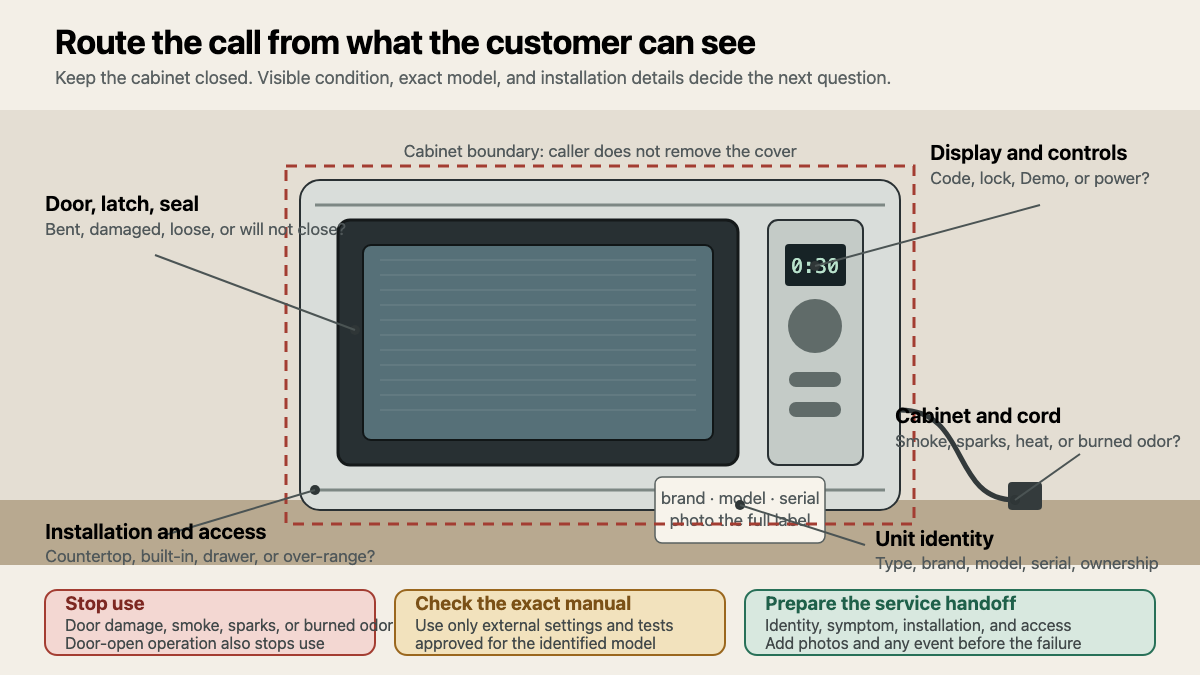
Ask about the door before discussing settings. Does it close firmly? Is it bent or warped? Are the hinges, latch area, viewing screen, or seal surfaces visibly damaged? Does the oven ever continue running when the door is open? The FDA’s microwave oven guidance tells consumers not to use an oven when the door will not close firmly or is bent, warped, or otherwise damaged. It also says to discontinue use immediately if an oven operates with its door open.
Then ask what happened during the failed cycle. Smoke, sparking, flame, a burned odor, a hot or damaged cord, a scorched outlet, or a breaker that trips should move the call out of routine troubleshooting. Tell the customer to stop using the appliance and follow the shop’s safety and dispatch policy. Do not ask for another test cycle to “see if it happens again.”
Keep the direction narrow. The office is recording an observed condition and setting a safe next step. It is not conducting a radiation inspection, clearing the appliance for use, or deciding that a damaged door only needs an adjustment.
Confirm what “not heating” means
Callers use the same phrase for several different behaviors. One oven may count down with the fan and turntable running but leave food cold. Another may be completely dead. A third warms slowly, heats unevenly, stops after a few seconds, or displays a code before the cycle starts. Those are different service notes.
Ask the caller to describe the last attempt in order. What was placed inside? Which function and time were selected? Did the clock stay on? Did the interior light, fan, and turntable operate? Was there a new noise, odor, flash, or display message? Did the door close normally? Did the cycle finish, stop early, or fail to start?
Record the caller’s own words when they are useful: “Fan runs, plate turns, display counts down, cup remains cold” is better than “bad magnetron.” The first note preserves observations. The second assigns a part before anyone has inspected the unit.
Manufacturer guidance shows why the control details matter. GE advises users with a running but non-heating microwave to confirm that the Timer function was not selected and to close the door firmly. Whirlpool’s over-the-range microwave support page also points to Control Lock, Demo mode, the Start control, power selection, and door closure. These checks vary by model. Capture what the display shows and use the identified oven’s manual.
Capture the microwave before naming an appointment slot
“Stainless microwave” does not identify the product. Get the brand, full model number, serial number, and a clear photograph of the label when the customer can reach it without moving or disassembling the appliance. Have the caller copy every character, including letters, zeros, suffixes, spaces, and dashes. Our model and serial number intake guide explains how to keep those identifiers intact.
The label may be around the door opening, on an interior frame, along a rear or side surface, or in another manufacturer-specified location. Do not give one universal location. Send the caller to the owner’s manual or manufacturer support page for that model. If the label is inaccessible, note that and ask for purchase records or a photo of any existing product sticker. Never tell someone to remove a built-in unit or open the cabinet to find it.
Next, identify the installation. Is it a countertop oven, an over-the-range unit, a built-in microwave, a drawer model, or part of a wall-oven combination? Ask whether it is still in its original position, whether cabinetry surrounds it, and whether the customer can reach the plug. A countertop unit that can be carried safely under shop policy presents a different dispatch question from an over-the-range model mounted above a cooktop.
For installed units, capture the floor level, stairs, parking, gate or elevator access, counter and cooktop clearance, nearby cabinetry, and anything that blocks the work area. Ask whether an adult decision maker will be present and who owns the appliance. Rental properties need the landlord or property manager’s authorization process in the note.
Keep troubleshooting outside the cabinet
A microwave cabinet is a hard boundary for caller instructions. The Consumer Product Safety Commission warns against do-it-yourself microwave repairs because the appliance uses high voltage and hazardous electrical charge may remain after it has been disconnected. GE gives the same practical warning: an internal high-voltage capacitor can retain charge after unplugging, and special equipment is generally needed for diagnosis.
That means the front desk should never direct a caller to remove screws, lift the cover, discharge a capacitor, test an interlock, probe wiring, bypass a switch, or inspect internal components. Unplugging the unit does not turn cabinet removal into a safe customer task.
External checks should come from the exact manufacturer instructions for the exact model. Depending on that guidance and the shop’s policy, the useful questions may include:
- Is the Timer, Control Lock, Demo mode, Delay Start, or a reduced power setting active?
- Does the door close firmly, and is any packaging or object interfering with it?
- Is the unit connected to its normal outlet, and did a breaker or fuse open?
- Does the display show a code or icon that can be photographed?
- Has the caller already completed a manufacturer-approved heating check, and what exactly happened?
Do not improvise a test when smoke, sparks, door damage, cord damage, unusual heat, or door-open operation has been reported. Even a routine water check should match the manual. Whirlpool, for example, gives a one-cup water procedure on the support page for the covered over-the-range products. That does not make the same sequence universal for every microwave.
Ask what changed before the failure
The event before the symptom can make the technician note much sharper. Ask when the microwave last heated normally and whether anything changed around that time. Was there a power outage, breaker trip, electrical work, deep cleaning, spill, move, installation, cabinet project, or impact to the door? Did the problem begin after a particular sound, odor, or flash?
Also capture whether the symptom happens on every heating attempt or only with one program. Ask if the customer has tried another microwave-safe container and whether the food remains completely cold or warms less than expected. Keep these as observations. Slow heating does not prove one cause, and a moving turntable does not clear the high-voltage system.
Check service history. Has this unit been repaired before? Which part or assembly was changed, by whom, and when? Is there a manufacturer, retailer, home-warranty, landlord, or extended-service plan involved? If the caller is already weighing replacement, route them through a separate repair-or-replace conversation after the office has the model, age information, condition, and diagnostic policy.
Explain the diagnostic visit without promising the repair
A caller may want a flat repair price once they have supplied the model. Explain what the booked visit includes, what the diagnostic fee covers, whether that fee may be applied under the shop’s current policy, and when the customer approves additional work. The wording should match the company’s actual terms. The diagnostic fee call guide gives a clean structure for that conversation.
Do not promise that the technician will carry the final part, complete the repair in one trip, or find the unit economical to fix. Model information helps with preparation, but symptoms can have several causes and parts may have revisions, substitutions, or availability constraints. For mounted units, removal and reinstallation may also require a second person, special access, or work outside the appliance shop’s scope.
Read back the appointment boundary: diagnosis comes first; the customer approves the next step after findings and price are available. If the shop excludes certain microwave types or does bench service only, say that before booking.
Send a technician-ready handoff
The final note should include the customer and service address, unit type, brand, model, serial, label photo, exact symptom, display behavior, door and latch condition, smoke or sparking history, cord and outlet observations, prior events, service history, installation, access, ownership, authorization contact, and any stop-use direction already given.
A useful dispatch summary could read: “Over-the-range microwave. Display counts down, light and fan operate, turntable moves, and water remains cold. Caller reports no smoke, sparks, burned odor, visible door damage, or door-open operation. Model and serial photos attached. Unit is mounted above a gas range; customer will clear the cooktop. Prior power outage occurred the evening before the first failed cycle. Diagnosis required. No internal part promised.”
An AI receptionist can collect the same fields after hours and preserve the caller’s wording. Safety routing, service eligibility, diagnosis, and repair approval still follow the appliance shop’s written policy.
The technician should arrive knowing which microwave is installed, what the customer actually saw, and whether the door or electrical history changes the visit. That is the whole job of the first call.