“My freezer is full of ice” can describe four different scenes. One caller sees white crystals around the door. Another has a hard sheet across the floor. A third finds the rear wall buried under snow-like frost. Someone else owns a manual-defrost chest freezer that has simply reached its normal defrost point.
A useful service ticket starts with the pattern. Ask where the frost appears, how much area it covers, when it began, whether it returned after being cleared, and whether the freezer is still holding its usual temperature. Then identify the appliance, document the door and recent use, and capture sound, airflow, water, and error indicators. Do not name a failed heater, sensor, fan, drain, control, or gasket on the phone.
Record the frost before it changes
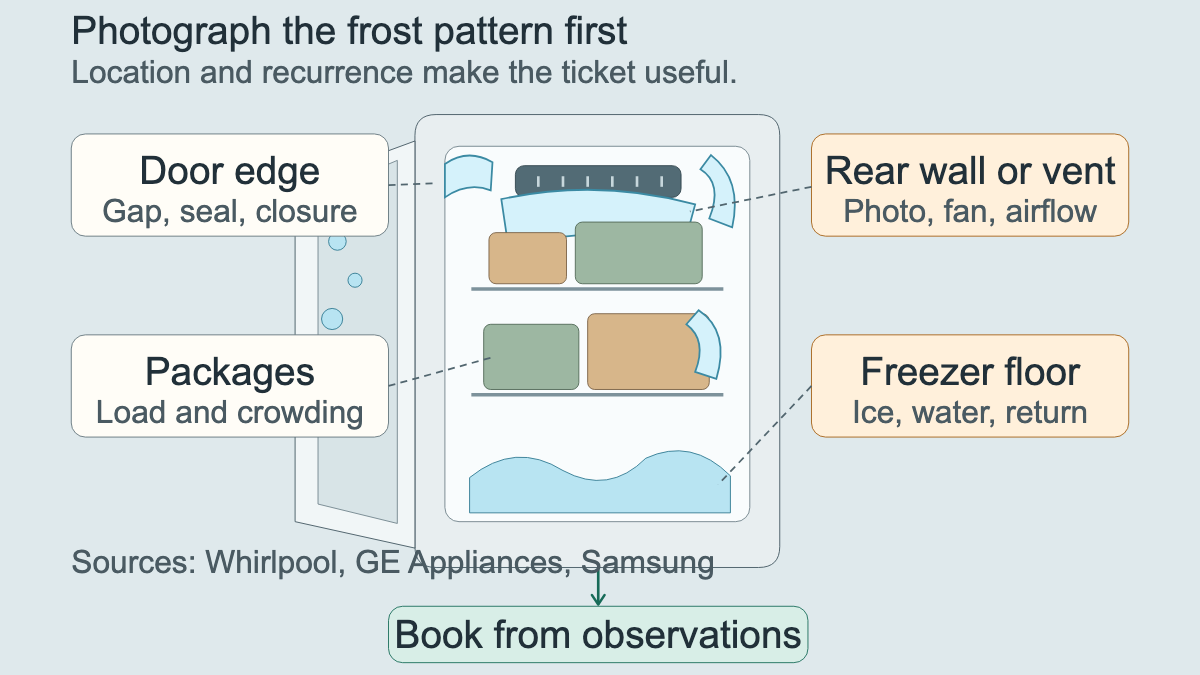
Ask the caller for one wide photo of the open freezer and closer photos of the affected areas. The wide view preserves context. It shows whether packages crowd the door, cover a rear vent, or rest against the back wall. Close photos should show texture and location without requiring anyone to chip, melt, or remove anything first.
Use plain location terms in the ticket:
- Door edge or drawer opening
- Rear wall or visible vent
- Ceiling, side wall, shelf, or package surface
- Freezer floor or beneath a drawer
- Ice bucket, chute, or dispenser area
- One corner, one compartment, or the entire cabinet
Then capture the form. Is it a light dusting, soft white frost, clear ice, frozen droplets, or a solid sheet? Does it bridge a drawer shut? Is water appearing under the refrigerator? Write what the caller sees. “Clear ice sheet on the freezer floor, thicker at the rear left corner” helps more than “freezer iced up.”
GE Appliances says ice accumulating on the wall of a frost-free refrigerator or freezer is not expected. Its freezer-wall guidance first checks humidity, frequent opening, warm food, packages against the rear wall, packages blocking closure, gasket condition, and fan operation. That list shows why a photo and timeline belong ahead of a phone diagnosis.
Identify which freezer the customer owns
Ask whether the complaint involves a chest freezer, upright freezer, top-freezer refrigerator, bottom drawer, side-by-side compartment, or a separate ice-maker area. Record the manufacturer, full model number, serial number, approximate age, and installation location. A rating-plate photo avoids swapped digits. The model and serial number intake guide gives the office a repeatable way to collect those details.
The defrost design matters. Ask whether the owner's manual describes the appliance as frost-free, auto-defrost, or manual-defrost. Do not infer the answer from age or appearance. Whirlpool's freezer frost guidance discusses periodic defrosting when frost reaches about one-quarter inch on applicable units. GE separately says wall ice is unexpected in frost-free equipment. Those statements are compatible because they refer to different designs.
Keep the model-specific distinction in the call record. A normal maintenance request for a manual-defrost chest freezer should not be routed as the same job as recurring rear-wall frost in an automatic-defrost refrigerator.
Ask where the appliance sits. A freezer in a kitchen, finished basement, hot garage, utility room, or commercial break area experiences different ambient conditions and access constraints. Capture nearby construction, a recent move, a power interruption, or a change in room heat if the timing matches the complaint. Avoid promising that room temperature caused the frost. It is one field in the history.
Build the door and moisture timeline
Warm, moist air becomes frost when it enters a cold compartment. Whirlpool, GE, and Samsung all point to door opening, blocked closure, warm loads, and seal condition as relevant observations.
Start with the last time the freezer was known to be normal. Was the door found ajar after groceries were put away? Did a package, shelf, basket, or ice buildup stop a drawer from closing? Was a large batch of warm food loaded? Did the customer rearrange shelves, reverse a door, move the refrigerator, or clean the gasket? Ask whether children, guests, tenants, or employees use the freezer, since nobody on the call may have seen the first event.
Inspecting the seal over the phone should stay simple. Ask whether the gasket is torn, folded, pulled away, dirty, or visibly separated from the cabinet at one point. Does the door sit flush? Is one corner proud? A straight-on photo with the door closed can show alignment. Reception should not declare the gasket bad because the customer reports frost near the opening.
Samsung's frost support guide tells owners to look for food that prevents full closure, inspect the rubber seal, and keep space in front of vents. The same guide warns against using a hair dryer to speed defrosting. Keep that boundary firm. Heat can damage the appliance, and aggressive ice removal can damage liners, tubing, sensors, or other hidden parts.
If the caller already cleared the frost, record how and when. Ask whether it returned and where it appeared first. Do not ask the caller to recreate the problem by leaving the door open or changing settings.
Capture temperature, sound, airflow, and water
Frost and poor cooling may occur together, but the office should record each symptom separately. Ask for the displayed temperature and setpoint if the unit has a display. If the customer used a separate thermometer, note the reading, its location, and when it was checked. “Food is still hard frozen” is useful as an observation, though it is not a measured cabinet temperature.
Ask whether the refrigerator section is behaving normally. Is ice cream soft? Are packages near one area thawing while others remain hard? Has the compressor seemed to run continuously, cycle differently, or stay quiet? Capture exact sounds such as a steady fan, scraping, repeated clicks, a hum, or silence. Note where the sound seems loudest.
A caller may report that air no longer moves from a visible freezer vent. Record that without asking them to remove a panel or reach behind a cover. If the visible vent is covered by a package or frost, note it and request a photo. GE lists a non-running freezer fan as a reason service may be required after simpler conditions have been checked, but sound alone does not identify which part needs repair.
Water changes the ticket. Ask whether it stays inside the compartment, freezes into a floor sheet, reaches the refrigerator section, or appears on the kitchen floor. Record when it appears. A puddle after someone left a door open belongs in the history, while a recurring floor sheet after the cabinet was cleared gives the technician a different observation to investigate.
For a freezer that is warming, shift to the refrigerator not-cooling intake. That workflow covers food protection, power status, and urgency. Office staff should follow company policy and the owner's manual when callers ask whether food is safe to keep.
Turn the call into a dispatch-ready ticket
A complete freezer frost ticket should contain:
- Customer name, service address, callback number, and access contact
- Appliance type, manufacturer, model, serial number, approximate age, and defrost design if known
- Frost location, texture, extent, first appearance, and recurrence history
- Displayed temperature, setpoint, separate reading, and food condition as observed
- Door closure, gasket appearance, package position, recent loading, and door-open history
- Fan or compressor sounds, visible airflow obstruction, error codes, alarms, and power events
- Water location, prior clearing or defrost work, and photos of the cabinet, pattern, display, and rating plate
Add practical access details. Can the technician reach the appliance without moving a full pantry shelf? Is a built-in panel involved? Does a chest freezer contain enough food that the customer needs preparation instructions before the visit? Is the unit under a manufacturer or retailer warranty? Confirm which brands and freezer types the company services before taking payment.
Read the summary back: “Bottom-freezer refrigerator in the kitchen. Frost-free according to the model page. Soft white frost covers most of the rear wall and the visible upper vent. The customer first noticed it four days ago after the freezer drawer was found partly open. The drawer now closes flush. Frost was wiped from the door edge but returned there the next day. Display reads 8°F with a 0°F setpoint. Ice cream is soft, the refrigerator section feels normal, and a scraping sound starts when the freezer drawer opens. Model, serial, wide cabinet, rear-wall, and closed-door photos are attached.”
That record gives the technician evidence without pretending the office has diagnosed the machine.
Set a careful appointment expectation
Explain that the visit begins with confirmation of the model, frost pattern, door closure, airflow, temperature behavior, and the appliance's defrost system. The technician may need to clear access or thaw affected areas under the company's procedure before every component can be tested. Parts and a return visit depend on what the inspection finds.
Do not promise a first-visit repair. Do not promise that clearing visible frost will solve the underlying complaint. If the caller reports exposed wiring, smoke, burning odor, sparking, water near an electrical connection, or a breaker that will not stay set, stop routine intake and use the company's safety escalation policy.
An AI receptionist can collect the same model, pattern, timeline, and access fields after hours. Its job ends at accurate intake and routing. The technician should arrive with the photos already open and know exactly where the first frost returned.