“The dishwasher is leaking all over my kitchen.”
That sentence can describe a damp line at the door, a puddle that appears during draining, or water still running across the floor. The first job on the call is to find out which one the caller means. Ask whether water is leaking right now, whether the dishwasher is running, and whether there is smoke, a burning smell, sparking, or a tripping breaker.
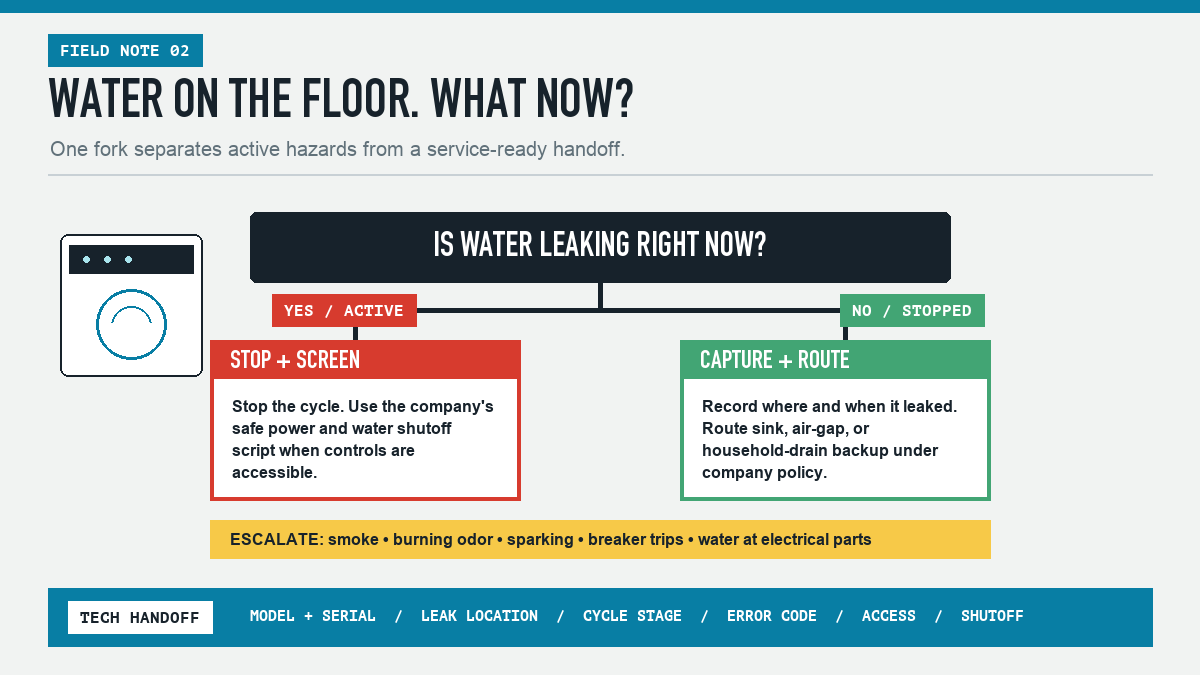
For an active leak, stop ordinary booking and use your company’s approved safety script. Whirlpool’s dishwasher leak guidance tells users to stop the cycle and, when the controls are safely accessible, switch off power at the breaker and shut the water supply. A receptionist should never tell someone to step into water, reach behind a wet machine, or open an electrical panel they cannot use safely. Escalate smoke, fire, sparking, or another immediate hazard under company policy and local emergency guidance.
Once the scene is stable, collect the observations that will help the technician. The useful questions cover where the water appears, when it appears, the machine’s identity, recent changes, and access to the installation. Leave the component diagnosis for the visit.
Start with water status and electrical warning signs
A calm opening keeps the call in order:
“Is water coming out now, or did you find it after the cycle stopped?”
If it is active, ask whether the caller has already stopped the cycle. Then follow the shop’s safety and escalation procedure. Do not bury the immediate question under name, address, warranty, or pricing fields. Those can wait.
If the water has stopped, ask what the caller did before calling. Did they press Cancel? Did the cycle finish? Did they close a supply valve or switch off a breaker? Has anyone run the dishwasher again? The technician needs the current state of the machine, especially if a family member changed it after discovering the puddle.
Record electrical warning signs in the caller’s words. “Breaker tripped twice” is a useful note. “Electrical fault” is a diagnosis the office has not earned. The same discipline applies to odors. Write “caller reports a hot-plastic smell near the control panel,” not “bad control board.”
Ask where the water first appeared
“Leaking from the dishwasher” is too broad for a dispatch note. Ask the caller to point to the first place they saw water:
- Along the bottom or one corner of the door
- Under the center of the machine or at the toe kick
- Inside the sink cabinet, near a supply or drain connection
- At the sink air gap or in a backed-up sink
- On the ceiling or floor below the kitchen
This is an observation list, not a menu of diagnoses. Manufacturer support pages sort dishwasher leaks by location because different areas lead to different checks. GE Appliances also separates dishwasher leak guidance by where water appears.
Ask how much water the caller found in plain terms. A few drops, a towel-sized wet area, and water spreading into the next room describe different scenes without pretending the office measured the volume. Ask whether cabinets, flooring, or the ceiling below are wet. If the company has a water-mitigation referral or escalation policy, the extent of the spread tells the receptionist when to use it.
Photos help when your system accepts them. Request one wide photo that shows the dishwasher and surrounding floor, then a closer photo of the first wet area. Tell the caller not to restart the machine to create a better picture.
Cycle timing makes the dispatch note more useful
A leak that appears before anyone presses Start is a different observation from one that shows up while the machine drains. The timing does not prove a failed part. It gives the technician a better place to begin the inspection.
Ask the caller to place the leak in one of four stages:
- Water was present while the dishwasher was idle.
- Water appeared soon after the cycle started filling.
- Water appeared after washing or spraying began.
- Water appeared near the drain portion or after the cycle ended.
If the caller did not see it happen, write that. “Puddle found in the morning after overnight cycle; exact stage unknown” is honest and useful. Do not ask them to run another cycle unless a technician or approved company procedure directs that test.
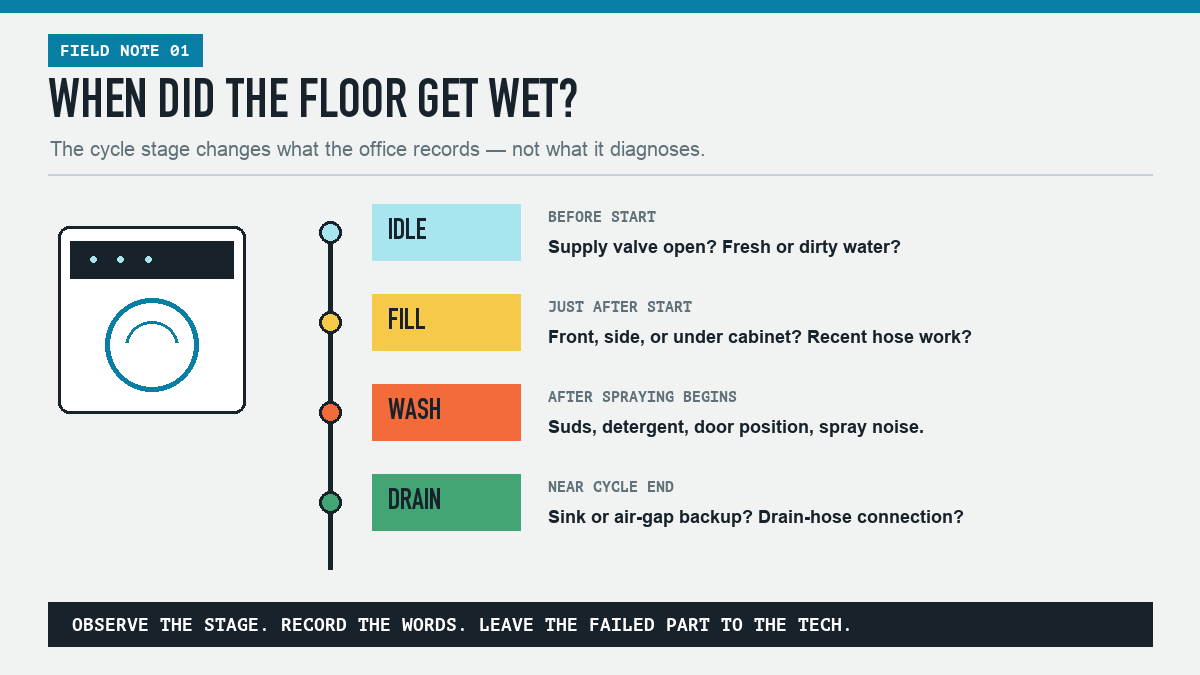
For a wash-stage report, ask whether the caller saw heavy suds and what detergent they used. Record the brand and product type if they have the container nearby. Ask whether anyone recently changed detergent, added hand dish soap, or spilled rinse aid. Excess suds can accompany door-area leaking, but the phone agent should stop there. “Heavy suds visible; caller switched detergent yesterday” gives the technician evidence. “Wrong soap caused leak” jumps past the inspection.
For a drain-stage report, ask whether the sink backed up or the air gap overflowed at the same time. Note where the dishwasher drain connects if the caller already knows. Do not send a homeowner under the sink to identify plumbing while water is present.
Separate appliance service from a plumbing handoff
Dishwasher calls sit at the edge of two trades. Water can appear near the appliance while the visible problem is at an air gap, sink drain, disposal connection, or household supply line. Your shop needs a written routing rule.
A confirmed overflowing sink or air gap may belong in a plumbing lane. Water from beneath the dishwasher, around its door, or inside its base usually stays with appliance service until inspection says otherwise. If your company services connection hoses but does not open household drains, write that boundary into the call guide. Another shop may draw it differently.
Never promise that a plumber or appliance technician is definitely the right provider based on one sentence. Explain the next step: “I’m recording where the water appeared and what the sink was doing so we can route this under our service policy.” If a second trade may be needed, say so before the appointment without making the caller coordinate a diagnosis.
The same restraint matters with insurance and warranties. Ask whether the machine is covered by a manufacturer warranty, retailer plan, home warranty, or service contract. Capture the administrator, claim number, and authorization instructions. Do not promise reimbursement for the visit, flooring damage, or the repair.
Capture the exact dishwasher and installation
Get the brand, model number, and serial number whenever the caller can reach the tag without moving the appliance or entering a wet area. Whirlpool notes that these details are commonly found on the tub frame. Location varies, so the owner’s manual or manufacturer support page is the safer reference for a specific machine.
Model and serial details do three jobs. They help the shop check serviceability and parts information. They show whether the unit is a standard built-in, drawer, portable, or panel-ready model. They also support a real recall check. The U.S. Consumer Product Safety Commission dishwasher recall list covers specific products, so a symptom alone never establishes that a machine is recalled.
Then capture the installation around it:
- Built-in, portable, drawer, or another configuration
- Approximate age and whether it was recently installed or moved
- Cabinet panel or trim that may affect access
- Sink, disposal, and air-gap arrangement if known
- Stairs, parking, gate, elevator, or building access
- Tenant, owner, landlord, or property manager authorization
- Previous service, recent plumbing work, and any parts already changed
- Pets, occupants, and a clear route to the kitchen
Ask whether an adult who can approve work will be present. For a rental, identify who approves diagnosis, repair, and payment before a technician stands in the kitchen calling three people.
Build the note around observations, actions, and access
A good dispatch note can be read once in the driveway. Put the information in a stable order:
Status: Active or stopped; cycle canceled or completed; power and water status; electrical warning signs.
Observation: First water location, extent of spread, cycle stage, suds, sink or air-gap behavior, error code, photo availability.
Machine: Brand, model, serial, configuration, approximate age, warranty or claim details.
Access: Address, parking, stairs, cabinet panel, pets, authorized adult, tenant or owner approval.
Expectation: Diagnostic fee quoted under the shop’s policy, appointment window, and the fact that repair scope follows inspection.
That last line connects naturally to a clear appliance diagnostic fee explanation. The leak may feel urgent, but urgency does not make a phone diagnosis or blind repair price more reliable. State what the visit covers and when the customer will receive a repair quote.
For another example of symptom-specific intake, the refrigerator not-cooling call guide shows how the first questions change when food temperature and power status drive the call.
An AI receptionist can follow the same approved sequence after hours and save the answers in a consistent format. The shop still owns the safety script, routing rules, service scope, and escalation contacts.
Before the next busy shift, read the last five dishwasher leak notes in your system. If they say only “dishwasher leaking,” replace that blank line with the sequence above. The next technician should know whether the water is active, where it started, when it appeared, which machine is in the kitchen, and what stands between the front door and the toe kick.