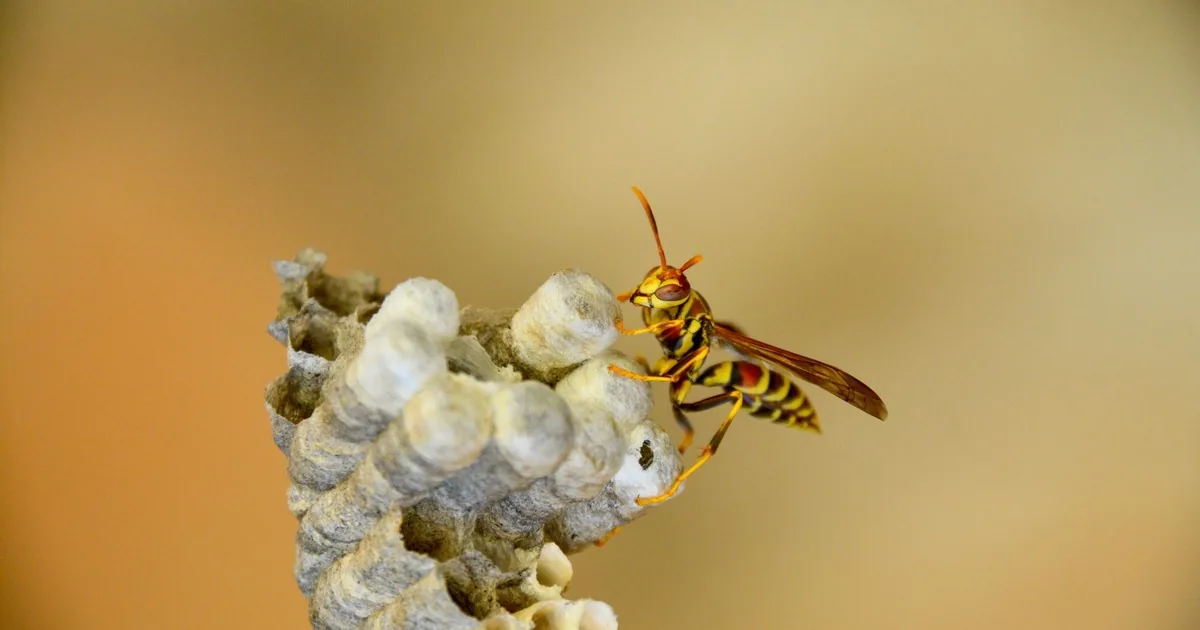
“The hornets are going into the wall beside our back door, and my son was stung.” That is not yet enough information for an ordinary pest-control appointment. The office needs to know whether anyone is having a severe reaction, whether insects are attacking now, which opening they use, how close that opening is to the door, and whether the caller can keep people and pets away.
A useful wasp and hornet nest service call follows this order: handle any medical emergency first, move the caller away from active insects, record what was observed without forcing a species identification, map the nest or flight path to the property, and let the technician own the treatment decision. Reception should never ask someone to approach a nest for a better photo.
Handle active stings before the service request
Ask one direct question at the start: “Is anyone being stung now or having trouble breathing, faintness, throat swelling, or another severe reaction?” If the answer is yes, stop the sales intake and follow the company’s emergency protocol. CDC/NIOSH says anaphylactic shock is a severe allergic reaction that requires immediate emergency care.
Do not diagnose the reaction. Do not tell a caller that swelling is normal or that an antihistamine will be enough. The safe office response is to direct emergency symptoms to emergency services under approved policy, then deal with the pest appointment later.
If insects are actively pursuing people, ask whether everyone can go indoors or reach another protected place without crossing the flight path. CDC advises people attacked by several stinging insects to run away and go indoors. Keep children, pets, residents, customers, and workers away from the reported nest area. The call record should state where they are waiting and which entrance remains usable.
A recent sting without current emergency symptoms still matters for dispatch. Record when it happened, where the person was standing, what activity preceded it, and whether several insects emerged. Mowing over a ground entrance, opening a shed, moving a ladder, or using a back door can reveal the nest’s relationship to the site.
Record evidence without naming the insect
Callers use “bee,” “wasp,” “hornet,” and “yellowjacket” interchangeably. That label can affect whether a beekeeper, pest professional, or another specialist is appropriate, but the office should treat it as the caller’s description until someone qualified confirms it.
Ask what the insect looked like only in plain observational terms: fuzzy or smooth, mostly black or strongly marked, approximate size compared with a familiar object, and whether the legs hang down in flight. More useful than color is behavior. Are insects entering one hole repeatedly? Are they clustered on exposed comb? Is there a closed paper envelope hanging from a branch? Are they feeding around trash with no nest visible?
Penn State Extension notes that bees tend to look hairy, many wasps look smooth with narrow waists, and harmless flies can mimic their colors. It also explains that identification changes risk and removal choices. A sharp photo taken from an already safe position can help. Never ask the caller to climb, lean from a window, probe a hole, strike a nest, or stand in the flight path.
A temporary honey-bee swarm also calls for different routing than a paper nest under an eave. Penn State reports that honey-bee swarms form exposed clusters while scout bees search for a new cavity, and these clusters often move on. Send uncertain bee and swarm cases to the company’s approved identification or referral path.
Map the nest by location and structure
The strongest intake detail is the exact place where insects leave and return. “Wasps in the yard” is weak. “Repeated traffic through a gap under the aluminum siding, six inches right of the back-door frame, with insects entering the wall” gives the technician a physical target and an access problem.
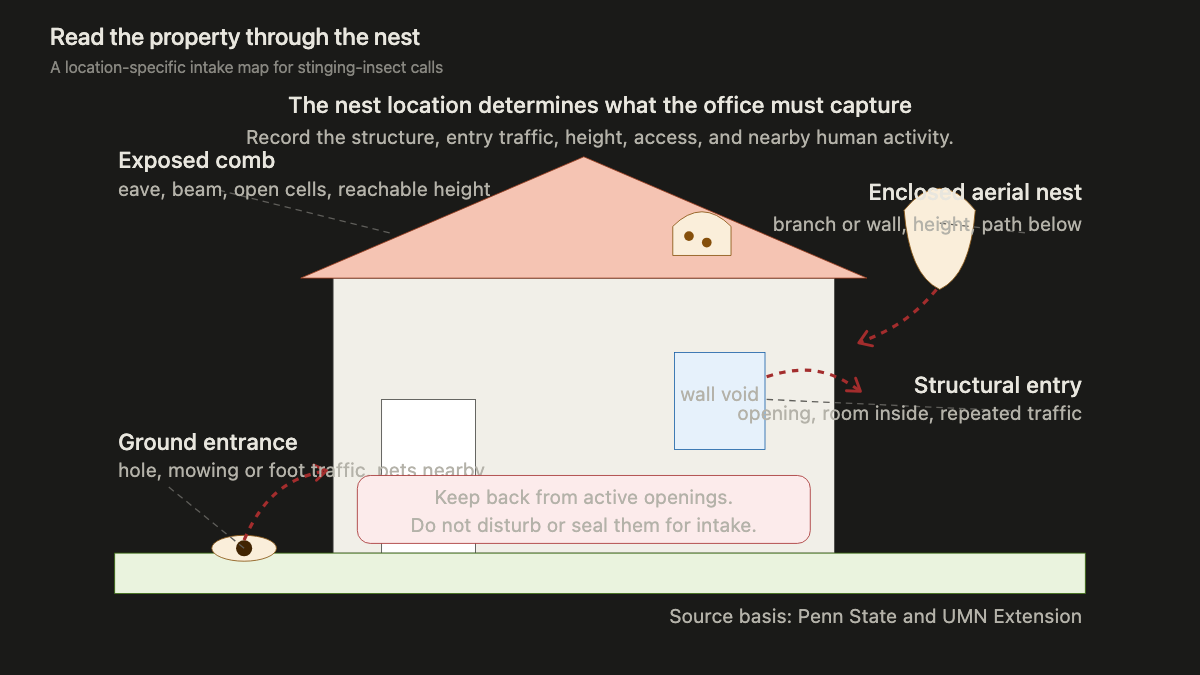
Use four location categories in the call record:
- Exposed comb: open cells under an eave, railing, beam, shutter, playset, grill, shed roof, or other horizontal surface.
- Enclosed aerial nest: a paper envelope attached to a branch, building face, soffit, or similar support.
- Ground entrance: repeated traffic into a hole in turf, a planting bed, a retaining-wall gap, or another low cavity.
- Structural void: insects entering siding, a roof edge, vent, wall crack, utility penetration, attic, or another concealed space.
University of Minnesota Extension describes yellowjacket nests in old rodent burrows, wall voids, attics, hollow logs, and landscape timbers. It describes paper-wasp nests under horizontal surfaces such as eaves, beams, garages, barns, and sheds. Penn State distinguishes above-ground paper-wasp and hornet nests from the ground or cavity sites commonly used by yellowjackets.
Those patterns guide intake; they do not prove species. Record the caller’s words and photos. Mark whether the nest itself is visible or only the traffic is visible.
For a concealed opening, ask which room lies behind it, whether insects have appeared indoors, and whether anyone has caulked, foamed, taped, or covered the gap. Penn State specifically warns against sealing active wasps inside a wall or the ground because they may excavate a new exit, possibly into the home. Reception should tell the caller only the company’s approved safety language, never an improvised sealing plan.
Capture height, access, and the traffic below
A nest fifteen feet up over an empty side yard is a different visit from one fifteen feet up over a restaurant entrance. Record the estimated height from ground level and how the caller estimated it. Note roof pitch, gutters, overhead wires, fences, locked gates, steep slopes, soft ground, decks, awnings, and whether a ladder could be placed on a stable surface. The technician decides access equipment.
Then map how people use the area. Is the opening beside the only door? Does a child’s bedroom sit behind the wall? Is a ground entrance next to a mailbox, dog run, pool deck, loading dock, outdoor dining section, school pickup lane, or mowing route? For a commercial property, record operating hours, site contact, customer traffic, work restrictions, and who can close the affected zone.
Penn State’s decision framework asks whether the colony threatens residents, children, pets, or structures. University of Minnesota Extension makes a similar distinction: an out-of-the-way nest may sometimes be left alone, while a nest near a walkway or doorway creates more conflict. The technician still decides the service recommendation after considering local species, season, access, and company policy.
Season belongs in the record too. Record the first sighting, recent change in activity, and whether the caller saw the same location used earlier in the year. Many paper-wasp and yellowjacket colonies are annual in northern climates, with activity building through summer and declining after freezing weather. That timing varies by climate. Do not promise that cold weather has made a nest inactive unless the qualified technician confirms the site condition.
Ask what the caller has already done
Prior action can change exposure and treatment planning. Ask whether anyone sprayed, dusted, flooded, burned, struck, removed, covered, or sealed the nest or opening. Record the product name from the label if it can be read without approaching the area, the application time, and the person who applied it. Do not recommend another product or tell the caller to repeat an application.
Also ask whether a handyman, roofer, landscaper, tenant, maintenance worker, or previous pest company disturbed the location. A soffit may have been opened. A ground hole may have been covered with a stone. A nest may have fallen into a wall cavity. Preserve those details exactly as reported.
For rental and managed properties, establish the occupant, owner or manager, authorization, notice, and technician access before booking. A tenant may report the flight path accurately while the property manager controls exterior access or repair approval. The pest-control resource hub collects related intake guidance for office teams.
Route the appointment without promising the treatment
Before offering a window, read the record back in one sentence: “You are reporting repeated traffic through the siding gap beside the occupied back door, one sting yesterday, no current medical emergency, insects seen inside the mudroom, and spray applied outside this morning.” That summary lets the dispatcher spot missing safety or access facts.
Route the call according to the company’s service area, licensing, species policy, building type, height limit, emergency availability, and bee-relocation process. Some companies inspect first. Others can assign a stinging-insect service slot when the location and access are clear. The office should state which one is being booked.
Avoid promises that the first visit will remove every insect, open a wall, repair a soffit, prevent all future nesting, or qualify for a warranty. Explain what the scheduled visit includes under the company’s written policy. Name exclusions such as structural opening, lift rental, roof work, repair, beekeeper relocation, or treatment outside the licensed service area when they apply.
The ant consultation intake guide uses room, trail, moisture, and entry evidence for a different pest problem. Stinging-insect calls need an extra safety layer because the caller may be close to a defended nest while speaking with the office.
An AI receptionist can ask the approved safety and location questions after hours, capture photos sent from a safe position, and escalate a high-exposure site to the on-call person. It should never provide medical advice, identify the species with certainty, or prescribe a pesticide.
Close with the access plan and one accountable next contact. The caller should know which area to avoid, which entrance to use, what appointment was booked, who will review the photos, and when the office will call if a technician must assess the site before confirming service.