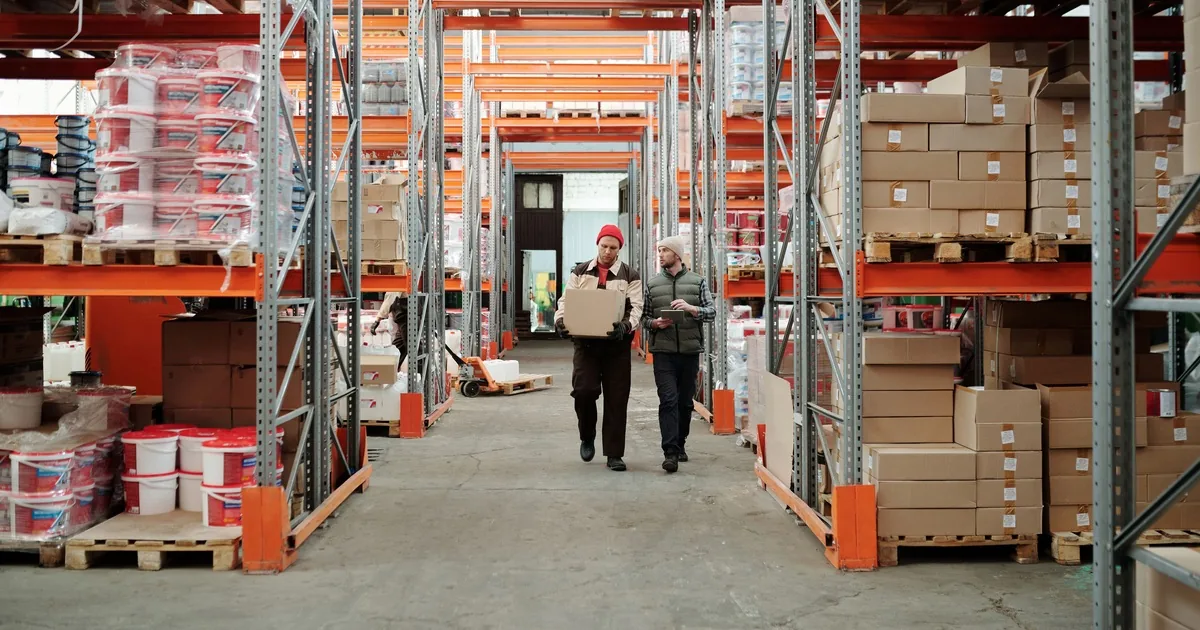
A warehouse supervisor calls at 6:18 a.m. and says, “We found droppings near a pallet.” The first outbound trucks leave at seven. Receiving opens at eight. Somewhere in a building with forty aisles, six dock doors, two tenants, and thousands of cartons, one vague note is about to become everyone else’s problem.
Start with the coordinates. Record the building, dock or aisle, rack bay, level, nearest fixed object, time, shift, and the inventory reference visible at that spot. Then capture what the employee observed, whether goods or packaging appear affected, whether the pallet or order has moved, what staff did afterward, and who controls access and product disposition. Reception preserves the report. A qualified professional identifies the pest and decides the service response.
Fix the report to a physical warehouse location
“By receiving” can describe a truck apron, dock plate, staging lane, returns cage, battery-charging area, break room, or the first row of storage racks. Ask the caller to name the site and then walk inward with fixed references.
A useful location sounds like “Building 2, receiving door 6, hold lane H3, floor beside pallet 004781.” Add the rack, bay, level, room, trailer, compactor, utility chase, or employee area when relevant. If the facility has its own zone codes, copy them exactly. Do not translate H3 into “back corner” because that is how a precise report gets lost.
Record the observation time and the shift. Ask who found it and whether that person is still available. A phone number for the witness can save a technician from reconstructing a hurried secondhand account after the shift changes.
For a multi-tenant property, identify the tenant, shared loading areas, landlord contact, and any boundary the caller cannot authorize. One street address may contain separate operators with different inventory, sanitation vendors, access rules, and pest-control accounts.
Keep observation separate from pest identification
Warehouse callers use labels such as mouse droppings, roach, beetle, moth, bird debris, or gnawing. Keep that wording, but record the physical evidence behind it. Ask what the person saw, heard, or found. Note the approximate amount, color, shape, condition, and whether it appeared in one place or several.
Request existing photographs when they can be taken safely. The best image includes the evidence, a wider view of its location, and an inventory or zone reference without exposing private shipping data unnecessarily. Never ask someone to climb racking, reach under operating equipment, enter a trailer without authorization, handle a trap, or disturb questionable material for a better picture.
The EPA’s integrated pest management principles place monitoring and accurate identification before control. That order matters on the phone. “Three dark pellets on the floor beside pallet 004781” is a sound intake note. “Confirmed active rat infestation” is a field conclusion the receptionist cannot support.
Ask whether anyone saw a live animal or insect and where it traveled. Record doors, wall-floor joints, drains, roof openings, damaged screens, utility penetrations, standing water, spilled material, and clutter as observations. They are inspection leads, not proof of cause.
Follow the inventory before it leaves the building
A warehouse report has a clock attached to it. The affected pallet may be stationary, already picked, split across orders, loaded on a trailer, returned by a customer, or waiting for a facility manager to decide what happens next. The office needs the movement status without directing the warehouse to release, destroy, or relocate anything.
Capture the product description and every reference the caller can provide: pallet ID, lot, batch, SKU, purchase order, trailer number, carrier, supplier, customer order, and receiving date. Avoid placing confidential details in an unsecured message. Use the pest company’s approved record system.
Then ask whether packaging looks torn, wet, stained, webbed, gnawed, or otherwise disturbed. Was evidence on the floor, on stretch wrap, between cases, inside an opened case, or on the product itself? Did staff find one affected unit or reports in several zones? Preserve the caller’s answer without deciding whether goods are usable.
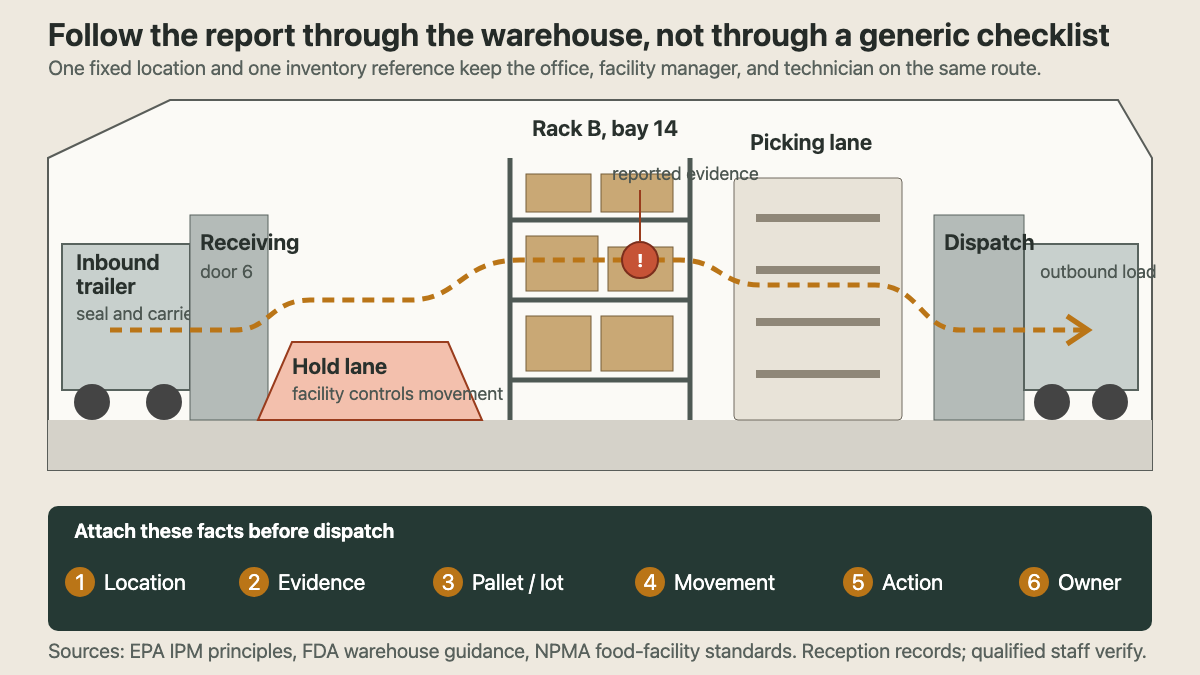
Food-storage calls deserve careful language. The FDA’s warehouse compliance guide addresses food affected by rodent, insect, or bird contamination in warehouse and storage facilities. That makes the record important, but it does not make the pest-control office the facility’s regulator or product-disposition authority. Record who placed the goods on hold, under which company procedure, and who will make the next decision.
Capture the route that brought the report to this point
Receiving history can narrow the technician’s first inspection. Ask whether the evidence appeared after a particular trailer, container, pallet exchange, return, transfer, or supplier delivery. Record the seal or trailer reference when the facility provides it. Ask whether staff noticed damaged cartons, loose product, wet packaging, webbing, insects, feathers, nesting material, or gnaw marks during unloading.
Do the same for outbound movement. Has the pallet been picked? Were cases divided among orders? Is a trailer still on site? Has anyone contacted another facility? Reception should document the answers and route them to the authorized account contact. It should not tell the warehouse to recall, ship, unload, or dispose of goods.
Warehouse conditions matter too. Note dock doors that remain open, failed door sweeps, damaged screens, gaps around utilities, roof leaks, standing water, overflowing compactors, spilled ingredients, vegetation against the wall, cluttered perimeter storage, and inaccessible rack edges. Orkin’s warehouse and logistics guidance calls attention to shipments, open dock doors, pallets, packaging, clear aisles, and dock sealing. Those details help scope an inspection. They still need field verification.
Record every action taken before the technician arrives
A forklift driver may sweep the area. A supervisor may move the pallet to a hold lane. Sanitation may wash the floor. Maintenance may close a gap. Someone may place a snap trap, glue board, aerosol, bait, repellent, or store-bought pesticide nearby.
Ask what changed, who did it, and when. For a product application, record the product name and a safe photograph of the label if the facility can provide one. Do not advise the caller to add another chemical, move a device, combine products, or clean up a possible exposure. Route health concerns under the company’s emergency policy and appropriate public-safety guidance.
Find out whether evidence remains available for inspection. If the area was cleaned, ask whether photographs, a work order, sanitation log, hold tag, or witness note exists. A cleaned floor does not erase the report. It changes what the technician will be able to observe on arrival.
Existing-account history belongs in the ticket. Check the service address, last visit, device map, open recommendations, recent findings, scheduled service, approved callback terms, and account contacts. The office can use its recurring pest-control scheduling process for routine timing while preserving this sighting as a separate evidence record. Do not promise a free return visit until the agreement and office policy have been checked.
Book around forklifts, docks, and facility rules
A service window is usable only if the technician can reach the reported zone. Ask when receiving, picking, sanitation, charging, and dispatch are active. A quiet office hour may still be the busiest hour on the floor.
Capture the access conditions:
- on-site contact, direct number, and authority to approve service
- gate, guard desk, check-in, badge, escort, and parking instructions
- required PPE, food-facility clothing, training, or vendor documents
- forklift traffic, locked cages, mezzanines, roof areas, pits, and restricted rooms
- whether racks, pallets, trailers, equipment, or compactors block the reported point
- photographs, logs, floor plans, device maps, and inventory records available on arrival
- the facility manager who owns follow-up after the technician leaves
Reception should never promise that a technician will climb storage racks, move loaded pallets, enter a confined space, open energized equipment, or stop warehouse operations. Record the obstacle and let the pest professional and facility assign safe access.
The NPMA food-facility standards make the boundary plain: the standards are general guidance, professional judgment is required, applicable law still controls, and a facility may impose stricter requirements. The phone team should collect those facility requirements before booking, not discover them at the guard desk.
Read back one technician-ready record
Finish by reading the operational facts back to the caller. A strong handoff might sound like this:
“North distribution building, receiving door 6, hold lane H3. At 5:55 a.m., the inbound lead found three dark pellets on the floor beside pallet 004781 after trailer 728 was unloaded. No live animal was reported. The pallet contains sealed dry goods and is marked on hold under the facility’s procedure. It has not entered picking. Staff photographed the floor and pallet, then swept nothing and applied no product. Facilities manager Lena Ortiz controls access and can meet the technician after receiving slows at 9:30. Safety vest, toe protection, guard check-in, and an escort are required.”
An AI receptionist can capture the same approved fields after hours and route them according to the pest company’s commercial-account rules. The value is the record itself: a precise point on the warehouse floor, the inventory connected to it, its movement status, and a named person who can open the right door.
Sources
- U.S. Environmental Protection Agency: Integrated Pest Management Principles
- U.S. Food and Drug Administration: Food Storage and Warehousing Adulteration Guidance
- National Pest Management Association: 2026 Pest Management Standards for Food Processing and Handling Facilities
- Orkin: Warehouse and Logistics Pest Control