A homeowner says, “Two boards feel soft. Can you replace them Saturday?” Then she mentions that the rail shakes and the deck has pulled slightly away from the house. The job has already outgrown a two-board repair call.
The office should not choose repair or rebuild. It should map the visible problem, how far it seems to spread, whether anything moves or sags, what happened before the change, whether the underside is accessible, and what the owner wants to keep or change. A qualified person can then inspect the walking surface, house connection, framing, posts, footings, stairs, guards, and hardware on site.
Start with the symptom, then map its spread
Ask the caller to describe the first thing that made them pick up the phone. “The deck is old” gives an inspector little to work with. “The board outside the sliding door feels soft after rain, and the next board has a dark edge” identifies a location, condition, and moisture pattern.
Pin every concern to a place. Is it beside the house, at the outer rim, around a post, near the stair opening, or in the middle of the walking surface? Ask whether one board is affected or whether the caller sees the same condition in several areas. Photos should include a wide view and a closer view with enough context to locate the spot later.
The U.S. Consumer Product Safety Commission tells homeowners to look for loose hardware, rotting boards, and eroding foundations, and recommends professional inspection for structural soundness. Currituck County’s deck guide expands that view to joists, beams, support posts, guardrails, stairs, flashing, and the attachment to the house. Those sources point to a practical rule for intake: surface damage is one clue inside a connected structure.
A useful first-call set includes:
- What feels wrong: softness, splitting, bounce, sag, movement, rust, a gap, or a loose rail?
- Where is it, and how many nearby parts show the same condition?
- When did you first notice it, and has it changed?
- Did heavy rain, impact, a storm, excavation, or a large gathering come before it?
- Can someone safely photograph the underside without climbing or removing material?
- Is the deck still being used, and has anyone already limited access?
Do not coach a caller to crawl beneath a low deck or push hard on a questionable guard. Capture what can be observed safely.
Treat movement as an urgent routing fact
A moving deck is a different call from peeling stain. If the caller reports a widening gap at the house, visible sag, a post that has shifted, stairs pulling away, or a guard that moves under ordinary contact, mark the record for prompt professional review. If collapse appears possible, tell the caller to keep people off the area and follow the company’s emergency escalation policy.
The American Wood Council gives special attention to the ledger, the horizontal member that connects many decks to the house. Its guidance warns that a ledger attached only with nails can be dangerous and calls for immediate evaluation by a qualified construction professional. The same publication says that even visible bolts or lag screws do not complete the assessment. Installation, spacing, the house framing behind the ledger, flashing, water damage, guards, and stairs still matter.
Reception should never turn a photo of bolt heads into a safety verdict. Write what is visible: “Caller sees two rows of hex heads,” “only nail heads visible,” or “attachment covered by siding and cannot be seen.” The inspector decides what those observations mean.
Inspect the house connection and the load path
A repair-versus-rebuild decision starts at the surface but must reach the ground. The deck boards transfer loads to joists. Joists meet a ledger or beam. Beams bear on posts, posts bear on footings, and attached decks also depend on the house connection. Stairs and guards have their own connections.
That is why a clean-looking surface can sit above hidden decay or corroded hardware. It also explains the opposite case: several worn boards may be replaceable when the framing, connection, and supports remain suitable after inspection. The number of ugly boards alone does not settle the scope.
Ask about access below. Is the deck high enough to walk under, close to grade, enclosed with lattice, or built over a finished room? Are stored items, vegetation, a patio ceiling, or skirting in the way? The answer helps the company schedule enough time and send the right person.
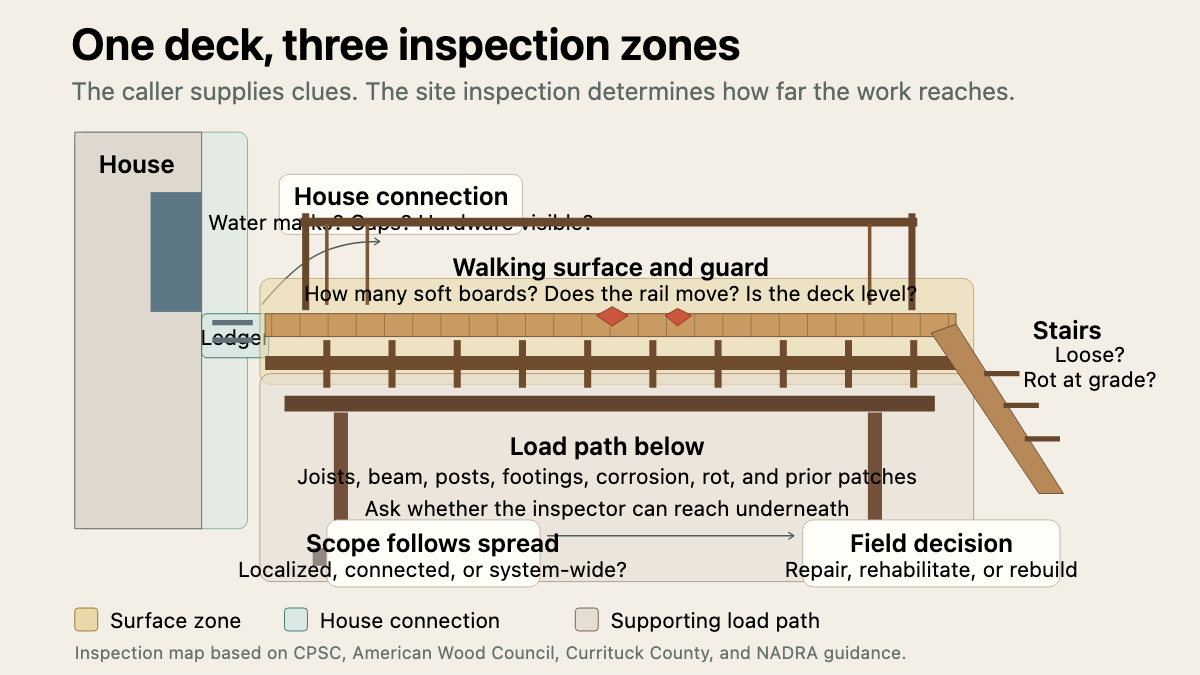
The North American Deck and Railing Association organizes its evaluation guide around stairs, footings and supports, posts, beams and joists, the ledger, deck boards, handrails, guards, and added features. Your intake form should preserve that physical map. A free-text note that says “deck needs work” loses it.
Ask what has already been changed
Old repairs often explain what the inspector will find. Ask whether boards, rail sections, stairs, posts, or hardware have been replaced before. Capture the approximate year if the owner knows it, who did the work, and whether permits or drawings are available. Do not treat missing records as proof of improper work. Flag the gap.
Also ask about coatings and recurring water. If the concern is limited to cleaning or finish condition, use the deck and fence washing intake. A caller may report that one corner stays damp, water collects beside the house, leaves pack beneath a stair, or a downspout empties near a footing. Those details help the inspector look for a source as well as damaged material.
Added loads deserve their own note. Hot tubs, outdoor kitchens, roofs, privacy walls, masonry features, large planters, and storage can alter the review. Record the product or feature, where it sits, and whether it was part of the original project. Never assure a homeowner that an existing deck can carry a new feature before qualified review.
Ask whether the owner wants the same deck back
Condition is only half of the scope discussion. The other half is intent.
A homeowner may want the same footprint and rail layout with damaged parts repaired. Another wants composite boards, wider stairs, a different landing, a roof, or more floor area. A sound portion of the existing structure does not guarantee that it fits a changed design. By the same token, a caller who likes the present layout may have options that would be missed if the office books every aging deck as a new-build estimate.
Ask four plain questions: Which parts do you hope to keep? What would you change if work begins? Are you trying to preserve the current footprint? Do you have a survey, old plans, permit records, or HOA requirements?
If the caller is planning a completely new layout, use the new-deck estimate intake. If the request is limited to isolated boards or a loose rail and no broader symptoms have been reported, the deck board and railing repair workflow may fit. Keep the paths separate until the facts support one.
Permit requirements vary by jurisdiction and scope. Reception can collect the address and describe the company’s process. It should not promise that replacing a named part is permit-free.
Write a handoff that preserves uncertainty
The best handoff reports observations without smuggling in a diagnosis:
“Owner requests an inspection of an attached rear deck and asks whether repair or rebuilding makes sense. Main concern is a soft area outside the sliding door involving three reported boards. Dark staining is visible along the house side after rain. Owner also reports movement at the outer guard near the stairs and says the stair landing appears lower than last summer. No sudden collapse or injury reported. Household has stopped using the stairs. Underside is walkable from the yard but partly blocked by stored furniture. Owner sees metal fasteners at the ledger but cannot identify them; no attachment conclusion made. Deck age is unknown. Several surface boards were replaced by a prior owner. Current goals are to keep the footprint, consider new surface boards, and move the stair landing if larger work is needed. Wide photos, close photos, property address, and available closing documents requested. Route for whole-deck condition inspection, including surface, ledger and flashing, framing, posts and footings, guard, and stairs.”
That note gives the field reviewer a map and leaves the decision where it belongs. The inspector can trace the soft spot through the joists, examine the house connection, test the guard and stair assemblies, and see whether the problem is local or connected. Only then do “repair” and “rebuild” become useful words.